
Summary
Personal Information
Voyage
Transportation
John Pobjoy was transported on the Larkins, departing 24th Jul 1817 and arriving 22nd Nov 1817 with 250 passengers.
1829 Voyage - Ship; Larkins, Captain Campbell, from Cork the 10th August, with 195 male prisoners. A Surgeon Superintendent, P. Sprout, Esquire. Arrived; 22 December 1829. Recapitulation; Mustered; 196. Died on Voyage; 3. Disembarked; 1. Total; 200
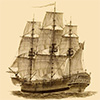 Larkins (generic)
References
| Primary Source | Australian Joint Copying Project. Microfilm Roll 88, Class and Piece Number HO11/2, Page Number 366 |
| Source Description | This record is one of the entries in the British convict transportation registers 1787-1867 database compiled by State Library of Queensland from British Home Office (HO) records which are available on microfilm as part of the Australian Joint Copying Pro |
| Original Source | Great Britain. Home Office |
| Compiled By | State Library of Queensland |
| Database Source | British convict transportation registers 1787-1867 database |
Claims
No one has claimed John Pobjoy yet.
Photos
No photos have been added for John Pobjoy.
Convict Notes
https://trove.nla.gov.au/newspaper/article/8645573?searchTerm=john%20Popjoy Follow the Link to read an account of John Popjoy’s evidence in court, about the seizing of the ship, as described in the Colonial Times, Hobart, 4 Feb 1831..
Colonial Secretary Index. POPJOY, John. Per "Larkins", 1817 1817 Dec 2 On list of convicts disembarked from the "Larkins" and forwarded to Parramatta for distribution (Reel 6005; 4/3497 p.191) 1818 Mar 30 On list of convicts to be sent to Newcastle per "Lady Nelson" (Reel 6006; 4/3498 p.118) 1820 May 16 Re transfer of to Hobart (Reel 6007; 4/3502 p.33) 1821 Feb 9 On list of prisoners transported to Newcastle per "Elizabeth Henrietta" (Reel 6007; 4/3503 p.96) 1822 Sep On monthly return of prisoners punished at Newcastle; listed as per "Speke" (Reel 6023; 4/1718 p.157) 1823 Feb 15 On list of convicts removed from Newcastle to Port Macquarie per "Sally" (Reel 6019; 4/3864 pp.388-9) 1824 Mar 15,23 Re punishment of as a runaway (Reel 6012, 4/3510 p.516; Reel 6061, 4/1778 p.247b) 1824 Mar 20 On list of persons proposed to be sent to Hobart (Reel 6012; 4/3510 p.550) 1824 Mar 20 On list of convict runaways from Port Macquarie forwarded to Hobart per "Triton" (Reel 6019; 4/3522 p.33)

Stole a gelding and originally received a death sentence changed to 14 years transportation. When returned to UK, married Mary Ann Kirke in June 1832. Had 1 daughter, Elizabeth. Died 31st August 1833 at sea, offf Boulogne, France when he was washed overboard and drowned.
From the Police Annual Account: Corporal Aldred and 4 Privates of the 48th Regt. a Reward advertised for the Apprehension of J. Popjoy, who broke out of Gaol – 5. 0. 0. Hobart Town Gazette, 9 May 1821. The Launceston Advertiser, 19 Oct 1829, reports: FROM THE GAZETTE OF SATURDAY. A Free Pardon has been granted to Jno. Popjoy. The reason why John was awarded a free pardon was for his role in the affair of the ship Cyrus, which was widely reported at the time in the newspapers and afterwards, in the following century, from which the following story comes: CONVICT PIRATES MADE ONE SIMPLE MISTAKE SO . . . THEY SAILED TO PRISON A song, very popular among the convicts of Van Diemen's Land in the early 1830's, and passed on by word of mouth to every chain gang on the island, told of the daring seizure of the brig Cyprus at Recherche Bay. Written by a prisoner known as Frank the Poet, the song ended with the rousing chorus: Then sound your golden trumpets, play on your tuneful notes. The Cyprus Brig is sailing, how proudly now she floats. May fortune help the noble lads, and keep them ever free From Gags, and Cats, and Chains, and Traps, and Cruel Tyranny. In August, 1829, the Cyprus left Hobart Town with a party of 31 convicts, bound for Macquarie Harbor. Ten soldiers, commanded by a Lieutenant Carew, guarded the prisoners night and day. They were all looked on as "incorrigibles," and were being sent to "Hell's Gates," as Macquarie Harbor was called, for the term of their natural lives. On August 9 the vessel put in to Recherche Bay to shelter from the wintry gales blowing up from the Southern Ocean. The prisoners, chained in groups of four on the lower deck, whispered among themselves. Two of their number had already tasted the appalling wretchedness of life at "Hell's Gates." They said death would be better than the fate that lay in store for them there. A former seaman, Bill Swallow, said he knew how to navigate the ship. If he and his mates could capture her he'd have no difficulty in setting her course for China, or any other country they might choose. But what chance did chained men have of seizing a vessel? MUTINY! The opportunity came sooner than anyone had expected. Seven of the convicts were taken up on deck for exercise. Among them were two who had most consistently talked of escape, Ferguson and Walker. They saw at a glance the deck was guarded by only two soldiers, who at that moment were leaning over the rails, muskets carelessly held, looking at something in the water below. There was immediate agreement the time had come to strike. The convicts stole up behind the unwary soldiers and quickly disarmed them. In a flash the guards were over powered. Before a signal could be given, the mutineers battened down the hatchway leading to the deck where the other soldiers and a number of passengers were at tea. Irons were soon removed from each convict, and the ship was in their power. Next morning the Cyprus sailed down the bay. Thirteen of the convicts did not want to stay on her, so were put ashore, along with the passengers — 45 men, women, and children. Bill Swallow took over the navigation of the vessel, setting her course for the Friendly Islands (Tonga Group). When they arrived there seven men deserted. Two of these we're subsequently captured and returned to Hobart Town, where one was hanged and the other condemned to Norfolk Island. The Cyprus next headed up into the China Seas, its company depleted by several more desertions. One day as they were moving towards the China coast they came abreast a derelict craft, the Edward. Some of the men boarded her, and among the articles left in her cabin was a sextant bearing the engraved name of the captain, William Waldron. It occurred to Bill Swallow the Edward might be the means of throwing off all suspicion as to their true identity. They would abandon the Cyprus and land not far from Canton. They would pose as survivors of the wrecked Edward, and they would have the ship's sextant to prove it. The men agreed to the plan, and divided into two groups. One, led by Swallow, came to Canton, where Swallow, introducing himself to the British Committee of Supercargoes as Captain Waldron, told a pitiful story of wreck and privation. The committee arranged for a free passage to England for the men; but before they had time to leave, other members of the Cyprus company arrived at Canton, and they, too, were taken before the British committee. They told substantially the same tale as their mates, but said that the name of the Edward's captain was James Wilson. Doubts were at once aroused. The eight men were taken into custody and sent to the police authorities in London. Brought before magistrates at the Thames street police office, the men pleaded their story was in most details correct. There seemed to be no evidence to warrant their detention. They were on the point of being freed when the clerk of Court happened to remember a curious story told by an ex-convict, Popjoy, who had been brought before the Bench to answer a charge of begging around the London docks. This man Popjoy had pleaded, as evidence of good character, that he was one of a party of men, women, and children landed in Recherche Bay by mutinous prisoners of the brig Cyprus, many months earlier. The clerk of Court suggested there was a possibility that the men now before the magistrates might be some of the Cyprus mutineers. At that time a Mr. Capon, the Hobart Town gaoler, was on a visit to London. He soon identified several of the convicts, and they were taken before the Court of Admiralty for punishment. Two men, Watts and Davis, were hanged in London. One was freed from lack of evidence. The remainder were taken back to Hobart Town to stand trial for piracy. The Argus, (Melbourne) 14 July 1956. Accounts of the story in 1911 state that John Popjoy was originally transported for stealing hares.