
Summary
Personal Information
Transportation
Edward Riley was transported on the Neptune, Scarborough And Surprize, departing 30th Nov 1789 and arriving 26th Jun 1790 with 1084 passengers.
Neptune 809 tons built on the River Thames 1779. The largest ship of the Second Fleet.
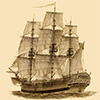 Neptune, Scarborough And Surprize (generic)
References
| Primary Source | Australian Joint Copying Project. Microfilm Roll 87, Class and Piece Number HO11/1, Page Number 56 |
| Source Description | This record is one of the entries in the British convict transportation registers 1787-1867 database compiled by State Library of Queensland from British Home Office (HO) records which are available on microfilm as part of the Australian Joint Copying Pro |
| Original Source | Great Britain. Home Office |
| Compiled By | State Library of Queensland |
| Database Source | British convict transportation registers 1787-1867 database |
Claims
No one has claimed Edward Riley yet.
Photos
No photos have been added for Edward Riley.
Convict Notes

26 July 1771. Birth. Middlesex, England Source. Ancestry.com. Australia and New Zealand, Find A Grave Index, 1800s-Current [database on-line]. Provo, UT, USA: Ancestry.com Operations, Inc., 2012. Original data: Find A Grave. Find A Grave. http://www.findagrave.com/cgi-bin/fg.cgi.
Edward Riley (c 1762 - 1821) Posted 15 Mar 2011 by stringfe1 Edward Riley was sentenced to death at the 14 Jan 1789 Old Bailey Sessions for the Highway robbery of a man on New Year's Eve. A bricklayer walking home through Whites Yard, off Cable Street in the East End was set upon at about 9.30pm by three men who demanded money. He told the court that Riley clapped his hand over his mouth, the other two held him and rifled his pockets. Finding no money they took his hat and ran off. A local resident looking out his window said he recognised Riley as a man who lived in the next street. Both he and the prosecutor claimed the lamplight was strong enough for them to identify him positively; We could not pursue him; he had got off, and turned down Saltpetre Bank, where he lodges, which is a dangerous place. Saltpetre Bank appears to have been regarded as something of a no-go area and a haven for criminals. The prosecutor at first claimed the robbers had stolen two guineas, but later recolledted that he had left the money at home. Riley's landlord, George Ashton, appeared as an alibi witness, stating that Riley had been home all night on the date in question. The jury disregarded his evidence, but recommended Riley to mercy. He was held in Newgate under a temporary respite from execution until Sept 1789 when his sentence was commuted to life transportation. He was embarked on the Scarborough transport on 10 Nov 1789. Riley was employed at Sydney in Sept 1791 when he gave evidence at the trial of a man charged with stealing a barrel of gunpowder from a ship in port. He gave evidence the following month at a burglary trial. Both cases suggest that he may have been employed as a watchman. In Dec 1794 Riley was granted a conditional pardon and granted 30 acres at The Flats in the Concord area which he sold to Commissary James Williamson prior to 1800. He was granted an absolute pardon in Sept 1795, which suggests that he was occupying a position of trust. At Sydney on 5 March 1797 he married Mary Burk(e) (Indispensable, 1796). In March 1800 Riley was one of two men who put up 50 pounds good behaviour bonds for Edward Dogherty after he was sentenced to a flogging for making a drunken statement about planting the tree of liberty in NSW which was regarded as seditious. Clearly Riley was sympathetic to liberal ideas; he was probably Irish. In Jan 1810 Riley petitioned Governor Macquarie for confirmation of a lease for a house and town allotment in Upper Pitts Row, Sydney, and a grant of land at Milk Maid Reach on the Hawkesbury which he had received from the anti-Bligh regime in 1809. He was still holding land in the Portland Head area in 1820. The Second Fleeter was almost certainly the Edward Riley buried at St Matthews Cemetery, Windsor on 9 Nov 1821; he was descibed as free, aged 59, having arrived as a sailor on the Scarborough in 1790. Muster records indicate that the emancipist Second Fleeter was the only man of that name in the colony; he may have attempted to give his neighours the impression that he had arrived free. Reference: Britains Grim Convict Armada of 1790; Michael Flynn
Transport Posted 15 Jun 2009 by LynnMareeM Australia's Second Fleet From Barbara Turner, 1992.1 A second fleet of six ships left England - Guardian, Justinian, Lady Juliana, Surprize, Neptune, Scarborough. The Guardian struck ice, and was unable to complete the voyage. She was stocked with provisions. Only 48 people died in the first group of ships, but this time 278 died during the voyage. This time transporting the convicts was in the hands of private contractors. _____________________________________________________ Excerpts from the "SYDNEY COVE CHRONICLE", 30th June, 1790 At last the transports are here DIABOLICAL CONDITION OF THE CONVICTS THEREON 278 died on the fearsome journey to Sydney Cove -----" The landing of those who remained alive despite their misuse upon the recent voyage, could not fail to horrify those who watched. As they came on shore, these wretched people were hardly able to move hand or foot. Such as could not carry themselves upon their legs, crawled upon all fours. Those, who, through their afflictions, were not able to move, were thrown over the side of the ships; as sacks of flour would be thrown, into the small boats. Some expired in the boats; others as they reached the hore. Some fainted and were carried by those who fared better. More had not the opportunity even to leave their ocean prisons for as they came upon the decks, the fresh air only hastened their demise. A sight most outrageous to our eyes were the marks of leg irons upon the convicts, some so deep that one could nigh on see the bones. ---- ----- We learn that several children have been borne to women upon the Lady Juliana, the cause for which were the crews aboard African slave ships which met up with the transport at Santa Cruz.--- " ------" So the Guardian is lost and with it our provisions. What, in the name of Heaven, is to become of us ? ----- "