
Summary
Personal Information
Crime
Voyage
Transportation
Joseph Rossiter was transported on the Lord Raglan, departing 3rd Mar 1858 and arriving 1st Jun 1858 with 270 passengers.
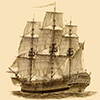 Lord Raglan (generic)
References
| Primary Source | Australian Joint Copying Project. Microfilm Roll 93, Class and Piece Number HO11/18, Page Number 262 |
| Source Description | This record is one of the entries in the British convict transportation registers 1787-1867 database compiled by State Library of Queensland from British Home Office (HO) records which are available on microfilm as part of the Australian Joint Copying Pro |
| Original Source | Great Britain. Home Office |
| Compiled By | State Library of Queensland |
| Database Source | British convict transportation registers 1787-1867 database |
Claims
No one has claimed Joseph Rossiter yet.
Photos
No photos have been added for Joseph Rossiter.
Convict Notes
Joseph Rossiter was born in the December quarter of 1839, the youngest son of William Rossiter (ca. 1795-1875) and Susannah nee Freke (ca. 1794-1883.) In 1841 Joseph was 1 year old living with his father (a shoemaker), his mother and 7 siblings, Hannah, Mary, Elizabeth, Samuel, Emma, Ann and William at Marshfield Road, St George, Bristol. In 1851 Joseph was with his parents and his brother William in Two Mile Hill. Susannah and the 2 boys were entered on the census as shoemakers and William the head of the household as ‘Shoemaker Master.’ On 29th March 1856 Joseph appeared before the Court on the charge of ‘assault to rob, being armed’ at the Spring Gloucestershire Assizes. Joseph was called before the Magistrate, Mr Baron Bramwell. Mr Baron Bramwell took pity on Joseph because of his youth and his situation and made an observation to the jury in his favour. Mr Bramwell later believed that may have influenced the jury’s acquittal of the case and took the blame for that on his own shoulders. (I don’t know why the Magistrate felt sympathy for Joseph and what Joseph’s situation was, all I know from the later newspaper article reporting his later conviction, is that Joseph was lodging with one of his brothers but it does not name which brother.) On 4th December 1856 Joseph aged 17, a boot-closer, was again in the dock before Mr Baron Bramwell, this time on the charge of burglary, breaking and entering into Mary Brain’s house on the night of 30th August 1856. Joseph stole a gun, gun case and a bunch of keys, the property of Mary Brain nee Tanner and a writing desk and other articles of Reuben Bancroft, a Wesleyan School Master, lodging at the house of Mary Brain and her family. The tool used to gain access to Mary Brain’s house, a screwdriver, was left behind at the scene of the crime and was linked to other tools which had been stolen from an Independent Chapel in the same neighbourhood shortly before. The other stolen tools were found in the garden of the house where Joseph lodged with his brother. It was also proven that Joseph was familiar with Mary Brain’s house as he had visited Reuben Bancroft with a view to becoming a pupil teacher in late 1855. Joseph’s stockings were covered in dirt and particles of sawdust as if he had been walking about without his shoes. A policeman had seen Joseph on the night in question going in the direction of Mary’s house and had spoken to him. Joseph was said to have then headed back in the direction of his brother’s house and the policeman had noticed that he could not hear his footfalls as if he was not wearing his shoes. Several of the stolen articles were found between Mary’s house and Joseph’s residence. The jury found him guilty as charged. Joseph then addressed the Court, trying to show his innocence but Mr Baron Bramwell when passing sentence mentioned Joseph’s earlier Court appearance that year, how despite his warnings, he was in Court yet again and that the observations Joseph had made, showed his guilt. There was no excuse for his crime and that it was ‘activated by a mischievous disposition.’ The sentence was that Joseph be transported for 15 years. Joseph Rossiter left onboard the Lord Raglan heading for Freemantle, Western Australia on 3rd March 1858 and arrived at the Swan River Colony in Freemantle on 1st June 1858 with 84 passengers and 267 other convicts, 2 convicts having died on the voyage. Joseph is described in the ships log as being a pupil teacher, single with no children, 5’ 3’’, with dark brown hair, dark hazel eyes, a round face with a fresh complexion, a stout build and with a mole on his right arm. There is also the comment ‘also (8878) on Belgravia 1866.’ In the Bristol Mercury of Saturday 3rd December 1864 Joseph's name was incorrectly reported as James Rossiter. Joseph was apprehended after returning to England under the assumed name of George Seaman, this was a dangerous thing to do as returning to England while still under transportation sentence was a Capital Offence and Joseph could have been hanged. He appeared in front of Mr Baron Bramwell once again on Thursday 8th December 1864 and was sentenced for a further 15 years transportation, charged with 'breaking into the Wesleyan Chapel at Hanham and being at large before his term of 15 years' penal servitude had expired,’ he was issued with a new convict number. I suspect the Wesleyan Chapel may well have been the same 'Independant Chapel' he had stolen the tools from in his earlier escapade. The Belgravia left with Joseph onboard on 4th April 1866. He was described as a school master, single with no children, 5' 3 3/4'', with brown hair, dark brown eyes, a round face with a sallow complexion, a middling stout build, with a scar on his left knee. The Belgravia arrived in Freemantle on 4th July 1866 after leaving Portland, England on 7th April 1866. In 1882 Joseph married Mary Ann Lavery and it was around this time that he changed his name to George Joseph Rossiter, they had 4 children, 2 of whom died in infancy. George Henry Rossiter born 1883 in Freemantle, Florence Rossiter b 1885 Freemantle (later married William James Adams in 1906 Victoria, Australia) died in 1933 Felton, Victoria, Australia, Emily Rossiter born 1886 Williamstown, Victoria and William Rossiter born Malvern, Victoria in 1890. Emily and William both died in their respective birth years. Joseph aka George Joseph, his wife and 2 eldest children had left Freemantle on 6th January 1886 onboard the 'Franklin'. George Joseph Rossiter died in 1896 in Mavern and his wife Mary Ann Rossiter nee Lavery died in 1935. I would like to say a big THANKYOU to Paul Rossiter and his Oz connections Martyn and Jules for their help and giving me the crucial weblink to 'The Rossiter Research Registry' and the Freemantle Prison website Convict Database http://www.fremantleprison.com.au/Pages/Convict.aspx Also a big THANKYOU to 'THE ROSSITER RESEARCH REGISTRY' which can be found at http://users.winshop.com.au/merv/ which is where I discovered what became of Joseph on his 2nd arrival in Australia. Helga D. Fox