
Summary
Personal Information
Voyage
Transportation
John Russell was transported on the Royal Admiral, departing 4th Jun 1833 and arriving 26th Oct 1833 with 226 passengers.
The Royal Admiral was built at Lynn in 1828. Convicts were transported to New South Wales on the Royal Admiral in 1830, 1833, 1835 and to Van Diemen's Land in 1842. 1833 - Ship; Royal Admiral. Commenced fitting as a Convict Transport at Deptford on the 29 March. Surgeon Superintendent [Andrew Henderson] joined on the 3rd April. Guard embarked on the 13th. Sailed on the 17th and anchored in Kingston Barbour near Dublin on the 9th May. 220 convicts embarked on the 16 May 1833 and the ship sailed from Dublin Bay for Sydney on the 4th June and arrived there on the 20 October. Originally embarked with 221 convicts, 5 Died at sea, 1 was Relanded. 11 sick on shore, The convicts were described as 220 such wretchedly debilitated creatures ... Refer to the surgeons journal for full details
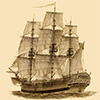 Royal Admiral (generic)
References
| Primary Source | Irish Convict Database, by Peter Mayberry. |
Claims
No one has claimed John Russell yet.
Photos
No photos have been added for John Russell.
Convict Notes
Robbery in this City. Henry Hollands, John Russell, and John Hagan, were indicted for feloniously and burglariously entering the home of Robert Lamrock, Fen quay-street, and robbing it of a quantity of tobacco the morning of the 10 September last. Robert Lamrock proved the breaking open of his house, and the stealing from it of a piece tobacco, winch afterwards got in the Mayor’s office—the robbers had effected an entrance into the shop. James Nolis—Recollects passing Mr. Lamrock’s house on the morning of the th Sept, last; observed the cellar door open, and went and knocked to awaken the inmates; after rapping the door, observed man issuing from the cellar, and instantly seized him; identifies the prisoner Hagan, is the person whom secured, a young man, (Mr. Dean,) was in company with witness, and assisted him in securing Hagan; while he had hold Hagan, Hollands made his appearance out of the cellar; had hold Hagan with his left hand, and immediately caught hold of Hollands with his right ; not able to hold both, and Hollands being a very powerful man, burst from witness and made off. Cross-examined by Mr. Shannon—Had hold Hollands, and is quite sure of him ; could not be mistaken in either him or Hagan, as both the prisoners lived in the city; saw them often before ; there was communication from the shop the cellar. James Menan (an approver)—Knows the three prisoners ; identifies them, met them on the night of the 10th September last, and went with them to Mr. Lamrock’s ; they pulled open the cellar door, and Hollands and Russell went in, short time after Hollands reached out to witness a small roll of tobacco; went and hid it, and returning saw two young men coming down the street; witness and Russell then ran down Linenhall-street, and got round to gate ; they left Hollands and Hagan in the cellar; getting back to the gate Hollands came running towards them they then went to the place where the bad women stop ; they took the tobacco with them, they hid it; witness afterwards pointed out where it was to Mr. Kitchen, who showed the place to the Sheriff; Russell assisted in pulling the cellar door. Cross examined Mr. Shannon—Came to the table out of the dock; Mr. Rankin charged witness with stealing sugar; never was in gaol for stealing from Mr. Steen ; was not charged with stealing tub of clothes from Mr. Patterson; was not charged for stealing from Hugh M‘Keown ; witness assisted in the lifting of the cellar door; sees no other in Court except Mr. Shannon himself who deserves the gallows.—(Laughter.) Samuel Kitchen, Governor the Gaol —The last witness took him to where the tobacco was secreted. The Jury immediately found the prisoners guilty. Baron Pennefather then said, they had been found guilty of burglary, and this was not their first offence, he had to inform them that the penalty for that crime was forfeiture of life, he would, however, recommend them mercy, but he must tell them, that, even though his recommendation was attended to, they could not expect anything but banishment out of the country for life. Before leaving the bar, Russell said, Thank you, my Lord, for your advice, but never knew any one prosper after it.” Londonderry Sentinel, 24 March 1832.
Irish Convict Database, by Peter Mayberry. John Russell, age on arrival, 17, per Royal Admiral (2), 1833, Tried at Londonderry Derry Co, 1832, Life, for Burglary. DOB 1816, native place, Donegal, single, protestant. Trade-Umbrella maker. ---------------------------------------------------- Convict Death Index. John Russell, per Royal Admiral, Date, 24/1/1840. District, Lachlan. Shot in the act of firing at the police. * Please note that there was also a John Russell who arrived 2 years later in 1835, per Royal Admiral, but records show that the later arrival, John Russell was awarded his Conditional Pardon in 1848, so the Death Index entry applies to this John Russell. ------------------------------------------------------ The following case gives the circumstances of the shooting of John Russell. SUPREME COURT. CRIMINAL SIDE — Monday, Feb. 24. Before His Honor the Chief Justice. Thomas Wetton stood indicted for the wilful murder of John Hawker, at Oak Park, on the 19th January last, by shooting him with a pistol through the back, from which wound he died on the following day. Before commencing the case the Chief Justice requested Mr. Purifoy to undertake the defence for the prisoner. The Attorney General in opening the trial to the Jury said, that the first count charged the murder as having been actually perpetrated by Bernard Reynolds, and the prisoner as an aider and abetter; the second laying the deed to the prisoner ; there was another count which laid the actual perpetration of the murder to a man, to him (the Attorney-General) unknown, and the prisoner with other bushrangers, being present and assisting. There were four on the spot at the time, one of which number (Russell) was wounded at the capture of the prisoner and Reynolds, and before he would suffer himself to be taken, shot himself with a pistol, the barrel's mouth of which he deliberately put to his head and fired ; another of the party was subsequently to the murder of Hawkins and prior to prisoner's capture, shot by Mr. Fry in self-defence; the third, Bernard Reynolds put an end to his own existence in a cell on Sunday evening by hanging himself; the prisoner was now the only remaining one of the party. Francis Oakes sworn — I reside at Oak Park, situated about 180 miles from Sydney; on the 19th January last, I was in a field reaping with thirteen men, and about four o'clock in the afternoon four armed and mounted- men rode up to us; they had three double and one single-barrelled fowling pieces, and several pistols, they were all mounted; John Hawker, the deceased, was in the field reaping close by me; he was an assigned servant to Mr. Shelly; when I first saw the party approaching, I told the men to keep on working, and I was convinced they were bushrangers ; when they arrived opposite to where I and two or three others were standing they dismounted, and one fired off his piece ; I then ran off, the deceased following close behind me; but he shortly afterwards fell; at this time several shots were fired, I should think about fifteen; they were fired so fast that I could not count them; we had no arms in the field except reaping hooks; Hawker was about twenty yards behind me when he fell; I ran off in the direction of Long's station, about three and a-half miles off, and having arrived there, sent to the Police Magistrate at Goulburn ; when I returned home the house was burnt ; Hawker had been removed from the field to a hut where he expired on the following morning, I saw his body and the wound; it was caused by a bullet which entered at his back and lodged near the skin of the right breast; I cannot swear prisoner at the bar was present on the occasion of the firing; I went in pursuit in company with Mr. Stewart, Mr. McGuinnis, Serjeant Freer and two troopers of the Mounted Police, and about two miles from the Lachlan River, on a small flat we fell in with Wetton, Reynolds and Russell; just as we came up to them, Wetton was in the act of mounting a horse; I was foremost of our party; and as soon as I was pretty close the bushrangers stationed themselves behind trees, and commenced firing ; the two troopers had not then come up to us ; about eleven rounds were fired at us; Freer fired at Russell and he fell; the other two (Wetton and Reynolds) started off, and were making towards a rocky eminence, when Mr. McGuinnis and myself mounted and pursued them; Mr. McGuinnis headed them, and when about thirty yards dismounted ; I was about the same distance behind them, and also dismounted; they then on being ordered put down their arms, and they were secured; I knew they were the same party, because, they had the horse they took out of my stable on the night of the murder and arson; Reynolds had on a coat he took from my house; when Wetton and Reynolds were secured, I asked them how they came to carry arms in the field; Wetton replied, You may thank your good neighbours for it;" Reynolds said at the same time that " they were tipsy, and were very sorry for it, and that was the only thing he was ashamed to die for" — namely, having acted as they had done at Mr, Oake's farm. By Mr. Purifoy — I was reaping with the men, when the prisoner and his companions came up; I did not run until they had fired one shot ; the horse Wetton was mounting on the day of capture was not mine ; I cannot identify the prisoner as the man that fired the shot when he came to the field. John Blackburn, assigned to Mr. G. Oakes sworn— I recollect the day the bushrangers came to the farm; I was not reaping myself, but was about forty yards from them at the time; there were four bushrangers, mounted and armed; I first thought they were policemen; when they came close up I overheard them say something about baling up to the fence; and one of the bushrangers instantly fired, when all the men in the field ran off excepting three and myself; the bushrangers called out to us to stand or they would fire; this was after they had fired once; they then fired about fifteen shots; I knew John Hawker; I saw him shot, and thought all the others that had hidden themselves in the wheat were also killed or wounded; Hawker did not fall immediately after receiving the wound, but turned round in the direction of the man that fired at him, and then fell on his side ; he died from the wound about seven o'clock the following morning; I saw the wound; it was made by a ball which entered at the back and lodged in the right breast; I did not see the prisoner Wetton's countenance sufficiently in the field to be able to identify him as the man that fired the shot; I saw prisoner with the other bushrangers about an hour afterwards at the house; he had clothes on like those worn by the man that shot Hawker; all the bushrangers were dressed in the same clothes at the house as when they were in the field; prisoner spoke to me and said, " tell the Messrs. Oakes I'm one of the Bathurst mob, and would make them all sorry for assisting in disarming a bushranger named Marshall some time ago;" the bushrangers while refreshing themselves said they would burn down the barn; I think I said to them, or else another of Mr. Oake's men, that there was wheat m the barn, and it would do the men more harm than good; they replied they would not only burn the barn but the house ; they also said they would remain in the neighbourhood for several days till they shot the Messrs. Oakes; before they went to fire the house, they ordered all the men to "sit down or they would blow their brains out; they said they would fire the field and burn the men concealed in it whether dead or alive; when I said there was a wounded man in the field, they asked me why I did not "pole-axe" him, and put him out of his misery; I went to get a conveyance to take the wounded man to his hut, and about three quarters of a mile from the house, saw it in flames; they talked with us till they went off, when they took a horse belonging to Mr. Oakes from the stable. By Mr. Purifoy — The prisoner had the same dress on at the house as when in the field; I could not identify him by his features; the same man told me his name was Wetton; I was about forty yards from Hawker when he was shot; he only turned round and fell on his side; I saw the prisoner on the Sunday following. Re-examined by the Attorney-General — When prisoner told me to say he was one of the Bathurst mob, he told me his name was Wetton; I could not swear that he or the others were drunk. Serjeant Freer, of the Mounted Police, sworn — I was present at the capture of the prisoner on the 24th January ; I had been with two troopers on the look-out for the party to which he belonged for three weeks; at the time we came up to Wetton's party, I was the first, my horse being the best; Russell, one of the party, fired at me, and the ball struck my horse in the forehead; he did not fall but turned round and I then dismounted; Russell again presented his piece at me, but being behind a tree I supposed he could not get an aim at me; I think he then levelled his piece at Mr. Oakes, and in the act of so doing put out his left leg from behind the tree; I then levelled my piece, fired, and he fell; I loaded my piece, mounted my horse, and went in pursuit of the other two, and when a short distance off, Reynolds fired at me; Wetton was about to fire at Mr. McGuinnis, when I ordered him to drop his piece which he did; when I in company with Mr. Oakes marched Wetton up to Reynolds, he was surrounded by the two troopers, Messrs. Oakes and McGuinnis; Russell had shot himself through the head when he found himself wounded; we placed him on the horse pointed out by Wetton as his; it belonged to Dr. Gibson; both Wetton and Reynolds told me they had been at the Messrs. Oakes to take revenge for assisting in the disarming of a bushranger named Marshall; they also said it was one of Mr. Oakes' men that told them about Marshall, and that was the reason they paid the visit; Wetton told me that when they first went to the field he had shot a man with the intention of shooting Mr. Oakes. This was the case for the prosecution, Mr. Purifoy rose to make the usual objection as to the want of evidence as to the identity of the prisoner, which the Chief Justice overruled satisfactorily. His Honor having addressed the Jury upon the general points of the case, and of the evidence summoned up ; and the Jury having retired for about five minutes, returned and gave in their verdict. Guilty. The prisoner was asked if he had anything say, why the sentence of the Court should, not be passed upon him; when, after a momentary hesitation, replied no. His Honor then proceeded to pass the last sentence of the law upon the culprit; which the Chief Justice prefaced by a few touching and appropriate remarks, and they were to all appearance thrown away upon the prisoner, who maintained a careless indifference throughout the whole of the trial until the sentence of death was passed upon him. The execution was ordered to take place as near to the spot of his outrages as possible. Commercial Journal and Advertiser, Wed 26 Feb 1840.