
Summary
Personal Information
Crime
Voyage
Transportation
William Smith was transported on the Lady Feversham, departing 3rd Apr 1830 and arriving 29th Jul 1830 with 181 passengers.
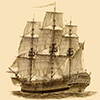 Lady Feversham (generic)
References
| Primary Source | Parish Register Transcripts for Bishopstone (Wiltshire, England) pub. Wiltshire Family History Society British newspaper Archives Devizes and Wiltshire Gazette, pub. 21 January 1830 NSW Australia Certificate of Freedom |
| Source Description | This record is one of the entries in the British convict transportation registers 1787-1867 database compiled by State Library of Queensland from British Home Office (HO) records which are available on microfilm as part of the Australian Joint Copying Pro |
| Original Source | Great Britain. Home Office |
| Compiled By | State Library of Queensland |
| Database Source | British convict transportation registers 1787-1867 database |
Claims
No one has claimed William Smith yet.
Photos
No photos have been added for William Smith.
Convict Notes

Salisbury The following prisoners (convicts) were removed from our County Gaol, and put on board the Leviathan Hulk, Portsmouth Harbour, on Thursday the 11th inst William Cripps, alias Major, sentenced transportation for life; Isaac Lucas, for 14 years ; Joseph Maidment, William Marshall, Simon Haskell, George Smith, Joseph Smith, William Smith, Antonio Spelzmo, Thomas Hams, James Hams, John Cox, Seager Smart, John Batchellor, Thomas Ayres, John Parnell, Thomas Willis, and John Smith, sentenced at our county sessions 7 years' transportation each: and Thomas Lambert, found found guilty at our last city sessions of stealing a silver watch, the property of Ann Easton, and sentenced to 7 years transportation. Salisbury Journal, 15 Feb 1830.

William was married (to Elizabeth). At the time of his arrest, he had one child;a second daughter was born during his trial. He was arrested, charged and convicted alongside his father (John Smith) and brother (Joseph Smith) after stealing " sugar candy, nutmegs and other articles " from a warehouse in Wanborough, Wilts. A newspaper article reporting the trial described the prisoners as "three remarkably fine looking men". William was awarded his certificate of Freedom and in it was described as a stonemason.