
Summary
Personal Information
Voyage
Transportation
Samuel Terry was transported on the Earl Cornwallis, departing 31st Jul 1800 and arriving 12th Jun 1801 with 298 passengers.
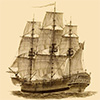 Earl Cornwallis (generic)
References
| Primary Source | Australian Joint Copying Project. Microfilm Roll 87, Class and Piece Number HO11/1, Page Number 279 (139) Gwyneth Dow, 'Terry, Samuel (1776–1838)', Australian Dictionary of Biography, National Centre of Biography, Australian National University, https://adb.anu.edu.au/biography/terry-samuel-2721/text3833, published first in hardcopy 1967, accessed online 26 Ap |
| Source Description | This record is one of the entries in the British convict transportation registers 1787-1867 database compiled by State Library of Queensland from British Home Office (HO) records which are available on microfilm as part of the Australian Joint Copying Pro |
| Original Source | Great Britain. Home Office |
| Compiled By | State Library of Queensland |
| Database Source | British convict transportation registers 1787-1867 database |
Claims
No one has claimed Samuel Terry yet.
Photos
No photos have been added for Samuel Terry.
Convict Notes
Family connections for Samuel (Terry) are: TERRY Samuel (Terry) was born about 1767 & became a labourer. He was tried for theft of 400pairs stockings at Salford Lancaster Quarter Sessions on 22 1 1800, held on hulk FORTUNEE at Langstone harbour from June 1800, sentenced to 7years & arrived in NSW as a convict on 12 6 1801 after a voyage of 10months on EARL CORNWALLIS; he worked in Samuel (Marsden)s Stonemasons gang. By 1807 his sentence had expired & he had worked as a private stonemason, been a private & had a shop at Parramatta & by 1808 he became a landowner. In 1809 he had a farm on Hawkesbury River & he became an Innkeeper at Sydney. He married Rosetta (Pracey/Madden her fourth marriage) on 27 3 1810 at St Phillips CofE Sydney; thereby gaining his wifes Inn in Pitt St. He went on to bigger & better success with 'Mt Pleasant' Farm at Nepean & property at Illawarra in 1815 & a wealthy trader. He bacame known as the 'Botany Bay Rothschild'. In 1820 he owned 1450cattle 3800sheep 19,000acres which some say may have come by fair or foul means (as related in his entry on this Website). He was a respected citizen gaining Directorship of a bank after much opposition to his appointment. He was uncle of John Terry (Hughes mentioned just above). He died on 22 2 1838 age about70 after a paralytic seizure & was buried with Masonic Honours with a largely attended funeral. [Some details taken from this Website] Rosetta (Pracey) married Edward (Madden). She arrived in NSW with only her child on 26 7 1799 after a voyage of 9months on HILLSBOROUGH. She had a second relationship (2of4) with Henry (Marsh). She, as (Pracey/Marsh, had a third (3of4) relationship with (John (Harris his third relationship) & produced a child. She became an Innkeeper in Pitt St Sydney. She died on 5 9 1858 mother of 6children. 1.Henry (Madden) was born in England. He arrived in NSW as Henry (Marsh) with his mother on 26 7 1799 after a voyage of 9months on HILLSBOROUGH. .. 1a.Noted an Ann (Terry) is shown as born in the colony in 1801, but not shown in Smees records. It seems appropriate to suggest her as a child of Samuel (Terry). 1.Ann (Terry) married George Frederick (Read) on 1 11 1820 at St Davids CofE Hobart.] ..Noted a George Frederick (Read)-who was born about 1794-is recorded as arriving in Australia as a ships master in 1814 on AMELIA. He was Master of the Brig LYNE in 1816. ..Details of George Frederick (Read)s family are given in entry for Edward (Robinson ADMIRAL BARRINGTON 1791) on this Website. .. Rosetta (Pracey/Madden) & Samuel (Terry) produced 3children: 1.Edward (Terry) was born on 26 4 1810 & baptised on 27 5 1810 at St Phillips CofE Sydney. He died on 28 11 1838 age28 childless. 2.Martha Foxlow (Terry) was born on 31 10 1811 & baptised on 24 11 1811 at St Phillips CofE Sydney. She married John (Hosking) merchant on 16 6 1829 at St James CofE Sydney. ..John (Hosking) was born in 1806 in England. He was brought to Australia by his parents in 1809 on AEOLUS. He was a merchant in 1829. ..Details of John (Hoskings)s family are given below. .. 3.John (Terry) was born about 1811-not shown in Smees records. He married ??? (Rouse) in 1831. The family was active in political life. ..This ??? (Rouse) may be Mary or Jane or Eleanor or someone else. Details of the only (Rouse) family I have come across are given below. ROUSE Richard (Rouse) married Elizabeth (Adams) in 1796 in England. He arrived in NSW as a settler with his family on 14 12 1801 after a journey of 6months on Fleet ship NILE. Elizabeth (Adams) arrived in NSW with her family on 14 12 1801 after a journey of 6months on Fleet ship NILE. Richard (Rouse) & Elizabeth (Adams) produced maybe 5children: 1.Mary (Rouse) was born on 13 1 1799 in England. She arrived in NSW with her parents on 14 12 1801 after a journey of 6months on Fleet ship NILE. She married Jonathan (Hassall) on 22 11 1819 at St Johns CofE Parramatta & produced 8children. ..Jonathan (Hassall) was born on 31 1 1798 in Tahiti. He arrived in NSW with his parents on 14 5 1798 on NAUTILUS & in Bathurst about 1818 from Camden. In 1823 he was granted 800acres at O'Connell Plains, which he named 'Wanera' & sold by auction in 1828. He was recorded in 1829 as farmer & grazier. He died on 13 12 1834 age36 at Camden & was buried at (St Matthews?) CofE Windsor. ..Details of Jonathan (Hassall)s family are given in entry for John (Small CHARLOTTE 1788) on this Website. 2.John Richard (Rouse) was born at sea on 27 8 1801 arrived in NSW with his parents on 14 12 1801 after a journey of 6months on Fleet ship NILE. 3.Jane (Rouse) was born on 23 6 1809 & baptised on 10 6 1813 age4- at St Johns CofE Parramatta. She died on 4 5 1877 age65. [Noted 4?.Elizabeth (Rouse) was born on 14 7 1811. She died on 1 8 1811 age18d.] [......5?.Eleanor (Rouse) was born on 15 5 1813 & baptised on 10 6 1813 at St Johns CofE Parramatta. She died on 18 5 1898 age85+.] .. [Noted an Elizabeth (Adams) married John (Simmons) free on 10 8 1826 at Christ Church Newcastle] & a ??? (Rouse) married a John (Terry). John (Terry) was born about 1811. He was active in political life. Details of John (Terry)s family are given above. HOSKING John (Hosking) married Ann Elizabeth (Mann). He arrived in Australia as a teacher with his family in 1809 on AEOLUS. [Noted a John (Hopkins) arrived in NSW as a convict in 1808 on AEOLUS] John (Hosking) & Ann Elizabeth (Mann) produced 4children: 1.John (Hosking) was born in 1806 in England. He was brought to Australia by his parents in 1809 on AEOLUS. He was a merchant when he married Martha Foxlow (Terry) on 16 6 1829 at St James CofE Sydney. ..Martha Foxlow (Terry) was born on 31 10 1811 & baptised on 24 11 1811 at St Phillips CofE Sydney.] ..Details of Martha Foxlow (Terry)s family are given above 2.Mary (Hosking) was born on 25 5 1813 & baptised on 27 6 1813 at St Phillips CofE Sydney. 3.Elizabeth Ann (Hosking) was born on 6 5 1815 & baptised on 17 8 1815 at St Phillips CofE Sydney. 4.Priscilla (Hosking/s) was born on 21 10 1818 & baptised on 15 12 1818 at St Johns CofE Parramatta. Reference: Craig James Smee 'Births and Baptisms Marriages and Defacto Relationships Deaths and Burials New South Wales 1788-1830' ..a complete listing from church & other records in the early colony.

..."he arrived at Sydney in June 1801. He worked under Samuel Marsden's direction in a stonemasons' gang on the Parramatta female factory and gaol, and he helped to cut stones for the church; he was both flogged for neglect of duty and rewarded for his industry. Before his sentence expired in 1807 he had served as a private soldier, been self-employed as a stonemason, and had set up a shop at Parramatta. By 1808 he was not only one of the 'proprietors of landed property' who asked Governor William Bligh for 'privileges of trade' and trial by jury, but also listed as a favoured recipient of government cattle; by 1809 he had a farm on the Hawkesbury River. Terry moved to Sydney, became an innkeeper, and in February 1810, when liquor licences were curtailed, his was one of the twenty granted. On 27 March 1810 he married the widow variously known as Rosetta (Rosata) Marsh or Madden, née Pracey, a woman of some importance, whose background is as elusive as her age. She had come free to the colony in 1799 in the disease-ridden Hillsborough on which a third of the convict complement had died. It seems probable that she came as the wife of the convict Edward Madden who died in the Hillsborough at Cape Town, and that she later became the widow of another convict, Henry Marsh. She was an innkeeper herself when she married Terry, and he acquired both her Pitt Street property and her three children. The Terrys prospered rapidly, first through their inn and store but soon by speculation in city and pastoral properties. By 1815 Terry had established a farm, Mount Pleasant, on the Nepean River and also had Illawarra properties; in 1817 Governor Lachlan Macquarie, who granted him city allotments, described him as a 'wealthy trader'. Terry was also an important supplier of flour and fresh meat to the government. Between 1817 and 1820 he held more than a fifth of the total value of mortgages registered in the colony, a higher proportion than that of the Bank of New South Wales. Commissioner John Thomas Bigge reported that in 1820 he had 1450 cattle, 3800 sheep, and 19,000 acres (7689 ha), almost exactly half of the land held by former convicts. He was also one of the largest shareholders in the bank, but when he stood for election as director in 1818, 1819 and 1820 he was unsuccessful; when elected in 1822 he was refused his seat on the pretext that, as an expiree, he was not 'unconditionally free'. The means by which Terry prospered were the subject of public gossip but they have never been carefully assessed. Certainly he acquired wealth first by frugality and shrewdness; his enemies were quick to add charges of unscrupulous extortion. The Bigge report gives the gist of the charges, based largely on Marsden's hostile evidence, that were amplified in the distorted moral homilies of 'A.L.F.' (The History of Samuel Terry, in Botany Bay … London, 1838) and Rev. Thomas Atkins and in later irresponsible journalism. Bigge alleged that officers and small settlers, after becoming intoxicated at Terry's public house, signed away rights to their possessions as security for debts. By this means, according to Bigge, Terry accumulated considerable capital, and land second only to D'Arcy Wentworth's. Edward Eagar dismissed such charges as 'mere naked assertions, unsupported by any fact or any evidence', and cited the 'approbation of his good Character' by Macquarie, who had known Terry for twelve years. Neither his detractors nor his supporters were disinterested. Terry was a litigious man and had brought at least twenty-eight actions in the Supreme Court by 1821. Though he apparently acted within the law and though his misdeeds were exaggerated by the emancipists' enemies, public bitterness towards him suggests that he was relentless in his business dealings. But those were litigious times, and some cases brought against him speak less well for his adversaries than for Terry. In the 1820s Terry consolidated his wealth; he established a bloodstock stud on Illawarra land granted him by Macquarie, built the vast Terry's Buildings opposite his residence in Pitt Street, established a country seat, Box Hill, and developed his farming properties at Liverpool, on the Nepean, and later at Yass and Bathurst, as well as flour-mills and breweries. When again elected to the board of the Bank of New South Wales in August 1828 by 308 votes to 83 he took office only until December. By that time he had become a leading philanthropist, contributing inter alia to the Benevolent Society, Auxiliary Bible Society, Sydney Public Grammar school, and later to Sydney College, on whose committees he served actively. He supported the Wesleyans and became a trustee for them in 1822. In the late 1820s Terry was firmly established as a public figure, though still often censured for his methods and for his material success. He became increasingly identified with the political aspirations of the emancipists and at times their spokesman: for example, as treasurer of the committee formed in 1821 to defend their rights. In 1827, 1830 and 1831 he was a leader in organizing petitions for trial by jury and a house of assembly, and also in expressing patriotic feeling through Australia Day celebrations; he was in the chair at the fortieth anniversary dinner in 1828 and again in 1831 as first president of the 'Australian Society for the Promotion of the Growth and Cultivation of Colonial Produce and Manufactures'. In 1826 he became president of a Masonic Lodge and was prominent in its activities in the following years of his life. Despite criticisms and snubs he had attained a position of public eminence and often of public responsibility. Terry was also now the patriarch of a large family which he liberally supported, but any dreams of a financial dynasty were to be largely dispelled. His son and principal heir, Edward, died childless soon after Terry himself. Some of the family's fortune was dissipated in the speculations and bankruptcy of the mercantile firm of Hughes & Hosking. A daughter, Martha, married John Hosking and a step-daughter, Esther Marsh, married Terry's nephew, John Terry Hughes. At a ceremony performed by Marsden himself, a son, John Terry, married into the respected Rouse family in 1831, and his children were to be active in the colony's political life. When Terry died on 22 February 1838, three years after a paralytic seizure, he was buried with Masonic honours and the band of the 50th Regiment led the procession. The funeral, described as the grandest seen in the colony, may be taken as the summation of his life's striving. He left a personal estate of £250,000, an income of over £10,000 a year from Sydney rentals, and landed property that defies assessment. His will was eventually published by the government as a public document. His wife lived until 5 September 1858. The family sold to the government the land now occupied by Martin Place and the General Post Office, Sydney. The Terrys, Samuel and Rosetta, may be seen in retrospect as two able, singleminded early colonists who resolved to reverse their unfavourable, brutalizing early fortunes—and succeeded." Copied from https://adb.anu.edu.au/biography/terry-samuel-2721
This article was published inAustralian Dictionary of Biography, Volume 2, (MUP), 1967 Terry, Samuel (1776–1838) By Gwyneth Dow. Samuel Terry (1776?-1838), merchant landowner and 'The Botany Bay Rothschild', was a labourer at Manchester, England, when on 22 January 1800 at the Salford Quarter Sessions, Lancashire, he was convicted of the theft of 400 pairs of stockings and sentenced to transportation for seven years. In June he was transferred to the unsalubrious hulk Fortunée at Langstone Harbour, and thence to the transport Earl Cornwallis in which he arrived at Sydney in June 1801. He worked under Samuel Marsden’s direction in a stonemasons' gang on the Parramatta female factory and gaol, and he helped to cut stones for the church; he was both flogged for neglect of duty and rewarded for his industry. Before his sentence expired in 1807 he had served as a private soldier, been self-employed as a stonemason, and had set up a shop at Parramatta. By 1808 he was not only one of the 'proprietors of landed property' who asked Governor William Bligh for 'privileges of trade' and trial by jury, but also listed as a favoured recipient of government cattle; by 1809 he had a farm on the Hawkesbury River. Terry moved to Sydney, became an innkeeper, and in February 1810, when liquor licences were curtailed, his was one of the twenty granted. On 27 March 1810 he married the widow variously known as Rosetta (Rosata) Marsh or Madden, née Pracey, a woman of some importance, whose background is as elusive as her age. She had come free to the colony in 1799 in the disease-ridden Hillsborough on which a third of the convict complement had died. It seems probable that she came as the wife of the convict Edward Madden who died in the Hillsborough at Cape Town, and that she later became the widow of another convict, Henry Marsh. She was an innkeeper herself when she married Terry, and he acquired both her Pitt Street property and her three children. The Terrys prospered rapidly, first through their inn and store but soon by speculation in city and pastoral properties. By 1815 Terry had established a farm, Mount Pleasant, on the Nepean River and also had Illawarra properties; in 1817 Governor Lachlan Macquarie, who granted him city allotments, described him as a 'wealthy trader'. Terry was also an important supplier of flour and fresh meat to the government. Between 1817 and 1820 he held more than a fifth of the total value of mortgages registered in the colony, a higher proportion than that of the Bank of New South Wales. Commissioner John thomas Bigge reported that in 1820 he had 1450 cattle, 3800 sheep, and 19,000 acres (7689 ha), almost exactly half of the land held by former convicts. He was also one of the largest shareholders in the bank, but when he stood for election as director in 1818, 1819 and 1820 he was unsuccessful; when elected in 1822 he was refused his seat on the pretext that, as an expiree, he was not 'unconditionally free'. The means by which Terry prospered were the subject of public gossip but they have never been carefully assessed. Certainly he acquired wealth first by frugality and shrewdness; his enemies were quick to add charges of unscrupulous extortion. The Bigge report gives the gist of the charges, based largely on Marsden's hostile evidence, that were amplified in the distorted moral homilies of 'A.L.F.' (The History of Samuel Terry, in Botany Bay … London, 1838) and Rev. thomas Atkins and in later irresponsible journalism. Bigge alleged that officers and small settlers, after becoming intoxicated at Terry's public house, signed away rights to their possessions as security for debts. By this means, according to Bigge, Terry accumulated considerable capital, and land second only to D’Arcy Wentworth’s. Edward Eager dismissed such charges as 'mere naked assertions, unsupported by any fact or any evidence', and cited the 'approbation of his good Character' by Macquarie, who had known Terry for twelve years. Neither his detractors nor his supporters were disinterested. Terry was a litigious man and had brought at least twenty-eight actions in the Supreme Court by 1821. Though he apparently acted within the law and though his misdeeds were exaggerated by the emancipists' enemies, public bitterness towards him suggests that he was relentless in his business dealings. But those were litigious times, and some cases brought against him speak less well for his adversaries than for Terry. In the 1820s Terry consolidated his wealth; he established a bloodstock stud on Illawarra land granted him by Macquarie, built the vast Terry's Buildings opposite his residence in Pitt Street, established a country seat, Box Hill, and developed his farming properties at Liverpool, on the Nepean, and later at Yass and Bathurst, as well as flour-mills and breweries. When again elected to the board of the Bank of New South Wales in August 1828 by 308 votes to 83 he took office only until December. By that time he had become a leading philanthropist, contributing inter alia to the Benevolent Society, Auxiliary Bible Society, Sydney Public Grammar school, and later to Sydney College, on whose committees he served actively. He supported the Wesleyans and became a trustee for them in 1822. In the late 1820s Terry was firmly established as a public figure, though still often censured for his methods and for his material success. He became increasingly identified with the political aspirations of the emancipists and at times their spokesman: for example, as treasurer of the committee formed in 1821 to defend their rights. In 1827, 1830 and 1831 he was a leader in organizing petitions for trial by jury and a house of assembly, and also in expressing patriotic feeling through Australia Day celebrations; he was in the chair at the fortieth anniversary dinner in 1828 and again in 1831 as first president of the 'Australian Society for the Promotion of the Growth and Cultivation of Colonial Produce and Manufactures'. In 1826 he became president of a Masonic Lodge and was prominent in its activities in the following years of his life. Despite criticisms and snubs he had attained a position of public eminence and often of public responsibility. Terry was also now the patriarch of a large family which he liberally supported, but any dreams of a financial dynasty were to be largely dispelled. His son and principal heir, Edward, died childless soon after Terry himself. Some of the family's fortune was dissipated in the speculations and bankruptcy of the mercantile firm of Hughes & Hosking. A daughter, Martha, married John Hosking and a step-daughter, Esther Marsh, married Terry's nephew, John Terry Hughes. At a ceremony performed by Marsden himself, a son, John Terry, married into the respected Rouse family in 1831, and his children were to be active in the colony's political life. When Terry died on 22 February 1838, three years after a paralytic seizure, he was buried with Masonic honours and the band of the 50th Regiment led the procession. The funeral, described as the grandest seen in the colony, may be taken as the summation of his life's striving. He left a personal estate of £250,000, an income of over £10,000 a year from Sydney rentals, and landed property that defies assessment. His will was eventually published by the government as a public document. His wife lived until 5 September 1858. The family sold to the government the land now occupied by Martin Place and the General Post Office, Sydney. The Terrys, Samuel and Rosetta, may be seen in retrospect as two able, single-minded early colonists who resolved to reverse their unfavourable, brutalizing early fortunes—and succeeded.