
Summary
Personal Information
Crime
Transportation
William Vaughan was transported on the Grenada, departing 3rd May 1821 and arriving 16th Sep 1821 with 152 passengers.
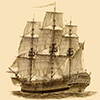 Grenada (generic)
References
| Primary Source | Australian Joint Copying Project. Microfilm Roll 88, Class and Piece Number HO11/4, Page Number 32 |
| Source Description | This record is one of the entries in the British convict transportation registers 1787-1867 database compiled by State Library of Queensland from British Home Office (HO) records which are available on microfilm as part of the Australian Joint Copying Pro |
| Original Source | Great Britain. Home Office |
| Compiled By | State Library of Queensland |
| Database Source | British convict transportation registers 1787-1867 database |
Claims
No one has claimed William Vaughan yet.
Photos
No photos have been added for William Vaughan.
Convict Notes

William Vaughan was listed as 21 years old on arrival. Native Place: Hereford. William was 5'7½" tall, dark complexion, black hair, brown eyes. Colonial Secretary Index: VAUGHAN, William. Per "Grenada", 1821 1823 Sep 22-Oct 15: To be transported for 14 years. In reports of prisoners tried at Court of Criminal Jurisdiction (Reel 6023; X820 p.107) 1823 Oct 15: On lists of prisoners transported to Port Macquarie per "Lady Nelson" (Reel 6019; 4/3864 pp.80, 440-1)
Another account, with more detail about the roles of the pirates. It gives an account of how William Vaughan was shot at and wounded by them, before being thrown overboard. PIRACY. Our readers are aware that the schooner Caledonia, from this port, was captured in December last, by prisoners at Moreton Bay, and had not been heard of for a considerable length of time. The vessel was carried to the Navigator's Islands, where the commander, Mr. Browning, succeeded in effecting his escape from the pirates, and has arrived at Sydney by the American whaler Milo ; The following is Mr. B.'s narrative of the piracy :— The schooner Caledonia of Sydney, on a voyage to Loo Island, for the purpose of procuring what was saved of the wreck of the ship America, purchased by the owner of the Caledonia, had occasion to put into Moreton Bay. About 36 hours after, at night, the schooner was boarded by 11 armed men, who immediately took possession of her, obliging the master to deliver up the whole of the arms he had on board, consisting of two muskets and two pistols. The master and part of the crew were then called on deck, and compelled to assist in getting the vessel under weigh ; after which the whole of the crew, with the exception of the master, were sent on shore in the pilot-boat, in which the pirates had come off. So well did the fellows lay their plans, that the watch on deck did not suspect anything till they were in the act of jumping on board. The crew, when they got ashore, of course gave the alarm, and two boats immediately put off in chase of the schooner, but were unable to come up with her. The master, having made several vain attempts to leave the vessel with the rest of the crew, was obliged to assist in navigating her, under a threat of having his brains blown out in case of a refusal. Accordingly, under the direction of the pirates, he shaped his course for the Island of Rotumah, they assuring him that he should sustain no injury if he did not deceive them, but that upon the least appearance on his part of an attempt to betray them, he should instantly suffer death. The duties of first and second mate were discharged by two of the pirates, named Evans and Hastings. About a week after leaving Moreton Bay, the master was ordered by these two men and another named William Smith, to go aft and take the helm, when a man called John McDonald, one of the pirates, was called up, and immediately shot through the head by Evans. Another of the party, named William Vaughan, was then called up, fired at, and wounded by Hastings, and was then, after considerable struggling on his part, thrown overboard by the three principal actors in this bloody scene — namely Smith, Evans, and Hastings. Another of the party, named Connor, was next called up, and compelled to jump overboard ; and a man named John Smith, who was intended to share the same fate, was only spared after the most earnest entreaty. Nothing particular occurred after this until the vessel made New Caledonia, for the purpose of procuring water. There she put into Port St. Vincent, and filled up the casks. The day before she again put to sea, Evans and Smith quarrelled with Hastings about some grog, in consequence of which, it was agreed that Hastings should be left behind, and he was accordingly put onshore. The vessel, in due course, made Rotumah, one of the New Hebrides; nothing particular happening in the mean time, except a repetition by Evans of the threat that the master should suffer instant death if he showed the least sign of an intention to betray them. At Rotumah a friendly chief, named Emery, came on board, but Mr. Browning was so narrowly watched, that it was impossible to communicate to him the circumstances under which he was placed. One of the party, called Harry, ran from the boat, and remained at Rotumah. After taking in two casks of water, the master was directed to make for Wallis's Island, where he was told it was the intention of the pirates to land in the whale boat, and send him back in the vessel, together with, three Rotumah women, who had accompanied the party from that island : he was, however, subsequently informed by three of the men, that it was the intention of Evans to scuttle the schooner with him and the women on board. Two of the party, named Watson and Hogg, who, with John Smith, had behaved kindly to the master, declared to him their suspicions that it was the intention of Evans and others on board, to shoot them. The vessel missed Wallis's Island, but made Footona, where some pigs and fruit were procured from the natives. On the 29th of Feb. she made Davi, where John Smith was landed, together with the three Rotumah women. Watson and Hogg also, acting under the dread of personal violence from Evans and the rest, got into a canoe, went on shore, and remained behind : the master, however, was still so closely watched, that an attempt at escape was impossible. The vessel then stood out to sea. Evans told the master that she was to be scuttled, and he expected nothing else but to go to the bottom with her. When about 15 miles off the land, however, the master was called by the pirates to assist in packing up some things to put into the boat; and about 12 o'clock on the following day the vessel was scuttled, and the whole party got into the boat, and stood in for Toofoa, where Mr. Browning, and a man named Thomas Massey were taken by one chief, and Evans and Smith by another. The day after landing on this island, the other three men came down with a body of natives, and took away the boat. They also told Mr. Browning that he was in danger of his life, and wished him to go with them; but, being in possession of a musket, he declined doing so, expressing his intention, at the same time, to leave the island by the first vessel that touched there. After Mr. Browning had been on the island for eight days the barque Oldham came into the offing, and he went on board in a canoe. He there learnt that a report prevailed of the Caledonia having foundered at sea. Mr. Browning was asked on board the Oldham, who was the master of the Caledonia. He, of course, stated that he was ; but upon the chief officer and some of the crew proceeding on shore, the pirate, Evans, told them he was the master. A suspicion, in consequence, arose, and an enquiry having been made among the natives, by means of an interpreter, Evans was immediately secured and put in irons. The other three men could not be discovered, being, doubtless, concealed by the natives ; but the boat which they took away was found at the place to which Mr. Browning learnt it had been taken. Such is this gentleman's narrative of as an atrocious an act of piracy, accompanied by deliberate murder, as is to be found upon record. It is to be hoped that the remainder of the wretches who were engaged in it will yet be discovered by vessels trading among those islands pointed out by Mr. Browning. Sydney Gazette, 17 May 1832.
Portsmouth, Portsea and Gosport. The business of the Sessions for the borough of Portsmouth, commenced on Thursday, before Edward Carter, Esq. Mayor, Win. Selwyn, Esq. Recorder ; and Sir S. Spicer, Knight, James Carter, Esq. Sir H. White, Knight, and Daniel Howard, Justices. The criminal part of the calendar had fifteen indictments, and four of the prisoners were ordered to be transported for seven years, viz. Wm. Bran, for stealing five ducks and six fowls, in the parish of Portsea, the property of Rebecca Hill, widow; Wm. Vaughan and John Barker, for stealing 11 lbs. of beef, the property John Silk, and George Dagwell, aged 19, for stealing yards of canvas, in the parish of Portsea, the property of Allan Mackenzie, Esq. Hampshire Chronicle, 15 Jan 1821. William Vaughan received a Colonial sentence and was sent to Moreton Bay penal establishment. Moreton Bay Convict Records Wm Vaughan, Grenada, Southampton Q.S. 11 Jan 1821, 7 years, miller. Colonial sentence, Newcastle Bench, 28 Nov 1829, sentence 3 years for Violent assault and theft. Sydney Crim. Court, 29 Sep 1823, Robbing Mr Dixon’s Stores. Run. Absconded per “Caledonia” 16 Dec 1831. NARRATIVE Of Captain Browning, late Master of the Caledonia schooner, who was taken from Moreton Bay by pirates, on the 16th of December, 1831. Our readers may perhaps recollect, that in the month of December last, a schooner called the Caledonia, belonging to Messrs, Mackay and Folkard of Sydney, was taken possession of by a large party of convicts, at Moreton Bay, and carried off to sea. Mr. Mackay, and the crew of the Caledonia were allowed to go ashore ; but the master, a young man named Browning, was compelled by the prisoners to remain on board for the purpose of navigating the vessel. A considerable time having expired without any tidings of the Caledonia having reached Sydney, it was conjectured that the Captain had been sacrificed by the miscreants, on their arrival at some of the numerous islands of the Southern Seas. However, on Monday last, an American whaler, the Milo, came into port, having on board the long lost Captain Browning; by whom, we have been kindly favored with the following particulars.-- On getting out to sea, the pirates informed Mr. Browning, that he must take the command of the Caledonia and steer for some of the Islands, where English whalers were in the habit of calling, - for the purpose, as they said, of stowing away in some of those vessels, and thereby reaching England in safety. Mr. B. at first was very reluctant to obey their orders, telling them that he did not understand the management of a vessel. They swore they would compel him, as they knew he was Captain of the Caledonia. Perceiving no alternative, he at last acquiesced in all their proceedings with a policy and presence of mind, rarely met with in persons placed in such a situation. Captain Browning invariably seemed to applaud their conduct, and listen to their complaints, -saying, that it was a pity for fine young fellows like them to be lagged from their native country, and how natural it was for all men to flee from bondage, and such like expressions; and by this stratagem, gained their confidence, and averted his own destruction. During the passage the pirates quarrelled, and several of them were murdered in a most diabolical manner. On leaving Moreton Bay, they were eleven in number, six of whom entered into a conspiracy, to destroy the other five. One man was with difficulty despatched. The villains deliberately fired at him when off his guard, but only wounded him in the hand, and slightly grazed his head. Mr. B. states his cries for mercy were most pitiful ; his supplications were unheeded, and they chased him about the deck with weapons, and endeavoured to make him jump overboard. At last he made a leap, and catching hold of one of the ropes of the vessel, he was suspended between life and death, when the savages cut away the rope and the poor wretch met his fate! Another of their number was put ashore at New Caledonia, where from the known ferocity of the natives, there is little doubt of his having met with a dreadful death, at the hands of these cannibals. The destruction of their comrades, is attributed by Captain B. to old disputes that existed amongst them while at Moreton Bay. Shortly after this murderous epoch, they encountered a dreadful storm which shook their courage, and proved that the monsters were at heart, a most despicable set of cowards ; and the courage displayed by Captain B. on the occasion, tended to raise him in their respect ; some of the fellows went on their knees begging of him to do his best in conducting the vessel in safety to some island. He told them he was certain they would "all go to the devil together," their crimes were of so aggravated a nature. After this he heard them distinctly planning his death, which was to be accomplished as soon as they arrived at their desired haven. The vessel was to be scuttled with the Captain on board. They observed that Mr. Browning was a good fellow, but he must be sacrificed for their safety. This scheme was concerted at a time when the Captain was supposed to be asleep. The island where this tragedy was to have been performed, was passed by Mr. Browning during the night, and he ran the Caledonia into one of the Navigator's Islands, near the Fejees. Here the Captain was on the "look out" for his life, which was saved, in consequence of the natives boarding the boats in an unexpected manner, and seizing the whole of them. On their arrival at Savi, (by some called Oteewhy), the prisoners commenced their work of destruction, by destroying the Caledonia with crowbars and other instruments, notwithstanding the earnest entreaties of Captain Browning, who requested them to spare the vessel ; but his efforts to save her proving ineffectual, the Caledonia speedily sank in deep water off the above Island. On coming on shore, the Captain was peculiarly fortunate in gaining the protection and esteem of one of the Chiefs. The pirates represented themselves as shipwrecked seamen, and the Captain as a missionary, accordingly the whole of them were treated with kindness by the natives. During Captain Browning's stay at this friendly island, he witnessed and joined in most of their customs. Sometimes he amused himself in shooting pigs, attended with the Chief; at other times he visited their place of worship, which was conducted with the greatest decorum, and assisted the Chief in officiating to his numerous audience. He used occasionally to give them a tune on a violin which he contrived to save from the Caledonia, and endeavoured to teach them to dance like Europeans, at which they were extremely delighted. One of their customs was very repulsive to Mr. B.; this was the process of making a drink which they called Kava. This liquor was made from some root, which, after having been cut up, was chewed by unmarried females, and then mixed with a liquid, which completed the dish. The Captain with difficulty persuaded them that he could not drink it, and was under the necessity of pretending illness when it was offered to him. Mr. B. represents the natives of this island as a fine race of people, of a copper colour, and they were nearly in a state of nudity. The Captain also states that these Islanders are remarkable for their humanity and kindness towards Europeans. After residing with them for some time, the Oldham, an English whaler, commanded by Capt. Johnson, touched at the Island. Mr. Browning contrived to get on board the vessel, and represent his case to the officers, who received him in a most hospitable manner. In a short time he succeeded in capturing one of the pirates, named Evans, and had him conveyed on board the Oldham in irons. The rest of the prisoners made their escape to the natives, who would not allow them to be taken. On the passage up Evans escaped from the Oldham by jumping overboard, in a heavy sea, with the tide running in a most rapid manner ; he was heard to express the determination of destroying himself rather than be brought alive to Sydney ; but from the violence of the sea at the period alluded to, the wretched man must have met a watery grave. Captain B. had considerable difficulty in leaving the hospitable residence of the friendly Chieftain ; who, with tears in his eyes, endeavoured to pursuade him to stop with them. But on Mr. B. faithfully promising to return again in a few moons, he was allowed to embark on board the Oldham, his faithful friend the Chief supplying him with pigs and other articles of subsistence for the voyage. The Oldham shortly after fell in with the Milo, bound to Sydney, and Captain Browning embraced the opportunity of returning home. While on board the Milo, Mr. B. was attacked with a severe fit of illness; and which, but for the great kindness of Captain West, would probably have proved fatal. He has, however, arrived in Sydney in good health and spirits, to the great surprise and happiness of an extensive circle of friends. Sydney Herald, 17 May 1832.