
Summary
Personal Information
Voyage
Transportation
Richard White was transported on the Hilsborough, departing 30th Sep 1798 and arriving 26th Jul 1799 with 300 passengers.
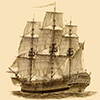 Hilsborough (generic)
References
| Primary Source | Richard White's son John born London 1797, died Tasmania 1883. Australian Joint Copying Project. Microfilm Roll 87, Class and Piece Number HO11/1, Page Number 249 (125). My references are oral and historical records eg Land Auction. Tasmanian Archives |
| Source Description | This record is one of the entries in the British convict transportation registers 1787-1867 database compiled by State Library of Queensland from British Home Office (HO) records which are available on microfilm as part of the Australian Joint Copying Pro |
| Original Source | Great Britain. Home Office |
| Compiled By | State Library of Queensland |
| Database Source | British convict transportation registers 1787-1867 database |
Claims
No one has claimed Richard White yet.
Photos
No photos have been added for Richard White.
Convict Notes

Does anyone know when &/or the circumstances of John White's (Richard White's son) migration from England to Australia? Was he transported at the same time as his father, or did he arrive later? Tradition was that child stayed with their mother, but she (Elizabeth) died around the time that Richard was transported, when John was under 2 years old. Did he arrive with his father & housed in an Orphan School?
Old Bailey Proceedings Online (www.oldbaileyonline.org, version 8.0, 03 July 2021), February 1797, trial of RICHARD WHITE (t17970215-24). RICHARD WHITE, Violent Theft > highway robbery, 15th February 1797. 141. RICHARD WHITE was indicted, for that he, in the King's highway, in and upon George Shilletto , on the 5th of February , did make an assault, putting him in fear, and taking from his person, a metal watch, value 40s. a steel chain, value 6d. two watch keys, value 6d. a metal seal, value 6d. and nine shillings, the goods and monies of the said George . GEORGE SHILLETTO sworn. - I live in Osborn-street, St. George's in the East: On Sunday night, the 5th of February, as I was returning from Hertford, I was stopped between Enfield-wash and Edmonton ; I was in company with Mr. and Mrs. Wright, in a post-chaise. Q. What time of the night or day was it? - A. As near as I can recollect, about a quarter after six, or half an hour past six; we were stopped by a single highwayman; he rode up to the horses, and stopped the chaise; he let down the window, and presented a pistol, and demanded our money; we all three gave him what money we had; he then demanded our watches; Mr. Wright told him he had not one, and Mrs. Wright told him the same; I told him. I had a watch, and gave it him; he then rode off; and on the Thursday following, an officer from Bow-street came to where I was employed in Bread-street. Q. Had you given notice at Bow-street? - A. I had not. Q. What are you? - A. Clerk to a wholesale grocer, Mrs. Naylor; an officer came there to me, and told me he had taken a man on suspicion, on Sunday night, and told me there was a watch and some other property found upon him, and Mr. Addington wished I would go to the office, to see if it was mine; I went up immediately, and saw the watch at the office; it was my watch; a metal watch, with two keys and a metal seal. Q. What money did you give him? - A. To the best of my recollection, about nine or ten shillings. Q. I would ask you whether you could distinguish the person of the man that robbed you? - A. I could not sufficiently to swear to him. Q. Can you say what sized man he was? - A. I cannot. Q. Nor the horse? - A. No. JOHN IZOD sworn - I am a farrier, at Ponder's end: On Sunday, the 5th of this month, about half past six o'clock, I was going home, through Edmonton, when this gentleman stopped a chaise; I stopped, and saw him stop the chaise; I heard him ask for the watch and money, and shew the pistol; I was on the foot path. Q. Do you know who it was that robbed him? - A. I cannot say further than partly his complex ion; I know what coat he had on; he was a dark man*. *The prisoner was a Creole. Q. Was it moon-light? - A. It was quite light. Q. You could see the complexion of the man? - A. Yes; he was a dark complexioned man, and his hair was very rough, and a kind of a little tail behind; he had a rough blue coat on, a kind of a matted coat. Q. What horse did he ride? - A. A while horse, with a blaze down the face, rather white nose; and then I saw a pistol, but I cannot say what sort of a pistol it was, rightly, I think it was a brass one; it was not a steel one, I am almost sure, nor yet an iron one; he turned back again, and went before the chaise. Q. Did you hear what he said? - A. Yes; I heard him say, stop, and deliver your money and your watches. Q. Did he see you? - A. I should think he must; he stood right over me, he could not miss seeing of me; if I had not seen the pistol, I would have went and took him if I could. Q. Did you see which way he came towards the chaise? - A. He came from London, and then returned towards London again. Q. Now look at the prisoner at the bar? - A. That is the gentleman. Q. Do you mean to say positively he is the man? A. Yes; I am sure of it. Q. What sort of a voice had he? - A. He had a very gruff voice. Cross-examined by Mr. Knowlys. Q. What kind of a hat had he on? - A. A round hat. Q. A great coat on? - A. A great coat buttoned round. Q. And this was half past six? - A. Yes. Q. I do not know whether you were here in the morning, or not? - A. No; I was not. Q. The last trial in the morning? - A. No; I was not. Q. Do you mean to swear that the moon was up? - A. No; I do not. Q. Then without a moon, and at half past six, on the 5th of February, you swear to a man's complexion, do you? - A. Yes; I could swear very safely that he was a dark man, I looked at him very much. Q. How many yards might you be off of him? - A. I was only just across the road; he was on one side of the way, and I on the other. Q. Twenty yards, perhaps? - A. No, not so much. Q. How much of his complexion might you see? - A. The whole; his face, when he turned his horse's head, I saw more of it. Q. From the eye to the lower lip? - A. Yes. Q. Had you ever seen the man before? - A. Never to my knowledge. Q. Now I should be glad to know whether it was not extermely dusk at this time? - A. No; it was not then, I know. Q. Will you swear that? - A. Yes; I can swear it was not dark. Q. It was dark in some degree? - A. Yes, to be sure it was. Q. That is the best time for observing complexions I suppose? - A. No; I cannot say it is. Q. I should think every man's complexion would look much the same at that time? - A. I should know a dark man from a light one. Q. And you swear positively to him? - A. Yes. Q. Is there any reward in this case? - A. No. Q. There is not? - A. I do not come with any such view. Q. You do not know of any reward in this case, if the man is convicted? - A. No. Q. You have not heard it? - A. No. Q. How long have you been attending this Court? - A. These four days. Q. And never heard in your life, that there was a reward for apprehending a highwayman, upon his conviction? - A. Yes. Q. Then why did you say you had not heard of it? - A. I did not say that. Mr. Knowlys. Then I will not ask you another question. - I am sure the Jury must have heard his answer. Court. Q. Have not you an expectation of a share in the reward, if this man is convicted? - A. No; I have not. Q. Did you assist in taking him? - A. No, I did not. THOMAS BARRET sworn. - I live at Crouchend, in the parish of Hornsey, I keep the King's-head: The prisoner called, on Sunday the 5th of February, about ten minutes after seven, at my house. Q. How was he dressed? - A. He had a blue great coat on. Q. What hat? - A. A round hat. Q. Did he come on horseback? - A. Yes; upon a brown mare with a white heel behind, and some white upon her face. Q. What white upon her face? - A. I cannot say particularly what white. Q. How far is Ponder's end from your house? - A. I never was there, but it is represented to be about six or seven miles; the mare was very hot indeed. Q. Are you certain it was the prisoner? - A. Yes; he came up to the door, and asked if I took in horses; I was very busy, my boy was out, and I went round and let him into the stable; I would have taken his horse and tied him up, but, says he, I understand the horse better than you, I will tie him up myself; says I, my lad will be in in a few minutes, and he shall come in and dress it; says he, I would be willing to give the lad sixpence to dress my horse well; says he, could I have tea; I told him it was an unseasonable time for tea, and I could not rightly tell; he asked me if I had any thing in the house to eat; I told him we had got some nice roast beef; he seemed to like tea better; I went in and asked Mrs. Barret if she could make tea for one; she said yes, and he came in and had tea; he cleaned the horse himself, and then he came in and washed his hands, he had some eggs with his tea; it seemed a very good horse; and having heard of Lancaster being so lately shot, I thought he might be somebody of that description; I went and looked at his horse in the stable, and found the marks that I have represented to you; after that, I went into the parlour and stirred the fire, and asked him if he was warm and comfortable; he said yes; I asked him if he had rode a great way, for his horse was very hot indeed; he said, the roads were very heavy; he asked me how far it was to Highgate, and I told him; and then he asked me how far it was to Hampstead; then he asked whether the road was lighted from Highgate to town; I told him, yes; and that it was watched and well patroled; in that time, the prisoner wanted another quartern of corn for his horse, and he took it in; and the officers belonging to Mr. Addington happened to come in, and I called out one of the officers, Mr. Bacon, and I told him my thoughts upon this man; and Bacon went and looked at the horse, and then he took him. Cross-examined by Mr. Raine. Q. The roads at this time were very heavy? - A. I don't know, the prisoner told me so. Q. You must know whether the roads were or not very heavy? - A. They might be. Court. Q. They must be? - A. I believe they were. Mr. Raine. Q. Have you had any conversation with the last witness on this subject? - A. Nothing particular. Q. What in general? - A. Nothing. Q. How came you to say nothing particular? - A. It is a common phrase in speaking. Q. Then you meant that you had had no conversation with him at all? - A. I did. Q. With respect to this, horse, he had a whitesnip? - A. I cannot say, there was some little white in the face. Q. You examined the horse very particularly? - A. Yes; I went to the stable with a candle. Q. Had he a white heel? - A. Yes. WILLIAM BACON sworn. - I am a patrol belonging to Bow-street: On Sunday the 5th of this month I was at Crouch-end, with my party; I was in at Mr. Barret's, I believe we drank a pot of porter; he called me on one side, and told me his suspicions, and I went into the parlour, but he was not there; I returned from the room, and told the landlord no person was there at all; he said, then he supposed he was in the stable, and said, he would be in a moment; I had some more men in the tap-room; I desired one of them to sit down in the parlour, and we had a pint of porter, and in about four or five minutes the prisoner came in; I told him I had a suspicion that he was a highwayman; the words were scarcely out of my mouth when he rose from his chair at the same time that I did, he whipped his hands into his close-bodied coat pocket, his great coat was off, and I immediately secured his hands in his pocket; I took his hands out of his pocket, and told him, if he had any thing in his hands to drop it; he was very quiet; I took his hands out of his pocket and put my own in, and took these pistols, one out of each coat-pocket,(producing them); I then began to search him; he had pantaloons on, and I took them off; out of his pocket I took this watch, I think it was his waistcoat-pocket, I am not quite clear, and several other articles. Q. Were the pistols loaded? - A. They were loaded and primed, with powder and ball. Q. Are they loaded now? - A. They are not; I unloaded them before the Magistrate. Q. Did he say any thing? - A. Nothing particular; I then tied him to one of my own men, and sent him to town; I took the horse and rode her with him till we came to I slington, and there I put him in a coach; I took him to the Brown-bear in Bow-street, and when I took him there, he told me he wanted to speak to me in private; I told him, very well; after that, I took him over to Covent-Garden watch-house; I took him into the back room, and there he asked me if twenty pounds was an object to me, I think that was the word as near as I can speak it; and I left the room immediately. Cross-examined by Mr. Knowlys. Q. How much money was there found about him? - A. A half-guinea, two half-crowns, ten shillings, and two sixpences, and some halfpence. Q. You know the roads were remarkably dirty and heavy? - A. I have seen them more so. Q. Were they not very heavy and dirty? - A. They were. DONALD M'GILLEVRAY sworn. - I held the prisoner when Mr. Bacon was taking the property from him. Q. (To Bacon.) Have you traced the horse? - A. Yes, to a Mr. Calvert; it was his horse, but he is not here; he was at Bow-street. Q. (To M'Gillevray.) What did Bacon find upon him? - A. A pair of pistols, and a watch. Prisoner's defence. Bacon says I offered him twenty pounds, which I had not that money at the time; the man that swears to me says he was twenty yards from me; he swore so at Bow-street; it being dark I don't think he could swear to me at that distance. Q. (To Bacon.) What time did you come out of London that Sunday? - A. Between five and six o'clock. Q. Did you observe what kind of light there was at that time? - A. At that time it was certainly rather dusk. Q. Did it get lighter after that when you got to Crouch-end? - A. I did not make any particular observations upon the light. Q. Do you think, you being on one side of the road, and a man on the other, you could discover his complexion? - A. I should suppose if a man paid attention to a particular object be might. Q. (To the Prosecutor.) Look at that watch? - A. This is the watch I gave to the highwayman that Sunday night; I know it by the seals and the keys, and the chain, and every part of the watch; I do not know the number, the maker's name is Plumer. GUILTY . Death . (Aged 23.) Tried by the second Middlesex Jury, before Mr. Justice ROOKE.
I would like to add a correction to a previous post of mine. A few years ago in Merimbula, NSW I met. a descendant of the Bank Manager who was Secretary of the Private Company which backed Batman and Fawkner in their voyage which founded Melbourne. Their land claims in Victoria were rejected by thw NSW Government who stated that all the land there belonged to NSW. NSW later held Land Auctions for the land that had been claimed. THe descendant told me that overall they made nothing. though I think some may have bought lands at the auctioin.

1) May we put to sleep the furphy that Richard White had anything to do with Johnnie Walker? The origin is almost certainly a harmless remark to be found in the Dennis Hodgkinson papers in the Local Studies Library at Launceston. Hodgkinson writes: "We can picture him 'got up to kill' rather like Johnny Walker..." [Even Hodgkinson couldn't spell it properly.] And so we get a succession of people making unwarranted assumptions. Tom Browne, who drew The Striding Man for the company wouldn't have had a clue who Richard White was or what he looked like. 2) It was very fashionable in the reign of King George III for the wealthy to parade their wealth by outdoing each other. Exotic grooms, pet monkeys, cabinets of curiosities and... exotic servants I believe that Richard White really was from North America. You can't help wondering if he had a guardian angel. He got his death sentence commuted, he survived just about the worst hellship, he became a constable on Norfolk Island and, in VDL, he must have become very wealthy indeed. 3) In William Noah's account of the Hillsborough voyage he gives Richard White an alias of "Coates". I don't believe this was an alias at all. Only three names above White we find "Isaac Warren Alias Old Hike": in other words, just a nickname. And "Coats" was an old nickname for a servant, just as we call electricians "Sparks" now. It doesn't mean he was a coatman but, if he worked for the wealthy, he may well have had a uniform. Perhaps that's why liked to dress up.
Looking for information on Dicky (i.e.) White convict late of Norfolk Island to Tasmania. Im an interested in the circumstances of his birth in the USA/England, his mother Negro ??, his father and how his father John White came to go to the US. I think I am 6th generation. Have a family photo of 'grandfather and granny White (John White) Dickies son/ grandson not sure. This photo has my great aunt and great grandmother in it. The photo was taken on the occasion of their 60 wedding anniversary. All help and information appreciated. Many thanks Angela Aaltink
My father (Alan Macneill McCormick) used to often talk about 'Dickie' White who he used to see in one of the front bars at the Launceston Hotel. He said he wore old fashioned clothes. I believe this was around about the 1960'ies when Dad often visited Launceston on business. I had also heard or read that 'Dickie' White was one of the backers of Batman and Fawkner for their private expedition which founded Melbourne in 1835. I think that most of their backers were from Northern Tasmania. If so, he would have become very wealthy. Regards, Peter McCormick.
NSW Archives recently released the registers for Certificates of Freedom 1810-1814 to ancestry.com.au. Richard White's unconditional pardon entry dated 31 January 1814 stated his native place was "New York, America" and under General Remarks "half American black".
David Cail where is your proof that Richard White was born in Middlesex. Have you considered having DNA done? A fellow descendant has recently had DNA and results showed a small percentage of West African which ties in with being part Jamaican. All reports with description describe him as mulatto, creole, dark, or with coloured skin. I hope you will check your research.
Old Bailey records list Richard White as 'Mulatto'. In this era this was the only term to describe a mixed race individual, with one parent of african origin and the other of caucasian origin. Old Bailey records also indicate his place of birth as New York. *Publication of actual citations to disprove these characteristics would be greatly appreciated.
Richard was NOT born in USA as reported and did NOT have a Jamaican mother. This information posted is incorrect