Summary
Personal Information
Crime
Voyage
Transportation
William Hayward was transported on the Sir George Seymour, departing 4th Nov 1844 and arriving 27th Feb 1845 with 345 passengers.
Built c 1840. Wood ship of 580 Tons. THE 'EXILES' PER SIR GEORGE SEYMOUR'. The accounts given in the Hobart Town papers of the conduct, during the voyage, of the "Exiles" by the above ship, and of the cleanliness which pervaded the vessel on her arrival, are very flattering to all those concerned. The annexed is from the COURIER, of the 4th instant: 'The men, too, are of a very superior order, and the greatest credit is due to Dr. Hampton, the Surgeon-Superintendent, for the excellent arrangements which are discoverable in their comfort and classification. The vessel proceeds to Port Phillip the latter end of the present week with that portion of the prisoners who have obtained conditional pardons. The remainder, by far the larger portion, ticket-of-leave men and pass-holders, remain in the Colony. The Government have rented Mr. Solomon's house in Argyle-street, as a hiring depot for those latter men who are well clad, and present, altogether, a very different appearance from the ordinary class of convicts. Several of the men, we under stand, have been already engaged, at wages varying from ten to twelve pounds a year; and every facility is afforded by the Surgeon-Superintendent to those who, for the purpose of engaging servants, visit this vessel. It is necessary, however, to be provided with an order from the Colonial Secretary to go on board the ship." The Australian, 20 March 1845.
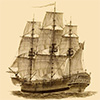 Sir George Seymour (generic)
References
| Primary Source | Australian Joint Copying Project. Microfilm Roll 91, Class and Piece Number HO11/14, Page Number 224 |
| Source Description | This record is one of the entries in the British convict transportation registers 1787-1867 database compiled by State Library of Queensland from British Home Office (HO) records which are available on microfilm as part of the Australian Joint Copying Pro |
| Original Source | Great Britain. Home Office |
| Compiled By | State Library of Queensland |
| Database Source | British convict transportation registers 1787-1867 database |
Claims
No one has claimed William Hayward yet.
Photos
No photos have been added for William Hayward.
Convict Notes

On 12 April 1843 the Bury and Norwich Post published a report on the Suffolk Easter Sessions held at Ipswich, Suffolk on Friday 7 April 1843. William Hayward, aged 20, and William Sones, 19, pleaded guilty of having stolen from a mill at Botesdale, 11 bushels of wheat, the property of Samuel Robinson. They also pleaded guilty to two other indictments of a similar nature. Each prisoner was sentenced to be transported for seven years. It was reported that William Hayward had been in the employ of Samuel Robinson for about 10 weeks as a miller. William Hayward had been taken into custody on 2 April 1843. The Ipswich Goal Book recorded him as being a labourer aged 20 years, residing at Rickinghall. He was described as being 5 feet 4½ inches tall, having brown hair with hazel eyes, and both his little fingers were crooked. He was Methodist by religion, and he had been born at Rickinghall. He was married with one child some 15 months old. His father was recorded as being William Hayward, labourer of Rickinghall. In the Rickinghall Parish register there is only one match to these details and that is William the son of William and Lucy Hayward who was baptised at Rickinghall Superior on 16 March 1823. In the Census taken on 7 June 1841 he was recorded aged 18 years living with his parents at Allwood Green, Rickinghall Superior. Botesdale, where the offence took place, lies adjacent to the village of Rickinghall. On 27 May 1843 the Ipswich Journal reported that William Hayward had been removed from the County Gaol to the Model Prison at Pentonville. William Hayward was transported in the Sir George Seymour which arrived in Tasmania on 27 February 1845. Convict records from Tasmania Archives Online (ref CON33/1/64) provide some details for him which differs slightly from those taken at Ipswich. He was recorded to be a Protestant and could read and write. His trade was a labourer and had worked as a miller. He was 5 feet 3 ¾ inches tall, of fair complexion, long head, brown hair, brown whiskers, long visage, medium height forehead, brown eyebrows, brown eyes, medium nose, medium mouth and medium chin. His native place was Botesdale. His marks were a ring on the second finger of left hand, and the little finger of the right hand was crooked. He received a Ticket of Leave on 07 March 1845, and a Conditional Pardon was approved on 30 November 1847.