
Summary
Personal Information
Crime
Voyage
Transportation
Zephaniah Williams was transported on the Mandarin, departing 24th Feb 1840 and arriving 30th Jun 1840 with 212 passengers.
640 ton ship. The 1843 voyage carried the 51 Parkhurst Boys from the Isle of Wight bound for Van Diemen's Land. (Another 31 went to New Zealand.)These boys were categorised as "ticket of leave" or "apprentice" boys.
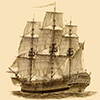 Mandarin (generic)
References
| Primary Source | Australian Joint Copying Project. Microfilm Roll 91, Class and Piece Number HO11/12, Page Number 153 (78) |
| Source Description | This record is one of the entries in the British convict transportation registers 1787-1867 database compiled by State Library of Queensland from British Home Office (HO) records which are available on microfilm as part of the Australian Joint Copying Pro |
| Original Source | Great Britain. Home Office |
| Compiled By | State Library of Queensland |
| Database Source | British convict transportation registers 1787-1867 database |
Claims
No one has claimed Zephaniah Williams yet.
Photos
No photos have been added for Zephaniah Williams.
Convict Notes
Wednesday se'nnight the convict ship having on board Frost, Jones, and Williams, put into this port (Falmouth) with loss of topmasts. It appears that these leaders were embarked on board the Mandarin at the last moment before she left Portsmouth. From our inquiries we learn that they are separate from the other convicts, and that they inhabit a cabin of 12 feet in length and about 8 in breadth, having three comfortable sleeping berths, a bathing machine, &c., fitted, and other conveniences ; although dressed In convict's attire, they were not shackled. When visited to-day at noon, Frost was reclining on his berth, sad appeared very dejected; but his companions were in good spirits; they had a large supply of books, with which Jones and Williams apparently had been amusing themselves. The convicts were generally occupied today in writing letters. From the expedition manifested in getting the vessel re-masted, Is is said that she will go out to-morrow at noon, Cambridge General Advertiser, 18 March 1840.
Zephaniah Williams: Description: Trade: mineral surveyor Age: 44 Complexion: sallow Head: round Hair: light brown to grey Whiskers: light brown to grey Visage: round Forehead: medium Eyebrows: light brown Eyes: brown Nose: medium Chin: large round Remarks: none Tried: 10 Dec 1839- life Embarked: 20 Feb 1840 Arrived: 30 Jun 1840 Protestant, can read and write Transported for High Treason Goal Report: very good Hulk Report: good Married with 2 children- wife, johan in monmouthshire name: Zephaniah Williams event: Banns event date: 25 Jul 1819 event place: Merthyr Tydfil, Glamorganshire, Wales spouse: Joan Llewelyn digital folder number: 004189879 Surgeons Report: no offences, how employed: general conduct being good Ticket of Leave: 27 Nov 1849 Conditional Pardon: 16 Nov 1852 Conditional Pardon: 27 Jun 1854 Free Pardon: 24 Feb 1857. Zephaniah Williams, Chartist and mine owner, was born at Merthyr Tydfil in Glamorganshire, Wales. He married Johan (b.1801) and they had a son Llewellyn, and a daughter, Rhoda (b.1830). The Monmouthshire Chartist, Henry Vincent, described Williams as 'one of the most intelligent men it has ever been my good fortune to meet'. Unlike John Frost he was a free-thinker and by 1831 had won notoriety by his spirited polemics against the local clergy. In 1832 he was charged with assaulting a constable in Monmouthshire but was acquitted. In 1838 he became a Chartist and several Chartist meetings were held at his Royal Oak Inn in Coalbrookvale, Blaina, Monmouthshire, where he combined the occupation of innkeeper with that of a mineral surveyor and coal merchant. With John Frost and William Jones he was one of the leaders of the Newport rising of November 1839, though unlike Jones he appears to have favoured a peaceful demonstration. When the rising failed Williams eluded his pursuers for three weeks but was captured at Cardiff on the point of sailing for Portugal, brought to trial at Monmouth and, together with his two associates, sentenced to be hanged, drawn and quartered for waging war against the Queen. The sentence was commuted to transportation for life; Williams sailed with Frost and Jones in the Mandarin, and arrived in Hobart Town on 30 June 1840. Williams was sent to Port Arthur where he was soon employed as a superintendent in the coal-mines. In November he attempted to escape by canoe and was sentenced to two years hard labour in chains at Impression Bay on Tasman Peninsula. His term of probation ended in November 1843 and he was transferred to the prisoners' barracks at Hobart; from there he went to New Norfolk as a constable at 12s. a week. In August 1846 he left the police force and became a barman in a Launceston hotel. Eighteen months later he made another attempt to escape and received a further sentence of twelve months with hard labour in chains on Tasman Peninsula, three months of which he spent in the coal-mines and the rest at Salt Water River. He was released in November 1848 and entered service first at Providence Valley and later in Hobart. He received his ticket-of-leave on 27 November 1849, a conditional pardon on 27 June 1854, and a free pardon on 24 February 1857. Williams took no part in public life although he remained in the colony. While in service in 1849 he began mining at Knocklofty without success, but later discovered the coalfield in New Town neglected for twenty years. In partnership with R. J. Collins until 1853 he worked the Triumph mine, producing between thirty and forty tons of coal a day, and helping by this competition to keep the general price low. When coal was found at the Mersey River Williams went to inspect it. Offers from a Launceston syndicate fell through and Williams started his own company. He acquired over 2000 acres, formed a miners' camp and commenced work at Tarleton where the Denison colliery was opened in 1853. He sent to England for miners, built houses for them, a tramway and a deep-water jetty. In 1855 he entered another partnership and until 1859 managed the Denison, Nook and Don mines. Williams left the industry when the mines failed, became a publican at Ballahoo and built a fine house at Tarleton. Meanwhile his family had come out to join him. His son Llewellyn returned to Wales soon afterwards and became a noted harpist, but his daughter Rhoda stayed and married George Atkinson, who became a leading citizen of Latrobe. Johan Williams died in 1863; Zephaniah died at Launceston on 8 May 1874 in his eightieth year. They both lie buried, together with their daughter and son-in-law, at East Devonport. References and Sources: Australian Dictionary of Biography Hobart Town Courier, 22 Dec 1847, 1 Sept 1855 correspondence file under Williams (Archives Office of Tasmania).