Summary
Personal Information
Voyage
Transportation
William Yeates was transported on the George The Third, departing 12th Dec 1834 and arriving 12th Mar 1835 with 220 passengers.
Built at Deptford, England in 1810. 394 tons, 114 feet length, 28 feet 3 inches beam. Registered at the Port of London. George III, was wrecked on reefs at the south-eastern entrance to the D'Entrecasteaux Channel, Van Diemen's Land (Tasmania) on 12 March 1835 near the end of a voyage from Woolwich to Hobart Town. 133 of 220 male convicts on board lost their lives, 81 survived, one being a 10yr old boy. Only five of the 88 crew, guards and their families were drowned. Firearms had been discharged to keep the convicts below decks while the latter were being evacuated.
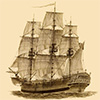 George The Third (generic)
References
| Primary Source | Australian Joint Copying Project. Microfilm Roll 90, Class and Piece Number HO11/9, Page Number 488 |
| Source Description | This record is one of the entries in the British convict transportation registers 1787-1867 database compiled by State Library of Queensland from British Home Office (HO) records which are available on microfilm as part of the Australian Joint Copying Pro |
| Original Source | Great Britain. Home Office |
| Compiled By | State Library of Queensland |
| Database Source | British convict transportation registers 1787-1867 database |
Claims
No one has claimed William Yeates yet.
Photos
No photos have been added for William Yeates.
Convict Notes
Extract from Home Office transportation registers (The National Archives microfilm HO11): William Yeaks; Buckinghamshire Assizes; 3-3-1834; Life; Drowned extract from Hobart Mercury: testimonies of prisoners and guards-Robert Hart, a prisoner. I saw the soldiers level their muskets against the prisoners, and one shot was fired, I saw one man, Robert Luker, fall. I am persuaded from the effects of the shot. I did not see him afterwards. I heard a second shot fired about 10 minutes afterwards, but I did not see it take effect. At the time the shot was fired I stood about two yards behind the soldiers. I was about 8 or 9 feet from Luker when I saw him fall. -James McKay, a prisoner. When we were trying to get out 2 or 3 shots were fired, a man fell about two feet from me that was shot. To the best of my knowledge it was Wm. Yates who fell. I also saw another man fall, but I do not know his name. James Elliot was standing beside me at the time. I heard Corporal Deverell call for more assistance. There was about 5 minutes between the time the first man fell and the second. There were a great many men in the hatchway and on the ladder at the time. I succeeded in getting on deck. -James Elliott, a prisoner. I was in the hatchway several minutes before I could get up. The soldiers kept me down and threatened to fire; I heard two shots fired: the first shot killed Robert Luker, and about 3 or 4 minutes after another shot was fired, and I saw another man fall. When I was knocked down from the hatchway I fell upon the body of R. Luker. I am quite sure that two prisoners were shot in the hatchway. -Henry Matson, 1st officer. If the prisoners had not been kept below, and the launch had not been kept clear by the exertions of the military and a portion of the convicts then on deck, the boat must have been swamped and all hands have perished. Had the accident happened in the daytime, when the greater part of the prisoners are usually on deck, the mortality must have been much greater. This was my opinion at the time when I expected the ship to go to pieces. I heard some shots fired, and that a a man had been killed, but I do not know by whom. -John Charles M. Poore, 2d officer.- I was part owner of the George III. I am satisfied that every thing was done to ascertain the position of the ship and that she was not lost by any inattention or ignorance on the part of the master. I heard shots fired and was afterwards told that a prisoner had been shot. I am of opinion that the measure of keeping the convicts below was absolutely necessary for the safety of all on board.