Summary
Personal Information
Crime
Voyage
Transportation
Thomas Alford was transported on the Atlantic, departing 24th Mar 1791 and arriving 20th Aug 1791 with 24 passengers.
Part of the Third Fleet. 220 male convicts.
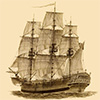 Atlantic (generic)
References
| Primary Source | Hunter Valley convicts/ passengers arriving on the Atlantic in 1791 1. Historical Records of Australia, Vol.1, p225 2. An Account of the English Colony in New South Wales: ... By David Collins, Philip Gidley King, George Bass 3. The London Times 21st March 1791 4. The London Times 28 March 1791 |
Claims
No one has claimed Thomas Alford yet.
Photos
No photos have been added for Thomas Alford.
Convict Notes


The Naval Agent on board was Lieutenant Richard Bowen, and the surgeon was James Thompson.
Atlantic's Captain: Archibald Armstrong
One of 220 convicts on third fleet, Thomas Alford who had been tried in Somerset was transported in the Atlantic. He leased a farm at Farm Cove. In 1814 he applied to Governor Macquarie to have his wife Mary Alford join him in New South Wales, however Thomas returned to England on the Kangaroo in 1817: "Governor Macquarie to Under Secretary Goulburn. Sydney, N. S. Wales, 17th May, 1814. Sir, Thomas Alford, an Old and very faithful Servant to Government, who has been for upwards of Twenty five years in this Colony, the greater part of which time he had served as Head Government Gardener to the entire Satisfaction of every successive Governor, having determined to pass the remainder of his days in this country, is particularly desirous to have his wife (who is still alive in England) and any of his family who Request for free may be willing to accompany her, sent out to join him, provided it could be done without any expense, which he is unable to defray. I have therefore to request you will be so good as to move Lord Bathurst to have the Goodness to order a Passage to be found for Thomas Alford's Wife and such of her family, as may wish to accompany her, at the expense of the Government on board of one of the first Convict Ships from England to this Colony. The following is Mrs. Alford's Address, viz. Mary Alford, Curry Rivle, near Taunton, Somersetshire, England. I also enclose a letter from her Husband for her, which I take the liberty to request you will have the goodness to forward, and shall esteem it a favour if you will be so good as to give the necessary facility to the request contained in his Letter - HRA, Series 1, Vol. VIII, p. 252." On 17th March 1791 at twelve o'clock, two of the transport ships from Portsmouth appeared off the harbour at Plymouth and made a signal to the Atlantic, Salamander and William and Anne vessels lying in Cawsand Bay; on which they weighed anchor, and got under sail immediately. (3) The London Times reported on the 24 March that the Atlantic, Salamander and William and Ann transports with convicts for Botany Bay, put to sea (again) from Plymouth on the evening of the 23rd, and it was hoped would now get out of the Channel and make a safe passage The Atlantic anchored at Sydney Cove about midday on 20th August 1791, a voyage of 146 days. Also on board was a sergeant and seventeen privates and provisions. From An Account of the English Colony in New South Wales....On the 20th, the Atlantic transport anchored in the cove from Plymouth, whence she sailed with two other transports; from whom she had parted five weeks since in bad weather between Rio de Janeiro and Port Jackson, the passage from which had not been more than ten weeks. She had on board a serjeant's party of the new corps as a guard to two hundred and twenty male convicts, eighteen of whom had died on the passage: except nine who were sick, the remainder were very healthy. The evening before her arrival she stood into a capacious bay, situated between Long Nose and Cape St. George, where they found good anchorage and deep water. The naval agent on board, who landed, described the soil to be sandy, and the country thickly covered with timber. He did not see any natives, but found a canoe upon the beach, whose owners perhaps were not far off. The Atlantic left Port Jackson bound for Bengal on 26th October 1791.