
Summary
Personal Information
Transportation
William Chevins was transported on the Nile, departing 18th Sep 1857 and arriving 1st Jan 1858 with 271 passengers.
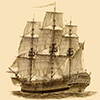 Nile (generic)
References
| Primary Source | Australian Joint Copying Project. Microfilm Roll 93, Class and Piece Number HO11/18, Page Number 242. --00-- Western Australia Convicts, at http://www.perthdps.com/convicts/w4572.htm |
| Source Description | This record is one of the entries in the British convict transportation registers 1787-1867 database compiled by State Library of Queensland from British Home Office (HO) records which are available on microfilm as part of the Australian Joint Copying Pro |
| Original Source | Great Britain. Home Office |
| Compiled By | State Library of Queensland |
| Database Source | British convict transportation registers 1787-1867 database |
Claims
No one has claimed William Chevins yet.
Photos
No photos have been added for William Chevins.
Convict Notes

IN WA: From his Fremantle jail record: CHEVINS, William; inmate #4573, arrived 1 Jan 1858 per Nile Date of Birth: 1819 Date of Death: 4 Sep 1862 Place of Death: Accidentally shot [Note: No further documentation has been found to verify this.] Marital Status: Married 4 children Occupation: Sawyer Literacy: Illiterate Sentence Place: Nottingham, Nottingham, England Crime: Highway robbery with violence Sentence Period: 15 years Ticket of Leave Date: 18 Feb 1860 (https://fremantleprison.com.au/). --00--
From the 'News of the World', March 23, 1856: "MIDLAND CIRCUIT NOTTINGHAM.- DARING HIGHWAY ROBBERY AT UPTON John Coggle, alias Cougill, 39, tailor; William Chevins, 35, sawyer; and John Watts, 30, labourer, pleaded not guilty to having, after a previous conviction, feloniously assaulted Arthur Trace Black, at Upton, on 4th of December, putting him in bodily fear and danger of his life, and stealing from his person a sovereign, a lancet-case containing four lancets, and a silk pocket handkerchief. The prosecutor, a surgeon, living at Tuxford said: On the 4th Dec., I had occasion to attend a patient at the Nag’s Head at Upton. I left Upton to return home a little before seven o’clock. I rode upon a pony, and a gentleman named Bourne rode by my side part of the way. We parted company before arriving at Askham, and I rode on before him. About two or three minutes after leaving Mr. Bourne, my pony shied, and directly afterwards the rein was checked, and I fell forward upon the pony’s neck. I then received a blow on the left shoulder, which came in contact with my hat and knocked it off. I instantly rose upon the saddle again, and received a blow on the small of my back. The second blow partially knocked me off my pony, and I felt sick. I did not see any person at that time. I was then seized by a tall man, who with the assistance of another man, dragged me to the ground. The tall man had on a cap. The other had a kind of glazed hat on. The tall man placed his hand across my throat and held me down. The other lay or sat across my legs, and a third person came up to me and unbuttoned my coat. This man also struck the pony, and it galloped away, and he afterwards unbuttoned my coat and rifled my pockets of the articles mentioned in the indictment. I could not raise an alarm because I was stifled. Mr. Bourne came up to me after the men left. I lost also my hat. Upton is about four or five hundred yards from the place where I was robbed. I found my pony about a quarter of a mile from this place. I afterwards went on to Tuxford, and gave information of the robbery. On the following Tuesday I saw the prisoners in custody at Retford. From the general appearance of the prisoners, I believe them to be the men who robbed me, but I will not swear positively to that. William Bourne said; Mr. Black left me and rode forward, and soon afterwards I heard a scuffle in the road. I afterwards came up with Mr. Black, and found him upon the ground. I saw three men, two of whom had hold of him, and the third was a little distance off. I got off my horse, and went up to the men to assist Mr Black. I knew the man Coggle by sight. He was one of the men against Mr. Black. Coggle was holding the prosecutor. He had on dark clothes and I believe a cap. Chevins, I believe, held the horse. Watts was also there, and I believe that he was assisting Coggle. When I approached all he prisoners ran away. I however, saw the features of Coggle and Watts distinctly. I saw Chevins, but was not so near to him. I am not certain as to his being one, but I believe him to be one. I speak with certainty in regard to Coggle and Watts. A few days afterwards I saw the prisoners at Retford station. The prisoners Coggle and Watts in their statement before the magistrates, admitted being out on the night in question in Company with Chevins on a poaching excursion. Watts stated also that he had shot a pheasant. The Jury returned a verdict of Guilty against all the prisoners. A previous conviction of highway robbery was proved against Coggle; of robbery from a dovecote against Chevins; and of a similar offence against Watts; and they were sentenced -- Coggle to transportation for life, and Chevins and Watts to 15 years transportation each." (Western Australia Convicts, at http://www.perthdps.com/convicts/w4572.htm)
TRIAL: 13 March, 1856: Nottingham Assizes -- William CHEVINS, John COGGLE and John WATTS were found guilty of highway robbery with violence after previous convictions; CHEVINS was sentenced to 15 years' transportation (England & Wales, Criminal Registers, 1791-1892; England; Nottinghamshire; 1856). --00--