
Summary
Personal Information
Voyage
Transportation
Michael Downing was transported on the Calcutta, departing 19th Apr 1837 and arriving 5th Aug 1837 with 342 passengers.
HMS Calcutta was the East Indiaman Warley (1795), converted to a Royal Navy ship. This ship of the line served for a time as an armed transport. She also transported convicts to Australia. The French Magnanime captured Calcutta in 1805. In 1809, after she ran aground during the Battle of the Basque Roads and her crew had abandoned her, a British boarding party burned her. In 1803 the Calcutta sailed into Port Phillip bay where at least 4 convicts escaped , in Sydney in April 1804 it was reported that 8 had died on the trip. Of the four known escapees one was shot on escape, 2 turned back after 2 days to reattach to the group at the camp in bay before the boat left , one continued on ...into Australia's history books. At least 13 convicts were transferred on to Van Diemen's Land (Tasmania), Australia.The ship also carried officers, wives and free settlers.
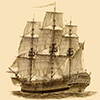 Calcutta (generic)
References
| Primary Source | Irish Convict Database, by Peter Mayberry. |
Claims
No one has claimed Michael Downing yet.
Photos
No photos have been added for Michael Downing.
Convict Notes

WATERFORD ASSIZES. RULE OF COURT. COUNTY COURT. John Crotty,... Michael Downing, .., and Maurice Millea, convicted of sheep stealing; ... Waterford Chronicle, 11 March 1837. Michael Downing was then placed at the bar, charged with having stolen two sheep, the property Thomas Pope Hobuat, of Foxhole, in the borders of the county Cork and Waterford. He was found guilty, and although the prosecutor gave him an excellent character, His Lordship said that the law gave him but one course to pursue; the prisoner had been found guilty, should sentence him to be transported for life. Waterford Mail, 11 March 1837. Saturday evening a large concourse of persons assembled opposite the Post-office, to witness the departure for Dublin, on route to Botany Bay, of the convicts left in our county gaol at the last assizes for transportation. Five convicts, namely, John Crotty, Michael Downing, Thomas Callaghan, Laurence Geary, and Maurice Meally, escorted by a guard of police and the governor of the gaol made their appearance shortly before six o’clock and popular curiosity was so great see them, that the police had to use their utmost vigilance to keep the crowd from too near an approach. The coach having arrived, two of the convicts were placed inside it and three outside, all heavily chained as to render escape improbable. Mr. Ryan, the governor, proceeded alone with them to Dublin and gave up his charge on Sunday morning to Mr. Dunn, the governor of the Kilmainham prison, whence, they were transmitted to the Calcutta transport ship, at present lying in Kingstown harbour, awaiting orders to proceed to New South Wales. We must say that this a great improvement in the manner of sending convicts to the transports, as it does away with the parade, expense, and endangering circumstances of cavalry and infantry escort through the country. Its expedition too is much to be lauded. It took, we believe, three days to send so many men to Cork before this, whereas, now, they are sent in one night, nearly twice the distance, and at nearly one-eighth the expense to the country. Waterford Chronicle, 15 April 1837.
Irish Convict Database, by Peter Mayberry. Michael Downing, alias Dowling, age on arrival, 24, per Calcutta II, 1837. Tried at Waterford, 1837, Life for Felony. DOB, 1813, native place, Cork Co. Single. Catholic. Servant indoor.