
Summary
Personal Information
Crime
Voyage
Transportation
Andrew Duff was transported on the Runnymede , departing 11th Nov 1839 and arriving 28th Mar 1840 with 201 passengers.
The original 'Runnymede' was built in London 1825, 389 tons. Sailing of this ship to Australia with convict transportees, including boy convicts 1839/1840 to Van Diemen's Land. (It appears this ship made other sailings to Australia, as a barque with immigrant passengers.) This Runnymede was wrecked near the Andaman Islands in the Bay of Bengal in 1844. n.b. There is another 'Runnymede' ship. Built in Sunderland in 1854, the 720 ton ship Runnymede II - embarked 248 male convicts at Plymouth on 15 June 1856, landing all in Western Australia on 7 September, after a passage of 84 days - the sailing also had soldier families for settlement there. A 284 ton barque Runneymede of Hobart was wrecked at Frenchman's Bay, on 24 December 1878.
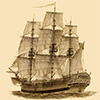 Runnymede (generic)
References
| Primary Source | Australian Joint Copying Project. Microfilm Roll 91, Class and Piece Number HO11/12, Page Number 120 |
| Source Description | This record is one of the entries in the British convict transportation registers 1787-1867 database compiled by State Library of Queensland from British Home Office (HO) records which are available on microfilm as part of the Australian Joint Copying Pro |
| Original Source | Great Britain. Home Office |
| Compiled By | State Library of Queensland |
| Database Source | British convict transportation registers 1787-1867 database |
Claims
No one has claimed Andrew Duff yet.
Photos
No photos have been added for Andrew Duff.
Convict Notes

SEIZURE OF THE LADY FRANKLIN. Intelligence has reached town this morning of the seizure of the Government barque Lady Franklin by a party of convicts headed by Quinn, Twitty, and Brewer, who were on their way to Norfolk Island pursuant to the sentences passed upon them at the Supreme Court. It appears that the vessel was seized on the night of the 28th December, Captain Willett having been suddenly awakened and overpowered by the prisoners, who had broken out of the hold. The prisoners obtained complete mastery of the vessel. Three of the crew were employed in working her, the master and mate being confined in the cabin. On the 8th January the convicts ordered the crew to launch the long-boat and cutter, both of which were fully laden with provisions. They embarked, having previously confined the master and crew and leaving a man at the maintop to liberate them when they made a signal from the boat, and threatened to shoot him if he descended before the signal was made. The desperadoes also cut the sails of the vessel and part of the rigging, so as to disable her from making any effective pursuit. After a fruitless attempt to reach Norfolk Island, Captain Willett made sail for Van Diemen's Land, and arrived in Spring Bay on Wednesday last. Captain Willett received several wounds in attempting to overpower the prisoners, but is now recovering from their effects. There was a non-commissioned officer's guard on board, who from the circumstances do not appear to have behaved very gallantly upon the occasion. The following are the names of the prisoners who were placed onboard on the 16th ultimo: James Quinn, Sir Robert Peel Charles Brewer, Lord Lyndoch (2) John Twitty, Gilmore (3) Thomas Williams, Lord Auckland Patrick Hickey, British Sovereign Andrew Duff, Runnymede Denis Griffiths, British Sovereign James Ford, Maitland Joseph McKenzie, Moffat (3) James Neal, Lady Kennaway (2) Robert McKinlay, Louisa Richard Walton, Elphinstone (3) Thomas Brown, Surrey Edward Dowdell, Orator Robert Mitchell, Pestongee Bomangec (2) John Meek, Orator James Clegg, Egyptian (2) Joseph Davis, Castor Thomas Clayton, Governor Phillip Joseph Cooper, Anson John Sullivan, Moffatt (3) James Merry, Forfarshire. … (The Courier (Hobart) 27 Jan 1854 p. 2.)