
Summary
Personal Information
Crime
Transportation
John Ferguson was transported on the Nile, departing 18th Sep 1857 and arriving 1st Jan 1858 with 271 passengers.
 Nile (generic)
References
| Primary Source | Australian Joint Copying Project. Microfilm Roll 93, Class and Piece Number HO11/18, Page Number 237 (120). Edgar, W. (Bill). (2018). “The precarious voyage of her majesty’s convict ship ‘Nile’ to the Swan River colony, late 1857 – and the unexpected aftermath.” The Great Circle, 40(1), 20–43. https://www.jstor.org/stable/26783779. Western Australia, Australia, Convict Records, 1846-1930; Convict Department, Registers; Convicts Transported Per Nile (R32). |
| Source Description | This record is one of the entries in the British convict transportation registers 1787-1867 database compiled by State Library of Queensland from British Home Office (HO) records which are available on microfilm as part of the Australian Joint Copying Pro |
| Original Source | Great Britain. Home Office |
| Compiled By | State Library of Queensland |
| Database Source | British convict transportation registers 1787-1867 database |
Claims
No one has claimed John Ferguson yet.
Photos
No photos have been added for John Ferguson.
Convict Notes


From the 'Weekly Dispatch', January 27, 1856: 'MURDER AND ATTEMPTED SUICIDE IN LIVERPOOL On Monday morning, about half-past 6 o’clock, an atrocious murder was committed in Wolfe Street, Toxteth Park, by a man named John Williams, alias John Ferguson, alias John Fake, and his victim being a woman named Sarah Drummond. The prisoner, whose real name is said to be John Ferguson, and who has been long known to the police as a thief and the associate of thieves, went that morning, at a few minutes past 6 o’clock, along with the female, to the Ruthin Castle public-house, in Prince William Street, where they had some ale and went away. In about 10 minutes afterwards the prisoner returned, and said to a man named Thomas, “I’ve cut your wife’s - throat;” an assertion which, in the sequel, proved only too true. It appears that Ferguson has cohabited with the woman Drummond for the last 12 months or better, and that prior to her going to live with the prisoner, in whose mother’s house they both resided, she had lived with the man Thomas, by whom she had two children. After leaving the Ruthin Castle, public-house, they went to the prisoner’s mother’s where they had some slight altercation when the prisoner suddenly drew a knife across the woman’s throat, inflicting so frightful a wound as to occasion her death in a few minutes. The mother of the prisoner states that when her son and the deceased came in she was in bed and heard some angry words between them, when she suddenly heard the deceased utter a gargling sort of sound, as if something was in her mouth, and the prisoner said, “Come, now Sal, I’ll take thee to the hospital,” and they both left the house. On getting up the mother saw a large track of blood on the floor and over the threshold of the house No 87, Prince William Street, where she lived. Thomas Ryecroft, who resides in Edward Street, off Wolfe Street, heard a woman shriek about half past 6 that morning, and, going in the direction indicated by the sound, he found the deceased lying in the footway, with her throat cut, and blood flowing profusely from the wound. Police-Inspector Creston had his attentions called to a cry of murder in Wolfe Street, and on going forward found the deceased lying on the footway, and quite dead. McCulloch, the detective officer, after a considerable search, discovered, on a dust heap, a clasp pocket-knife, which was afterwards identified as belonging to the prisoner. It was completely covered with blood, and no doubt can be entertained that this was the instrument with which the fatal wound was inflicted. The murderer was secured immediately on his stating to the man Thomas that he had cut the poor woman’s throat. After he had been conveyed to Bridewell it was discovered that the prisoner had endeavoured to commit suicide by cutting his own throat, and that in his attempt to do so he had inflicted a considerable, though not a dangerous, wound on the right side of his neck. He is a dirty, insignificant-looking wretch, of very low stature and forbidding aspect, and presents altogether a contemptible appearance. As already stated, he is well known to the police as a person of very bad character, and it is believed that the immediate cause of quarrel between him and his wretched victim was an opinion which he entertained that she had betrayed some of his companions into the hands of the police. Three of these companions, named respectively Thomas Garnett, John McBryde and Robert Roberts, the two first named being ticket-of-leave men, were that morning committed for trial on a charge of consequence of information given by the deceased. One of the female companions of the deceased stated distinctly that several days since Drummond said to the prisoner, in her hearing, that she would have “them snitched soon.” To which the prisoner replied, “If she did he would cut her throat.”' (http://www.perthdps.com/convicts/w4549.htm)
FOOTNOTE: Newspapers reports of the John Ferguson case: From the 'News of the World', January 27, 1856, p.3: 'FRIGHTFUL MURDER IN LIVERPOOL Another has been added to the already long list of murders reported since the commencement of the present year. The scene of the murder about to be recorded is Prince William Street, Toxteth Park, Liverpool, the victim’s name Sally Drummond, and the name of the murderer Johnny Williams, alias Jack, a character well known to the police and one of the most desperate in town. It appears that the unfortunate woman lived with Williams some time since, but had latterly been cohabiting with another party, by whom she had a child. On Sunday night Williams, deceased and her paramour were drinking together at the house where the latter resided, and remained there drinking until morning. None of the party were much intoxicated, but about six o’clock a quarrel arose between Williams and the deceased, in consequence of Williams having charged her with having stolen a jacket belonging to him. After some altercation, Williams threatened to cut her throat, and Drummond having dared him to do so, he seized her by the hair and drew the blade of a clasp knife across her throat, from the effects of which she shortly afterwards expired. Williams, upon being arrested, made a desperate attempt upon his life, and owing to his violence, had to be put in irons in Bridewell. The Liverpool Post gives the following additional particulars:- The murderer’s name is John Ferguson, but he was more familiarly known in certain quarters by the not very euphonious sobriquet of “Old Faik,” notwithstanding he was not more than 23 years of age. The prisoner was a first cousin to the murdered woman, whose name was Sally Drummond, and who was about 28 years of age. She is described as a fine, well-looking person, with light wavy hair and light complexion. She went to reside with the prisoner’s mother, Mrs Williams, in Prince William Street, when the latter took a house hear the cellar she had formerly occupied; and there went there to lodge a young man named Jack Thomas, blacksmith. The prisoner also resided there. An intimacy sprang up between the deceased and Jack Thomas, which resulted in the birth of two or three children, all of whom, however, died. Shortly after this there was a quarrel between Thomas and the deceased, in consequence of a jealous feeling, the result of the murdered woman having been upon too intimate terms with her murderer. Thomas consequently abandoned her, and Faik and the deceased subsequently lived together as ‘husband and wife’ in the house of the former’s mother, by and with the latter’s knowledge and consent. One child was the result, and the deceased, at the time of her unhappy and miserable end, was far advanced in pregnancy. On Sunday last the deceased again fell in with her former paramour, somewhere in the neighbourhood of Wolfe Street, where she was in company with a girl named Mary Loftus, and who lodged in the same house. They all three proceeded together into Hill Street. This appears to have been between four and five o’clock on Monday morning. The girl Loftus then said to the man Thomas, “Here is! Pug, won’t you treat her to a glass?” Thomas said that he had a shilling, and no objection. They then proceeded into a vault that had just been opened, and, after paying for what was ordered, fourpence change was placed upon the counter, which the deceased took up, and handed to “Faik” (who appears to have been just outside the door), adding that “if Jack has got any more money, you shall have it by-and-by.” The deceased and Thomas then left the vaults together, retired to a house in the vicinity, and the latter took off his jacket, which the deceased at once conveyed to “Faik,” for purpose of pledging, apparently by a preconcerted plan, for he was outside waiting. What took place from that period up to between six and seven o’clock, we don’t know; about that time, however, the murderer, the murdered, and another female named Ann Hughes, went into Harding’s vaults, corner of Wolfe Street, where more drink was obtained. There, some words occurred between the deceased and “Faik.” Some reference was then made to the coat which the deceased had handed to the murderer to pledge. After this, the party called for and were supplied with half-a-gallon of ale, for which he paid, borrowing a jug, left 4d as a deposit, and took her beer out of the premises. Shortly afterwards a man returned the jug, and spent the 4d deposit. The females again returned. Another quarrel ensued in reference to “Jack Thomas,” and his jacked, when the murderer threatened to know deceased’s eye out. The assistant at the vaults, William Hurt, said that he could not permit quarrelling, or the use of such language, and requested the party to leave the house, which they did. This was near seven o’clock. Not many minutes after they left, the murderer returned to the vaults, and said very coolly to the assistant, “I’ve done it.” “Done what?” interrogated Mr Hunt. “Done what? Why, cut her throat.” “Is that a fact?” asked the assistant. The fellow replied, “It is a fact - if it ain’t, I’ll pull out my two eyes.” The murderer again went out in a most excited state, and was shortly after taken into custody. It would appear that on being turned out of Harding’s vaults (the ‘Ruthin Castle’), the murderer took from his pocket a large spring knife, the blade of which was very sharp, rushed upon the unfortunate creature, and cut her throat from ear to ear. She ran a distance of some hundred yards into Wolfe Street, with her hands to the gash, the blood flowing copiously, and the assassin looking on with apparent composure. The woman fell - the villain ran towards her, and asked if he should place a handkerchief to the wound. The victim, unable to speak, motioned acquiescence. He had no handkerchief at hand, and he left her, it is supposed for the purpose of procuring one, but, instead, he returned to the vaults, as above stated. The accused was brought up in custody, before Mr. Maxwell, the presiding police magistrate. The court was densely thronged, and great anxiety was manifested to catch a glimpse of the prisoner. He is a young man about twenty-two years of age, about five feet two inches in height, and very insignificant in appearance. He was attired in a thick beaver overcoat, held his head down, and appeared so weak as scarcely to be able to walk. He did not utter a syllable. Inspector Kehoe said it was more than suspected that the murder had arisen partly out of the circumstance in connection with the burglary that had taken place in the park at an early hour on Sunday morning - that the murdered girl also knew of it, and had threatened to “snitch” (inform) - The prisoner was led out of the court to the Bridewell in custody of Detective Carlysle. On passing through the outside court, the crowd rushed to get a glimpse of the prisoner. Some person cried out “Well, Faik, what have you got?” The prisoner replied, in a loud voice, and with great bravado “Oh, I’ll be sent to trial at the assizes tomorrow. To - with them all. I only want to die. Keep your ears, all of you.”'
THE VOYAGE: John Ferguson’s behaviour during the voyage was “very bad”, according to his WA Convict record. He was flogged, receiving 24 lashes; and listed as "incorrigible" (Western Australia, Australia, Convict Records, 1846-1930; Convict Department, Registers; Character Book for Nos 4508-5585 (R8)). What prompted this punishment? Although a requirement, no journal/full report of the voyage from the ship’s Surgeon Superintendent has ever been located, according to Bill Edgar (2018) whose research fills in some blanks. Around two-thirds of the Nile’s 268 convicts could be considered “serious criminals” by virtue of the violence of their crimes, or their recidivism or both. A point that wasn’t lost on the ship’s crew or warders. Edgar (2018) says between the starting point of the Nile’s voyage at the head of the Thames at Sheerness and her arrival at Plymouth a week or so later to take on prisoners from Dartmoor, two warders “having seen the potential for trouble… decided to refuse duties they could clearly perceive as very dangerous”. They left the ship. Between the Nile’s departure from Plymouth, on 23 September, and her arrival just over 4 weeks later at Bahia (in Brazil), a “litany of frightening incidences took place aboard”. Fearing a mutiny, the captain had nine convicts placed in chains “where they were to stay for the remainder of the voyage”. There was no mutiny. Edgar writes, however: “It had been a near run thing. The prospect of a mutiny had been very real.” Despite the Nile’s arrival off WA late on the night of 31 December, 1857, the bulk of the prisoners were not disembarked for five days. Twelve men were unloaded on 2 January – three bound for hospital and nine who went in chains to Fremantle prison. The latter were the “failed mutineers”, listed as men of “bad character” by the ship’s Surgeon Superintendent in a letter to the Lords Commissioners of the Admiralty (Edgar, pp24-25, 27). They were: George Foxton (alias Thompson), John Turnbull, James H Jones, John Cirans (Ceirans), Thomas Ward, Patrick McBride, Michael Henry, John Ferguson, and George Woodcock (the possessor of at least seven aliases by this time). --00--
10 September, 1857: He was sent from Portland to the Nile for transportation to WA, listed as #42/6889 (Western Australia, Australia, Convict Records, 1846-1930; Convict Department, Registers; Convicts Transported Per Nile (R32)). --00--
18 March, 1857: He was admitted to Portland jail in Grove Road. Portland, Portsmouth, Chatham and Spike Island in Ireland were listed public works stations and the second stage in the penal process. After separate confinement, prisoners were “placed on work parties at various locations, most commonly naval stations, where maintenance of facilities was vital for the effective protection of Britain’s far flung commercial and military influences around the world. While there, attitude and behaviour were monitored closely. In theory, only after consistently positive reports was a prisoner moved on to the third stage of his incarceration—transportation.” (Edgar, p40) At Portland, John Ferguson was inmate #6889, 23 [his age when convicted], a labourer, single, reads only, CofE; convicted for manslaughter; two previous convictions, 17 summary offences "and imprisoned at Liverpool Boro Gaol from Jan 1847 to August 1854". Next of kin — his mother, Maria Ferguson of 17 Prince William Street, Toxteth Park, Liverpool. His health was "good" (UK, Prison Commission Records, 1770-1951; Portland Prison; Registers of Prisoners to 1875). --0--
19 June, 1856: Then followed 8 months 27 days in separate confinement at Leicester (Leicester County Gaol and House of Correction). “After a sentence of transportation was handed down, the prisoner entered into a separate stage where he was placed into an individual cell, isolated from others, apart from brief periods of exercise and attendance at chapel. However, no communication of any kind with other prisoners was permitted at any time. The philosophy behind this penal methodology had its provenances in the religious, monastic traditions; i.e., that in the isolation of his cell the malefactor would be able to contemplate the errors of his way, unadulterated by the negative influences of former contemporaries, and be reformed.” (Edgar, 2018, pp39-40) When first put into practice, the mandated period of separate confinement was 18 months. By the late 1840s, authorities had conceded that such conditions of imprisonment were “injurious to many prisoners’ mental health” and the stint was reduced to 12 months. Periods of separate confinement were reduced further “as a prisoner displayed good behaviour tendencies” (Edgar, p40). --0--
JAILS: January - June, 1856: John Ferguson was held at Kirkdale (Old Swan Police Station and Lock Up House) for five months. --0-- --00--
TRIAL: At his trial on 2 April, 1856 (the Spring Assizes at Liverpool started on 22 February which is often given, incorrectly, as his trial date), "the case for the Crown turning into one of manslaughter, the prisoner was sentenced to transportation for life" (Liverpool Daily Post, same date, p4). --0--
FOOTNOTE: According to various newspapers reports of the murder of Sarah Drummond, at Toxteth Park on 21 January, 1856, John Ferguson had at least three aliases: John Williams (although some papers said this was the name of her former lover), John Fake (irony?) and John Fagan. Sarah died violently -- her throat cut with a knife allegedly wielded by a drunk John Ferguson who, according to one report, then tried to kill himself. She was said to be his mother's cousin (Carlow Post, 21 April), known to "imbibe in intoxicants" and was reportedly in a relationship with Ferguson who was living with her. The case attracted much attention, with hundreds of words devoted to his character. The Northern Daily Times (23 January) reported, "John Ferguson, who is 23 years of age ...has, from his earliest infancy, led a most disreputable life." The Bolton Chronicle (26 January) called him "a notorious burglar" who had committed "one of the most coldblooded murders it has ever been our duty to record". Following the Coroner's inquest, and his committal to stand trial for wilful murder, the Morning Herald's (25 January) reporter reckoned, "The prisoner is a miserable-looking, undersized man." --0--
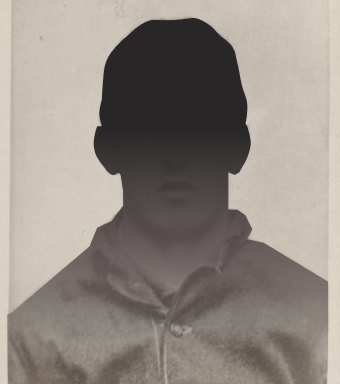
John Ferguson was Convict No. 4549. John was 24 years old, single, illiterate, protestant, 5'1 1/4" tall, dark brown hair, hazel eyes, healthy build, broken joint 2nd finger left hand, 11 blue dots on right hand, S.R. on right arm, cut on left temple, 11 dots left hand and H. 2nd finger left hand. 4/12/1862: TOL 14/5/1867: CP at Champion Bay.