
Summary
Personal Information
Voyage
Transportation
Patrick Keefe was transported on the Phoebe Dunbar, departing 2nd Jun 1853 and arriving 30th Aug 1853 with 37 passengers.
704 ton ship built at Sunderland in 1850. 1853 voyage: Kingston, Ireland direct to the Swan River, Western Australia - 89 days (8 deaths at sea, 2 at harbour). Also on this voyage were 93 pensioner guards and their families. Convicts transported are currently being listed (not yet complete).
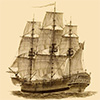 Phoebe Dunbar (generic)
References
| Primary Source | Western Australia convicts. --0-- Ireland, Prison Registers, 1790-1924 for Patrick Keefe; Dublin; Newgate; 1849-1858. --0-- https://nla.gov.au/nla.obj-2308603007/view --0-- https://waconvicts.fhwa.org.au/g0/p102.htm#i2545 |
Claims
"Jacqui Graham - WACC Phoebe Dunbar Project"

Photos
No photos have been added for Patrick Keefe.
Convict Notes

NOTE: Year of Birth is taken from official records but day and month are not known. The latter dates have been entered as 01/01 because the site does not allow those fields to be left empty.
From the Register of Convicts on Convict Ships: Patrick Keeffe [sic], 18, died 6 August, 1853, from “fracture of skull by a fall”, at sea (https://nla.gov.au/nla.obj-2308603007/view). --000--
OTHER RECORDS: Patrick Keefe Birth: 1833 Death: 6 August 1853 at sea; on voyage to WA. Convicted: Cattle stealing and sentenced to 7 years on 22 January, 1849, at County Wexford, Ireland. He had been convicted previously. Literacy: Literate Family Status: Unmarried Occupation: Shoemaker Transported: To WA on the Phoebe Dunbar leaving from Kingston, County Dublin, Ireland, on 2 June, 1853. He had been collected from Ireland prison. He died on the journey. Convict No.: 2545, assigned on 2 June 1853 (https://waconvicts.fhwa.org.au/g0/p102.htm#i2545). --0--
MEDICAL RECORD: The journal of the Phoebe Dunbar’s medical officer, John W Bowler, shows that PATRICK KEEFE died at sea two days after fracturing his skull: Folios 27-28: Robert Kieffe [sic], aged 18, prisoner; case number 13; disease or hurt, fractura. Put on sick list, 6 August 1853. Died 8 August 1853 (https://discovery.nationalarchives.gov.uk/details/r/C11542199). --00--
ABOUT THE DREADFUL VOYAGE: By Weaver, P (2004) at https://fremantlebiz.livejournal.com/37766.html “Part 1. Irish prisoners for Western Australia on Phoebe Dunbar & Robert Small in 1853 This is the first part in series of eight which were extracted from a public talk which I gave at the Old Fremantle Prison celebrations in June 2000: On 30 August 1853 the 704 ton hired British convict ship Phoebe Dunbar hove-to in Owen’s Anchorage off Fremantle, Western Australia. On board was a consignment of 286 mostly Irish convicts and 29 British pensioner guards with their families, numbering 21 women and 42 children. A few days earlier on 19 August a similar sized consignment of Irish prisoners and British guards had arrived at Fremantle on board another hired convict ship, the Robert Small. Robert Small lost nine convicts and the figure would have been higher had it not been forced to put into Rio de Janeiro to off-load 150 tons of putrefied ballast, a black peat-like mixture of sand and Dutch clay. A medical board of enquiry convened at Fremantle laid most of the blame on the ballast, ‘...the smell of which was most offensive and likely to prove a fertile source of disease.’ However, had the leaky ship not inadvertently stopped off in South America where fruit and vegetables were purchased the death toll probably would have been much higher than nine. Surgeon Superintendent Harvey Morris - doctor on at least three other convict shipments to Norfolk Island and Van Diemen’s Land (Tasmania) had by his own admission deliberately falsified his records by registering only one third of those who came to him sick. His intention, as he wrote in his shipboard journal, was to instil in the prisoners a false sense of confidence in his abilities: ‘It is always advisable in a Convict Ship, especially when diseases are numerous, to keep the sick list down, as it is termed, with a view of deceiving the general body as regards the healthiness or unhealthiness of the Ship; and the more effectually to do this it is often necessary to keep the names of some off the list who ought to be there, and to register those of others who have little or nothing the matter with them...’ Those passengers on board the other ship, the Phoebe Dunbar, were not so fortunate, being obliged instead to endure a non-stop, 89 day voyage from Ireland. The ship put to sea from Kingston Harbour on 2 June 1853 and by mid-June an epidemic described only as a ‘fever’ had broken out. Most people including the guards and their families were ill at one time or another, and diarrhoea was common throughout the ship. On the 21 June the first convict, a young man aged 21 died of typhus and by the end of July symptoms of scurvy were appearing in many of the prisoners. Most convict deaths occurred in August as the ship was bearing down on the Western Australian coast. Medicines which were carried on board were in the main ineffective. Although Surgeon Superintendent Bowler subsequently claimed that large doses of mineral acids and quinine were the most effective as remedies, this may have been because they were so repulsive that patients were reluctant to come back for more. Mineral acids as medicine had their origins in the 13th century and included nitric, sulphuric and hydrochloric acid. They were frequently mixed with wine to disguise the vile taste. Bowler was supposed to ensure that lemon juice was distributed about every three days in order to counteract scurvy, but his journal indicates that this did not happen. When this was queried at the enquiry in Fremantle he offered the excuse that the ‘temperance men’ on board would not take lemon juice mixed with wine, and that this was the reason it was not distributed more frequently. He also claimed that the stock of ships biscuit had deteriorated soon after departure and that as a result it could not be distributed to the prisoners. Including civilians, sixteen persons died on the ship en route to Swan River [including Patrick Keefe] or while it was at Owen’s Anchorage off Fremantle. In addition, three more convicts died not long after disembarkation, and eighteen of the Phoebe Dunbar convicts died before their tickets-of-leave had expired.” --00--
EMBARKED ON THE PHOEBE DUNBAR: From the Freeman’s Journal, 3 June, 1853, p 2: “KINGSTOWN. June 3, 1853. -- Wind N.E. by N. This evening the Phoebe Dunbar, convict ship, was towed out of harbour, having on board two hundred and ninety-five convicts, chiefy young men; she took the northerly course, and while I am I now writing (half-past nine p.m.) has cleared the banks. Should the wind remain in the present point she will reach the Tuscar Light on to-morrow evening. Heretofore convicts, when in harbour, were allowed to come on deck in squads, which enabled those remaining below to cleanse deck, &c., but this arrangement, conferring such benefits, has not been resorted to in the Phoebe Dunbar; since she received her human freight they have been stowed between decks. On yesterday I was permitted to visit her interior, accompanied by her commander, seemingly a most humane man, who, I am disposed to think, may have perhaps exercised a sound discretion in deviating from former arrangements -- such a number crowded below must be productive of the worst results. The unfortunate creatures, from their appearance, seemed perfectly resigned to their fate; many of them I observed reading their prayer-books, and now that they have leisure time may, perhaps, be the means for mature reflection and a fixed determination to make amends for their past life. I cannot state whether there is a chaplain in charge.” (https://www.britishnewspaperarchive.co.uk/viewer/bl/0000056/18530603/003/0002) --00--
From “Ireland-Australia transportation database”: Last name: KEEFE First name: PAT Full name: PAT KEEFE Sex: M Age: 16 Trial place: Co. Wexford Trial date: 22/01/1849 Crime desc: Cattle stealing Sentence: Transportation 7 yrs Ship: PHOEBE DUNBAR, 00/06/1855 Document ref1: TR 8, p 175 (https://findingaids.nationalarchives.ie/). --00--
1853, 31 May: He was sent from Newgate to board the Phoebe Dunbar for transportation to WA (Ireland, Prison Registers, 1790-1924 for Patrick Keeffe; Dublin; Newgate; 1849-1858; image 55). NOTE: All of his jail records list his age as 14 years when he was first admitted to jail in 1849. --00--
1853, 8 January: Patrick Keeffe [sic] was admitted again to Newgate Prison, in Dublin; inmate #1246. All details the same as for his previous Newgate and Mountjoy records (Ireland, Prison Registers, 1790-1924 for Patrick Keeffe; Dublin; Newgate; 1849-1858; image 55). --0--
1851, 18 December: Patrick Keefe was sent to Mountjoy Prison in Dublin (Ireland, Prison Registers, 1790-1924 for Patrick Keefe; Dublin; Newgate; 1849-1858; image 37). --0--