
Summary
Personal Information
Voyage
Transportation
Simeon Lord was transported on the Atlantic, departing 24th Mar 1791 and arriving 20th Aug 1791 with 24 passengers.
Part of the Third Fleet. 220 male convicts.
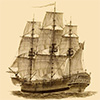 Atlantic (generic)
References
| Primary Source | http://adb.anu.edu.au/biography/lord-simeon-2371 |
Claims
No one has claimed Simeon Lord yet.
Photos
No photos have been added for Simeon Lord.
Convict Notes
Family connections for Simeon (Lord) are: Some amendments added Jun 2025. LORD Simeon (Lord) son of Simeon (Lord) & Ann (???) was born on 28 6 1771 at Dobroyd Yorkshire. He was tried for stealing cloth of Robert (Peel) at Manchester Quarter Sessions in April 1790, sentenced to 7years & arrived in NSW as a convict on 20 8 1791 after a voyage of 5months on Fleet ship ATLANTIC; he was Anglican; he was assigned as servant to Captain Thomas (Rowley) of 102nd Regiment. He apparantly adopted a daughter: why? benevolence? result of relationship?.>>> [Some details taken from this Website] 1.Joanna Henrietta (Short) daughter of Joseph (Short) & Elizabeth (Drury) was born on 29 9 1792 & baptised on 28 12 1792 on Norfolk Island & later adopted by Simeon (Lord). She married at age14 Francis (Williams) marine on 17 11 1806 at St Phillips CofE Sydney. ..Details of Joanna Henrietta (Short)s family are given in entry for Joseph (Short SURPRISE 1790 on this Website. ..Francis (Williams) was born about 1786 & became an officer (ships or military?). After arriving in Australia he became partner of father in law Simeon (Lord), travelling the world to originate trade deals in 1807 & in hat making in 1811. He went to Van Diemens Land (Tasmania) in 1813. .. >>>Simeon (Lord) had a relationship with Mary (Hide her second relationship) from 1805, whom he married on 27 10 1814 (both emancipists) at St Phillips CofE Sydney. He worked as auctioneer, banker, landowner of many acreages including a property named 'Dobroyd', grazier, hat manufacturer, leather goods manufacturer, litigant & perhaps unscrupulous businessman, magistrate, sealer, shipowner, shoe/boot manufacturer-much of this in partnership with Henry (Kable FRIENDSHIP 1788) & James (Underwood ALEXANDER 1791); they also owned the convict ship SYDNEY COVE. He also had involvements with Auxiliary Bible Society, Bank of NSW, Benevolent Society NSW, Waterloo Fund, Sydney College, International Trade. In 1803 he partnered with his step son in law Francis (Williams) in International Trade & in 1811 in hat making. In 1803 he also built a large house near Tank Stream bridge. He died on 29 1 1840 age about68 father of perhaps 9children. Mary (Hide) was born on 1 2 1779. She was tried for stealing clothes of her employer at Warwick Assizes, sentenced to 7years & arrived in NSW as a convict on 18 7 1798 after a voyage of 6months on BRITANNIA. She had a first relationship with John Henry (Black) & produced 2children. She was issued her Absolute Pardon on 7 9 1801. After her husbands death in 1840 she managed the family estate & became a wealthy woman. She died on 1 12 1864 age85 mother of 11children. [Some details taken from this Website] Simeon (Lord) & Mary (Hide) produced 9children: mostly boys 1.Charlotte (Lord) was born in 1805. She may have been the daughter who married an East India Co. agent, Colonel Sir Alexander (Dick). She may have been the daughter who took 'Dobroyd' farm as her dowry. 2.Sarah Ann (Lord) was born on 3 3 1806. She married David (Ramsay) emancipist merchant on 21 3 1825 at home of Simeon (Lord) & recorded at St Phillips CofE Sydney. She may have been the daughter who took 'Dobroyd' farm as her dowry. She died on 28 1 1889 age82. CCONVICTnot found ..David (Ramsay) was born about 1794. He arrived in Australia as a convict in 1820 on SURREY. ..David (Ramsay) is not shown on SURREY on this Website as yet & no SURREY voyage of 1820 is shown. Noted a David (Ramsay) has an entry on this Website - who was tried at Aberdeen Court of Justiciary Scotland, sentenced to 7years & arrived in Van Diemens Land (Tasmania) on 15 12 1821 after a voyage of 7months on CLAUDINE. He, David (Ramsey), was issued his Ticket of Leave no.253? in April 1828. ..Details of David (Ramsay)s family are shown BELOW. ..Sarah Ann (Lord) & David (Ramsay) produced at least 3children: girls ..1.Maria Louisa (Ramsay) was born on 2 1 1826 in Sydney & baptised on 15 1 1826 at Scots Kirk Sydney. ..2.Sarah Elizabeth (Ramsay) was born on 28 9 1827 at Dobroyd & baptised on 30 10 1827 at Scots Kirk Sydney. ..3.Isabella Helen (Ramsay) was born on 15 12 1829 at Dobroyd & baptised on 12 1 1830 at Scots Kirk Sydney. .. 3.Louisa (Lord) was born on 8 7 1808 & baptised on 23 8 1808 at St Phillips CofE Sydney. She may have been the daughter who married an East India Co. agent, Colonel Sir Alexander (Dick). She may have been the daughter who took 'Dobroyd' farm as her dowry. 4.Simeon (Lord) was born on 19 5 1810 & baptised on 19 6 1810 at St Phillips CofE Sydney. He became a Tasmanian and Queensland pastoralist and fathered two members of parliament, the founder of the Victoria Downs stations and a daughter who married a Queensland surveyor-general. 5.Francis Alan (Lord) was born in 1812. He became a legislative councillor in 1843-48, 1856-61 & 1864-92. He died on 2 12 1897 age about85. 6.Edward (Lord) was born on 18 11 1814 & baptised on 11 12 1814 at St Phillips CofE Sydney. He became city treasurer of Sydney and mayor of St Leonards. He died in 1884 age about69. 7.Thomas (Lord) was born in 1816. He died in 1876 age about60. 8.George William (Lord) was born in 1818. He became a member of the Legislative Assembly after 1856, colonial treasurer in 1870-72, a legislative councillor in 1877-80 and a prominent company director. He died in 1880 age about62.] 9.Robert Charles (Lord) was born in 1820/1. He died in 1851 age about31. RAMSAY David (Ramsay) was born about 1794. He arrived in Australia as a convict in 1820 on SURREY. He may have married as emancipist Sarah Ann (Lord) on 21 3 1825 at St Phillips CofE Sydney. David (Ramsay) is not shown on SURREY on this Website as yet & no SURREY voyage of 1820 is shown. Noted a David (Ramsay) has an entry on this Website - who was tried at Aberdeen Court of Justiciary Scotland, sentenced to 7years & arrived in Van Diemens Land (Tasmania) on 15 12 1821 after a voyage of 7months on CLAUDINE. He, David (Ramsey), was issued his Ticket of Leave no.253? in April 1828. Sarah Ann (Lord) was born on 3 3 1806. She may have been the daughter who took 'Dobroyd' farm as her dowry. She died on 28 1 1889 age82. Details of Sarah Ann (Lord)s family are given ABOVE David (Ramsay) & Sarah Ann (Lord) produced at least 3children: girls 1.Maria Louisa (Ramsay) was born on 2 1 1826 & baptised on 15 1 1826 at Scots Kirk Sydney. 2.Sarah Elizabeth (Ramsay) was born on 28 9 1827 & baptised on 30 10 1827 at Scots Kirk Sydney. 3.Isabella Helen (Ramsay) was born on 15 12 1829 & baptised on 12 1 1830 at Scots Kirk Sydney. REFERENCES Craig James Smee 'Births and Baptisms Marriages and Defacto Relationships Deaths and Burials New South Wales 1788-1830' ..a complete listing from church & other records in the early colony. Irene Schaffer & Thelma McKay 'Exiled Three Times Over! Profiles of Norfolk Islanders Exiled in Van Diemens Land 1807-1813' James Hugh Donohoe 'Norfolk Island 1788-1813-The People and Their Families' Reg Wright 'Forgotten Generation of Norfolk Island & Van Diemens Land'
The Naval Agent on board was Lieutenant Richard Bowen, and the surgeon was James Thompson.
Atlantic's Captain: Archibald Armstrong
Simeon Lord was born in the village of Todmorden in Yorkshire, England, on 28 January 1771. His parents were Simeon Lord and Ann Fielden. Much has been written about the Fielden family, and it is after their home in Yorkshire that Simeon renamed the farm he bought in Sydney, "Dobroyde". In 1790, Simeon was charged with the theft of some cloth, and although he proclaimed his innocence, was found guilty on 22 April 1790, and sentenced to 7 years transportation to Australia. He landed in Sydney as part of the third fleet on board "Atlantic", on 20 August 1791. The prisoners had embarked at Woolwich, and sailed from Portsmouth. Atlantic was the first ship to sail non-stop to Rio de Janeiro and then to Sydney. The passage took 146 days, and there were 18 deaths. On board were 220 male convicts, no female.
Life Summary [details] Birth: 1771 Yorkshire, England Death: 29 January 1840 Botany, Sydney, New South Wales, Australia Cultural Heritage: English Religious Influence: Anglican Convict Transport: Atlantic (1791)Third Fleet Education: Waterloo Fund (1816) Occupations: auctioneer, banker, benefactor (general), convict, emancipist, general merchant, grazier (unspecified), hat manufacturer, landowner, leather goods manufacturer, litigant, magistrate, sealer, shipowner, shoe/boot manufacturer, soap and/or candle manufacturer, textile manufacturer, trader Key Organisations: Auxiliary Bible Society (NSW) Bank of New South Wales Benevolent Society of New South Wales Sydney College Workplaces: Lord, Kable & Underwood Simeon Lord (1771-1840), entrepreneur, was the fourth child of Simeon and Ann Lord of Dobroyd, Yorkshire, England. He was convicted at Manchester Quarter Sessions in April 1790 of stealing 21 pieces of cloth, 100 yards (91 m) of muslin and 100 yards (91 m) of calico from Robert Peel and associates; as the jury gave to the stolen material a nominal value of only 10d., Lord escaped with a sentence of transportation for seven years. He arrived in Sydney in 1791 and was soon assigned as servant to Captain Thomas Rowley of the 102nd Regiment. Emancipated early and helped by his master, Lord seems to have begun his mercantile career as one of the shadowy figures who retailed spirits and general merchandise bought in bulk by officers of the New South Wales Corps. In September 1798 he bought a warehouse, dwelling house and other buildings on what is now the site of Macquarie Place. In 1800 he was one of the petitioners who sought the governor's permission to buy merchandise direct from the ship Minerva and so to by-pass the officers' ring. Next January he was appointed public auctioneer, and captains of vessels used him increasingly to sell their wares and as a general agent. Profitable though this was, Lord sought for years to import his own cargoes, preferably in his own ships. In 1799 he had bought a Spanish prize, tactfully renamed her Hunter, and sent her to India with oil, seal-skins and New Zealand spars. Her master, supposed to return with an illegal India cargo, sold the ship and absconded. In 1801 the same fate befell another prize sent to the Cape with coal; her captain, Hugh Meehan, who was Lord's partner, also absconded with the proceeds. During the next twenty years Lord was a retailer, auctioneer, sealer, pastoralist, timber merchant and ultimately a manufacturer, but probably his most consistent success was as a wholesale merchant and captain's agent, buying some cargoes and selling others on commission. Commissioner John Thomas Bigge commented favourably on Lord's reputation as a captain's agent. He was frequently given power of attorney by New South Wales residents and acted for Captain John Piper from 1802 to 1811, as agent and merchant banker. In 1803 he began building the large three-storey house by the Tank Stream bridge which became a Sydney institution as much as a residence. A boon to ships' officers who wished to sleep ashore near their merchandise, it was a rendezvous for captains and supercargoes for the next twenty years: in August 1804 one captain left there merchandise worth £7000. In January 1805 Lord formed a partnership with Henry Kable and James Underwood who for some years had been successful in boat building and sealing while Lord had experience of the London market and had a London agent Plummer, Barham & Co. Robert Campbell and Lord had been the first to export oil and sealskins to England in 1803. These valuable staples netted Lord, Kable & Underwood more than £18,000. Lord's share, when added to substantial sales on his private account, brought him more than £20,000. These totals would have been considerably higher if Plummers had not blundered badly. The partnership was almost defunct by the end of 1807 and ended in a welter of lawsuits in which the judgments favoured Lord. With mysterious ingenuity he contrived to prevent Plummers from extracting £8000 in debts from the defunct firm until at least 1819. Consignments of skins and oil established his credit in London, and he bought the Sydney Cove, which brought convicts to Australia in 1807; the government may never have known that an ex-convict owned her, for the strict instructions on behalf of the East India Co. to governors against overseas trading by New South Wales residents compelled her ownership to be disguised, so Lord mortgaged his ship to Plummers and registered her in their name. Similarly Lord, Kable & Underwood owned the Commerce in 1807, but carefully had her mortgaged to Alexander Birnie & Co. of London before permitting her departure from Sydney. In 1807 Lord also secretly bought a share in the sealer Brothers and in the Madras 'country' ship, General Wellesley. His ambition was to import English, Indian and China cargoes on his own account, and clandestine ownership seemed to solve most of the English and India problems. To obtain a China cargo he first sought to join with Americans in the sandalwood trade, the one staple he could provide which the Chinese merchants valued. A pioneer in the sealing industry, Lord had early become interested in the wider horizons of the Pacific. In 1803 his little schooner Marcia brought the first cargo of Fiji sandalwood to Sydney. In 1804 he signed articles with Isaac Pendleton of the American sealer Union for a sandalwood voyage to Fiji; the wood was to be sold at Canton and a China cargo obtained with the proceeds and brought to Sydney for sale on their joint account. However, Pendleton was murdered and the Union disappeared at Fiji. In 1805 Lord allied himself with Captain Chase of the American sealer Criterion in a similar arrangement. Governor Philip Gidley King sought to prevent this illegal conjunction, and was furious when his prohibitions were evaded and the Criterion reappeared in Sydney with a China cargo. Forbidden to land it, Chase took it to America, where its sale netted Lord 30,000 dollars. Later attempts to evade the legal obstacles of a China voyage, first with the General Wellesley and then with a Spanish prize, were prevented by circumstance or by Governor William Bligh. In spite of these frustrations Lord became wealthy. He had astonishing financial resilience, but he often sought to evade payment of his debts through litigious time-wasting devices, and he also suffered from the bad debts of others. In 1808 with Thomas Moore and Dr John Harris he bought the prize Pegasus and sent her sealing, and next year chartered the Boyd to take skins to England. On the way her captain was to open a trade between Sydney and Cape Colony in which Lord would exchange coal, cedar and New Zealand spars for Cape wines. Lieutenant-Governor William Paterson commended this illegal enterprise to the authorities at the Cape, but it did not survive the Boyd's destruction by Maoris. In 1810-11 the profits from sealing were declining, the London market was cold, and Plummers were attaching any consignments Lord sent to England to set off against his debts. So the man whose vessels had pioneered Foveaux Straits and the Penantipodes (Antipodes) Island abandoned the industry he had done much to establish. Lord now took as his partner, Francis Williams, who had married Lord's adopted daughter in 1806 and visited London and America on his behalf in 1807. After engaging in government contracts to bring rum, sugar and wheat from Calcutta along with similar merchandise on their own account, the partners sought to manufacture their own wares as overseas sources closed against them. These new ventures were launched in the teeth of severe financial reverses. In 1812 Lord lost five major lawsuits for a total of £11,500, and a further judgment of £8000 was given against the old firm in 1813; although he was awarded £12,000 against Kable, the victory proved fruitless. Next year he offered to sell his famous house to the government, as a combined court-house and residence for the judge-advocate and his clerks, but this was declined. Involved in Pacific ventures and manufacturing and other commitments he surrendered his auctioneer's licence to Robert Jenkins in 1813, but resumed it in 1816 after convicts had seized his brig Trial. His last export ventures seem to have been in the 1820s when, with Francis Shortt as partner, he was involved in large timber speculations, exporting cedar to England. Soon afterwards his trading activities seem to have ceased and he appears to have relied increasingly on his pastoral interests and the returns from his manufacturing business. Unable to import the goods he wanted in the early Macquarie period, Lord had launched an ambitious scheme of manufacturing. In 1826 he told Governor Darling that he had employed twenty convicts for 'upwards of twenty years' in tanning and currying leather and in manufacturing hats, cloth, blankets, soap and candles. The hat-making had not begun until 1811 when Lord & Williams allied themselves with Reuben Uther, a Lord employee who had mastered the craft. Uther withdrew in 1815 to launch his own business, and Lord's hat-making was thereafter managed by his stepson, John Black. In 1812 Lord & Williams formed a separate partnership with John Hutchinson, who may have claimed abilities he did not possess. They advertised for glass-blowers in May and a 'gross of perfect tumblers' had been produced by June. In 1813 the partners were seeking apprentices for weaving, spinning, pottery and dyeing. The firm dissolved in 1813, with the withdrawal of Williams to Van Diemen's Land and lawsuits between Lord and Hutchinson. Next year Lord built a factory at Botany and opened a fulling mill. His emphasis was now on shoes, hats, harness but especially textiles. In 1815 he was exporting to Tasmania, but lost two valuable cargoes, one in a wreck and the other in his brig Trial. He was employing sixty convicts and milling and dressing cloth for the government. In 1820 he showed Bigge samples of his textiles, hats, stockings and leather, which the commissioner estimated as a threat to British manufacturers. He also mentioned that he had produced shoes, candles and harness. These ventures have been described as premature, but they must have been reasonably successful since the factory was operating long after his death. In 1855 with a litigious pertinacity worthy of Simeon himself, his widow fought the commissioners of the city of Sydney to the House of Lords, winning compensation of more than £15,600 for the inundation of part of the Botany property and the loss of the stream which drove the mill. Lord first acquired land about 1793 and by 1800 he owned about 400 acres (162 ha) at Petersham where he grazed 284 sheep with cattle, horses, pigs and goats. In 1805 he bought the 200-acre (81 ha) Brush Farm at the Field of Mars from William Cox and Sunning Hill Farm from Nicholas Bayly. He was then exporting wheat and maize to Hobart Town. In 1810 Lord held six grants and two leases, including 1140 acres (461 ha) granted him by Lieutenant-Governor Paterson to pasture his 300 cattle and 1000 sheep. He had formed a partnership in a pastoral business with John and Gregory Blaxland in 1808, involving a joint ownership of 447 cattle and 2365 sheep. Some of the produce of his farms was probably sold to ships' captains to provision their ships. During the Macquarie period he acquired property in Tasmania and in 1820 sought permission to export 200 merinos there. In 1819 his real property outside Sydney included the 1500-acre (607 ha) Dobroyd estate between Long and Iron Coves, a 700-acre (283 ha) tract between Liverpool Road and Cook's River, the 2300-acre (931 ha) Townson's Retreat on Botany Bay and the adjoining 620-acre (251 ha) King's Grove, the 2170-acre (878 ha) Lord's Folly, near South Creek, and a further 135 acres (55 ha) on Botany Bay, the site of his factory. He must have disposed of some land by 1822 when he was said to own a little over 5000 acres (2024 ha) outside Sydney, only six Sydney residents holding more. In 1823 he was granted a further 600 acres (243 ha) adjoining his factory. Pressed by his creditors in the mid-1820s, Lord sought help from Governor Sir Thomas Brisbane with a long list of grievances, which were ignored. Governor Darling proved more responsive. In compensation for the loss of the land and the buildings bought in 1798 and torn down after 1811 to make Macquarie Place, Lord was awarded £3000 in cash and £3562 10s. in land at 4s. an acre. Thus Lord found himself possessed in 1828 of an additional 17,813 acres (7209 ha) scattered in substantial blocks from Sydney's outskirts to Orange. Some were sold to help pay off his creditors who had finally brought him to bay. Lord's relations with the governors varied. King approved his sealing enterprise and his trading which helped to wreck monopolistic activities, but he violently disapproved Lord's ingenious evasions of the East India Co.'s monopoly and his close relations with men like Michael Robinson. When King exiled Robinson to Norfolk Island in 1805, all Lord's threats and pleadings failed to get him back. When the governor left New South Wales Lord sued him for £5000 but was non-suited. Bligh, warned by his predecessor and with little sympathy for colonial enterprise, was soon at enmity with Lord and unjustly imprisoned him with Kable and Underwood in 1807. Lord's name was fifth on the requisition to Major George Johnston to arrest Bligh in 1808. At loggerheads with John Macarthur, a sealing and sandalwood competitor, Lord was on good terms with Lieutenant-Governors Joseph Foveaux and Paterson after Macarthur sailed for England. Macquarie particularly esteemed Lord, made him a magistrate in 1810, put him on the turnpike trust, and regularly had him to dine at Government House. A prominent subscriber to the race-course and active on several committees, he was one of the thirteen men whose deliberations in 1816 led to the formation of the Bank of New South Wales. He was an active member of the Auxiliary Bible Society, the Benevolent Society and the Waterloo Fund. In 1821 he resigned from the magistracy, but was prominent in the meetings which led to the petition to regularize past emancipations. He seems to have played little part in public life after 1821 when he leased his house and moved to a new home near his factory. His death on 29 January 1840 was barely noticed by the newspapers. For all its dubious ethics, its controversies, quarrels, litigations, withered hopes and blighted ventures, Lord's career was no failure. If his plans were over-ambitious for the times or his own resources, he pioneered commerce in Australia and helped to transform a prison farm into a flourishing colony capable of attracting men of capital. With a few others, he strikingly demonstrated what emancipists could achieve in a new country. Like any good bourgeois, after he belatedly married the mother of his children in 1814, he wanted to establish his heirs in comfort and respectability. His family were left well provided for and rose to prominence. His eldest son, Simeon, was a Tasmanian and Queensland pastoralist and fathered two members of parliament, the founder of the Victoria Downs stations and a daughter who married a Queensland surveyor-general. Lord's second son, Francis, was a legislative councillor in 1843-48 and again in 1856-61 and 1864-92. Edward was city treasurer of Sydney and mayor of St Leonards. George William was a member of the Legislative Assembly after 1856, colonial treasurer in 1870-72, a legislative councillor in 1877-80 and a prominent company director. One of Lord's daughters took Dobroyd as her dowry, and another, ironically, married an East India Co. agent, Colonel Sir Alexander Dick. In addition a stepson was cashier of the Bank of New South Wales, and a stepdaughter married the Sydney merchant, Prosper de Mestre, in 1821. Shrewd, unprincipled, impudent, a formidable litigant, a centre of controversy for many years, often generous, capable of bold and imaginative designs, perhaps Simeon Lord's most remarkable achievement was to found such a notable family. He owned the property at Orange in NSW, Narrambla", the birthplace in 1864 of Andrew Barton "Banjo" Paterson