
Summary
Personal Information
Crime
Transportation
John Marr was transported on the Nile, departing 18th Sep 1857 and arriving 1st Jan 1858 with 271 passengers.
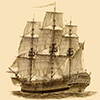 Nile (generic)
References
| Primary Source | Australian Joint Copying Project. Microfilm Roll 93, Class and Piece Number HO11/18, Page Number 247 (125). --0-- Edgar, W. (Bill) (2018), “The precarious voyage of her majesty’s convict ship ‘Nile’ to the Swan River colony, late 1857 – and the unexpected aftermath.” The Great Circle, 40(1), 20–43. --0-- Roscoe, Katy (2018), "Convicts and the sea: the naval influence on Gibraltar Convict Establishment" at https://staffblogs.le.ac.uk |
| Source Description | This record is one of the entries in the British convict transportation registers 1787-1867 database compiled by State Library of Queensland from British Home Office (HO) records which are available on microfilm as part of the Australian Joint Copying Pro |
| Original Source | Great Britain. Home Office |
| Compiled By | State Library of Queensland |
| Database Source | British convict transportation registers 1787-1867 database |
Claims
No one has claimed John Marr yet.
Photos
No photos have been added for John Marr.
Convict Notes


OTHER: 21 October, 1859: From the Perth Gazette and Independent Journal of Politics, p3: "Perth Police Court. ASSAULT AND DRUNKENNESS.-John Marr, T.L., was charged by Police Constable McCulham with having been drunk and out after hours on Friday, the 23rd ult., and also with having assaulted him at the time he was taken into custody. He was also charged with having a gun in his possession contrary to the Ticket-of-leave Regulations. Police Constable McCulham deposed that on the night in question he met the prisoner in St. George's Terrace about half past 11 p.m. He asked him if he was a conditional pardon man. The prisoner replied that he was. He then allowed him to pass. On considering he felt certain that the prisoner had deceived him, and therefore went to the house where the prisoner resided, and asked Jackson, the landlord of the house, if the prisoner was a conditional man. He replied that he did not think he was. He then asked him to light a candle so that he might see to arrest the prisoner. The candle had no sooner been lit than the prisoner jumped up and seized him by the throat, and eventually threw him down. The prisoner then endeavoured to choke him, and also bit him about the head very severely. He called upon those present to render him some assistance, but they did not do so. Corporal Dyer, who heard the noise, came to his assistance, and with his help he brought the prisoner to the station. The gun the prisoner had was not loaded. The prisoner had neither powder nor shot on his person. The prisoner, in defence, denied that he was so violent as the policeman had represented; he was, however, he would acknowledge, under the influence of liquor at the time, and had but very little recollection of what really did take place. The gun, he said, did not belong to him, and had not been used by him, in proof of which he pointed out the fact of his having neither powder nor shot in his possession. His Worship said that the assault was certainly a most savage and unmanly one, for which alone he deserved to be severely punished. He had in fact committed no less than four crimes, viz.: drunkenness, out after hours, assault, and carrying firearms contrary to the Ticket-of leave Regulations. As the gun did not appear to be a very serviceable piece, he would not take that charge into account, but for his other misdeeds he would sentence him to six month's imprisonment with hard labour." (https://trove.nla.gov.au/newspaper/article/2931903)
IN WA: From his Fremantle jail record: MARR, John; inmate #4750, arrived 1 Jan 1858 per Nile Date of Birth: 1832 Marital Status: Unmarried Occupation: Labourer Literacy: Illiterate Sentence Place: Leeds, Yorkshire, England Crime: Larceny Sentence Period: 10 years Ticket of Leave Date: 7 Jul 1858 (https://fremantleprison.com.au/). --0--
10 September, 1857: Sent from Portland to board the Nile for WA. On the voyage his behaviour was described as "bad", and he was "handcuffed for five hours" (Western Australia, Australia, Convict Records, 1846-1930; Convict Department, Registers;Character Book for Nos 4508-5585 (R8)). --0--
12 March, 1857: He was admitted to Portland for a second time; inmate #6756. Listed as 19 when convicted, alias Marra; illiterate; cloth dresser, Roman Catholic; next of kin -- his mother, Mary Marr, 3 Vienna Street, Leeds, a washerwoman (UK, Prison Commission Records, 1770-1951 for John Marr; Portland Prison; Prison Records to 1875). --0--
19 January, 1857: He was sent from the Bow Street Police Court and returned to Millbank prison at Westminster; listed as inmate #4129 (UK, Prison Commission Records, 1770-1951 for John Marr; Millbank Prison; Register of Prisoners to 1885). --0--
5 January, 1857: His Ticket of Leave was revoked -- no grounds listed on prison records. --0--
25 August, 1856: Ticket of Leave (Licence) #6349 granted. --0-- 11 September, 1856: He was discharged from Millbank prison at Westminster on licence (UK, Prison Commission Records, 1770-1951 for John Marr; Millbank Prison; Register of Prisoners to 1885). --0--
11 August, 1856: Admitted to Millbank prison at Westminster; inmate 3227 (UK, Prison Commission Records, 1770-1951 for John Marr; Millbank Prison; Register of Prisoners to 1885). Here, he was deemed worthy of a Licence for Parole (Ticket of leave), as below: "PCOM 3/59/6349 Licence number 6349: John Marr. Caption order and prison record from when he was convicted of larceny at the Quarter Sessions at Leeds, Yorkshire 4 March 1852. Then aged [not given] and by trade a [not given]. Sentence: 10 years Transportation. Licence granted 25 August 1856, for early release from Millbank prison. Gibraltar man. Licence revoked 5 January 1857, caption returned 22 January 1857. Revocation order only. Date: 1856 August 25" --0--
17 May, 1854: Sent from Portland to board the ship Ramilies for Gibraltar. 19 May, 1854: Sailed from England and on arrival at the large Gibraltar work station he was held on the Europa hulk; served 25 months 23 days before his return to England. Gibraltar and Bermuda were also listed public works stations (and the second stage in the penal process). On Gibraltar, as “convicts worked together with free men on the dockyards, lines between them became blurred. Convicts, like seamen, were ‘easily recognised’ by ‘their swarthy, weather beaten complexions…[and] muscular well-knit frames’. The discipline on the penal settlement was also influenced by the naval department, who superintended part of the works. In the 1840s, for example, convicts were provided ‘a half gill of rum’ at 11 AM and 5PM, which they drank from a trough. This mirrored the daily allowance of diluted rum, known as grog, to Royal Naval seamen in the Victorian era. Convicts were also allowed to use part of their earnings, to buy goods, usually tobacco, which they were allowed to smoke in the evening in the barracks. Though official correspondence cited health reasons for grog allowance, it seems likely that the convict authorities feared insubordination if they were banned from drinking and smoking, which were provided to the sappers and dockyard workers whom they worked alongside…. In 1854, the acting overseer stated that “half of the offences were committed when the men were excited by rum”. For more serious offences, convicts were flogged with a ‘cat o’nine tails’ whip against the ‘flogging mast’, and during an investigation Dr William Baly concluded that the whip which was used was an old naval cat, which was ‘much heavier than any now used in the government prison and hulks at home, or in the army.’” (Roscoe, 2018). --0--
3 May, 1853: Admitted to Portland prison, Grove Road, Portland, Dorset. Listed as inmate #3383; alias Marra; 19 when convicted; single, illiterate, cloth dresser, Roman Catholic. Served 9 months 10 days in public works; behaviour "very good". Portland, Portsmouth, Chatham and Spike Island in Ireland were listed public works stations and the second stage in the penal process. After separate confinement, prisoners were “placed on work parties at various locations, most commonly naval stations, where maintenance of facilities was vital for the effective protection of Britain’s far flung commercial and military influences around the world. While there, attitude and behaviour were monitored closely. In theory, only after consistently positive reports was a prisoner moved on to the third stage of his incarceration—transportation.” (Edgar, p40) --0--