
Summary
Personal Information
Voyage
Transportation
Michael Mcnally was transported on the Chapman, departing 25th Mar 1817 and arriving 26th Jul 1817 with 202 passengers.
The Chapman ship was built at Whitby, England in 1777, rebuilt in 1811 and refurbed in 1815. Tonnage: 558 The 1817 voyage from Ireland to New South Wales, Australia is not yet fully recorded on this web site - currently being updated. A mutiny occurred on this voyage with 7 men killed and many others wounded. (200 male convicts embarked) 1824 voyage from England to Van Diemen's Land (180 male convicts). 1826 voyage from England to Van Diemen's Land (100 male convicts, 2 escaped). Royal Staff guards & 19 private passengers.
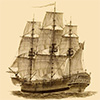 Chapman (generic)
References
| Primary Source | New South Wales, Australia, Tickets of Leave, 1810-1869 New South Wales, Australia Convict Ship Muster Rolls and Related Records, 1790-1849; 1817 Chapman https://refashioningrenaissance.eu/the-theft-in-the-bleachfield/ https://www.bl.uk/onlinegallery/onlineex/kinggeorge/t/003ktop00000052u046k0000.html |
Claims
No one has claimed Michael Mcnally yet.
Photos
No photos have been added for Michael Mcnally.
Convict Notes


PRISON: Michael McNally was transferred from County Antrim to Kilmainham Gaol, Dublin, on December 27, 1816. He became prisoner number 3062. He departed Kilmainham on January 18, 1817, to be “sent aboard the convict ship” (see Ireland, Prison Registers, 1790-1924; Dublin, Kilmainham 1815-1910).
Another convict on the Chapman, Patrick McKenna, had also received a similar sentence at County Antrim for robbing a bleach green. It’s not clear if the two were co-accused or merely appeared at the same session of the court. The severity of their sentences may be better understood after considering the manufacturing process for linen and the fibre's value – with items ranging from sheets to towels and clothing constituting an important part of household and personal textiles. In Denmark in the 17th century, for example, textiles were “desirable items to steal, as they could be transported easily and resold or pawned, and acted as a kind of currency”, according to Larsen (2019) at https://refashioningrenaissance.eu/the-theft-in-the-bleachfield/. An illustration in the British Library by Hinks from 1783 called “The Perspective View of a Bleach Green taken in the County of Downe” shows rows of linen spread out after wet bleaching. The Library says a linen bleaching green or bleachfield “consisted of a central house for bleaching and finishing the material, with lands extending up to 25 or 30 acres on which to spread the linen. The linen was bleached with an alkaline solution and then rinsed and spread on grass - a bleach green. The linen was rinsed a number of times and so many of these greens were situated next to rivers where a good supply of water could be accessed.” (https://www.bl.uk/onlinegallery/onlineex/kinggeorge/t/003ktop00000052u046k0000.html) Another description of the process (see Ireland and Peg's Cottage posts on Facebook) notes that until the end of the 18th century bleaching in Ireland was restricted to between March and October because the process needed “reliable and inexhaustible supplies of water... The linen had to be boiled and rinsed up to a dozen times before being laid out on the bleaching greens to be whitened by the sun and the rain. It was watered regularly, a process known as ‘wet bleaching’, and everyone had their own secret recipe for aiding the bleaching process, usually incorporating sour milk, urine and manure.”
CRIME: Michael McNally/McEnally was tried in County Antrim in Summer of 1816. His sentence of death was received for a "Bleach Green robbery" (see New South Wales, Australia Convict Ship Muster Rolls and Related Records, 1790-1849; 1817 Chapman). The sentence was commuted to transportation for life.
Sydney, Australia, Anglican Parish Registers, 1814-2011 Liverpool St Luke. Name; Michael McNally Abode; Liverpool When Buried; 1827, April 20th Age; 35 Ships Name; Chapman Quality or Profession; Assigned to Mr Mannix By whom the Ceremony was preformed; A Roman Catholic
1822 - 2 Jan. Gaol: Sydney. Record Type: Entrance Book Prisoner. Received from Liverpool. assaulting their Govenor ----------------------------------- 1823 - 27 Jun. On list of prisoners assigned. Comments:Per "Chapman", 1817. Page: 83 Assigned to Waterloo Company. Sydney ------------------------------------ 1826 - 2 Feb. New South Wales, Australia, Tickets of Leave, 1810-1869 No; 27/2163 Year of birth; 1786 Native Place; Co Derry Calling; Labourer Offence; No details Date of Trial: Co Antrim. Autumn 1816 Sentence; Life Height; 5 ft. 5 1/2 Complexion; Ruddy Hair Light Brown Eyes; Blue District; Airds