
Summary
Personal Information
Voyage
Transportation
John Mernargh was transported on the Tellicherry, departing 31st Aug 1805 and arriving 15th Feb 1806 with 161 passengers.
The 'Tellicherry' - built in 1796 at Thames, England for the East India Company. 467 tons. One sailing to Australia - Ireland to New South Wales in 1805, arriving 1806. 125 (or 130) male and 35 female prisoners, 2 children - 6 deaths. Many on the men on board were political prisoners. Departed from Cork, Ireland. (The register of these persons is NOT yet complete on this website - a work in progress.) In 1807 the Tellicherry was shipwrecked off the coast of the Philippines. The men were rescued and made their way to Manilla.
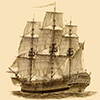 Tellicherry (generic)
References
| Primary Source | NSW Gov Records. Irish Convicts. Freemans Journal [Ireland], 26 & 31 July 1799 pages 1; 13&16 Dec 1799 pages 1; FJ 13 Dec 1805 page 2. |
Claims
No one has claimed John Mernargh yet.
Photos
No photos have been added for John Mernargh.
Convict Notes

Colonial Secretary Index. MERNAGH, John. Per "Tellicherry", 1806. 1805 Aug 17 - On list of convicts embarked on board the "Tellicherry"; listed as Merna (Reel 6028; 2/8283 p.37) 1806 Feb 22 - King to Marsden re transportation of Mernagh and his four companions without conviction; and their status in the Colony (Fiche 3289; 5/3822.2A pp.1-3) 1809 May - On list of all grants and leases of land registered in the Colonial Secretary's Office (Fiche 3268; 9/2731 p.176) 1811 Feb - Memorial for confirmation of grant and pardon; as Marnagh (Fiche 3003; 4/1821 No.96) 1813 Jul 1 - Subscribed to fund for building a court house at Sydney; appears as Mernough (Reel 6043; 4/1728 p.136) 1822 Feb 22 - On list of persons receiving an assigned convict; listed as Mariner (Fiche 3290; 4/4570D p.17) 1824 Oct - Memorial; as Marinagh (Fiche 3099; 4/1838A No.614 pp.585-8)

CAPTURE OF JOHN MERNAGH John Mernagh had not heard that the leader of his Wicklow Mountain Gang, Michael Dwyer, had surrendered himself in December 1803 on the basis of negotiating terms for him and his family be sent to America and his men pardoned. Martin Burke had been captured earlier in 1803 and was in Baltinglass gaol, later transferred to Wicklow gaol awaiting court martial; in late December 1803 Devlin had surrendered himself following Dwyer's lead, so had Hugh Vesty Byrne. But John Mernagh remained free, apparently unaware of his comrades' positions, until he was surrounded by troops as he was crossing a stream. Freemans Journal, Thurdsay 23 February 1804, page 3 "The outstanding Wicklow rebel, John Mernagh, and four of his associates, (the last of the gang) were on Monday apprehended by Captain Clinch of Peamont near Rathcoole – Mernagh had no fire-arms, but pelted Capt. Clinch with stones. Capt. C had a party of the Antrim militia with him.”
1799 PROCLAMATION FOR MARTIN BURKE: This description of JOHN MENAGH is one of a list of about 45 men who the government had published in Irish newspapers on 26th & 31st July 1799 and on 13th & 16th December 1799. Number 1 on the list was Michael Dwyer: “The following ROBBERS, MURDERERS and DESERTERS are now wandering about, and are occasionally concealed by disaffected persons in the Counties of Wicklow, Wexford, Carlow, Kildare, Dublin &tc and Rewards will be paid for securing such of them as are first mentioned agreeably to a Proclamation dated the 8th day of June last: "2nd JOHN MERNAGH, about thirty years old, five feet ten inches high, fair complexion, brown hair, well made, large grey eyes, and speaks thick, born near Seven Churches, Two Hundred Guineas for taking him."
July 1805 DEPARTURE FROM DUBLIN for CONVICT SHIP: Freemans Journal Tuesday 30 July 1805 page 2: “Thursday evening, Michael Dwyer, Martin Burke, Arthur Develin, Hugh Byrne and John Mernagh [sic], were conveyed from Kilmainham prison, by the Circular-road in carriages, and put on board an armed cutter in the river, which is to carry them to Cove, where a transport destined for Botany Bay, is ready to receive them.”
John played a major part in the '98 Irish Rebellion and its aftermath, John was self exiled to New South Wales for life by the Lord Lieutenant of Ireland.Under Governor King, John was granted 100 acres of land at Liverpool. By 1807, he had established an inn at Parramatta. Flourishing under the Macquarie administration, John amassed nearly 600 acres around Georges River. On May 10 1817 he became the second depositor of the Bank of NSW. The last rebel remnant of the Tellicherry Five or Wicklow Martyrs’ died on July 2 1857 and was buried in Braidwood cemetery.
Born - Ballinaskea Glenmalure Wicklow County Ireland. State Prisoner from Ireland and transported as an Exile. Died - 1857 Berlang Majors Creek Braidwood NSW.