
Summary
Personal Information
Transportation
James Nangle was transported on the Rolla, departing 4th Nov 1802 and arriving 12th May 1803 with 161 passengers.
On Thursday arrived the Ship Rolla, Captain John Cummings, from Ireland, with Prisoners of both sexes, viz. 119 Men and 37 Women: Seven of whom died on the passage; and the day after her arrival landed some of those who were weakly, at the General Hospital. She left Ireland the 4th of November, arrived at Rio de Janeiro on the 15th of January, sailed from thence the 6th of February, and in 95 days after came to an anchor in Port Jackson. During the latter part of the passage she experienced much bad weather; in the course of which, she sprung her main?mast and carried away her main?yard. She brings, for the use of Government, 234 pieces of Pork, 686 Casks of Flour, and 11 Tons of Sugar. Sydney Gazette, 15 May 1803.
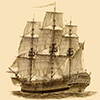 Rolla (generic)
References
| Primary Source | Freemans Journal, Saturday, August 15, 1801, p. 3. |
Claims
No one has claimed James Nangle yet.
Photos
No photos have been added for James Nangle.
Convict Notes


At the Inquest into the death of Mary Murphy held on 29th May 1812 (death on 28th May) James Nangle gave evidence. He said he was a lodger in Mary Murphy’s house. At about 7 o’clock in the morning, hed seen her in a weak state and made an observation to a neighbour that he didn’t expect her to live the day out. James Nangle made his mark in adopting the written record of his evidence i.e. he could not write his name. In October 1812, he made further attempts to return to Europe. He advertised in the Sydney Gazettes of 31 October 1812 (p.1), and 7 November 1812 (p.2) his intention to leave the colony in the ‘Isabella”. Again, he didn’t leave.. 4 December 1812 Isabella sailed (per SG 5/12/1812) with passengers Captain Durie of 73 regiment Lt Lundin, and Sir Henry Brown Hayes, pardoned as a life serving convict .” 1814 Muster, James Nangle, Free, per “Rolla” was mustered at Sydney and victualled off stores. In 1817, Nangle had another opportunity to return to Europe. The government’s brig “Kangaroo” was being sent by Governor Macquarie back to England, he believing the brig inadequate for its purpose and its commander, Captain, Charles Jeffreys, incompetent and lazy. Macquarie wrote in his diary on 29 January 1817 “I have ordered Lt. Jeffreys not to engage to take any Passengers Home but such as may have my permission, it being my intention, in pursuance of Orders received from the Secry. of State – to send Home in the Kangaroo as many Persons as she can conveniently accommodate who have lately become free by their Sentences of Transportation having expired.” Here was Nangle’s opportunity for a free passage home, since Macquarie included him on a nominal return of persons (dated 29 March 1817) for whom passages were to be provided on "Kangaroo" for England. Although Nangle again advertised his intention to leave the colony (Sydney Gazettes of 22 February and the 1st March 1817), yet again, he did not leave. In a letter of April 3 1817 from Governor Macquarie to Lt Jeffreys R.N., commander of the ‘Kangaroo” Macquarie wrote: “I have to inform you that James Nangle, free man, included in the List of Passengers going to England in the Kangaroo, has withdrawn his [indecipherable], not being able now to leave the Colony.” Why James could not leave the Colony was not explained. Macquarie recorded in his journal on 9 April 1817 that the Kangaroo had departed that day and included with the passengers were “8 Free Men (formerly Convicts) and 10 Free Women formerly Convicts.” In 1818, Nangle blotted his copybook by being found guilty at the Court of Criminal Jurisdiction on 4 December 1818, of stealing a blanket (SG 12 December 1818, p.3) and was sentenced to two years at Newcastle. He was listed on 31 December 1818 on list of prisoners on ship “Lady Nelson” for Newcastle. He would have spent all of 1819 and 1820 as a prisoner at Newcastle. 20 June 1822, Nangle was living in Kent Street, Sydney and was on list of persons set to receive an assigned convict — John Doyle per Lord Sidmouth. A notation states ‘returned by Gov’t”. 25 April 1823 – James Nangle of Kent Street, on list of persons receiving an assigned convict – who was, again, John Doyle per Lord Sidmouth. Doyle was from Wexford and had arrived in NSW in 1821. In Sept 1822 he’d been in a Parramatta road party before being assigned to Nangle in 1823. In the September 1822 Muster James Nangle was listed as an “oilman” of Sydney. An oilman could have sold oil, particularly lamp oil. (For example, in 1823 one Alexander Payne was “an oilman about the streets of Sydney”. Yet, by the time of the 1825 Muster he had at last achieved his desire of returning to England was listed in that year’s muster as “gone to England”
“The Assizes of Kilkenny ended the 9th instant [August 1801], at which the following persons were tried before Baron George: James Nangle, convicted of a felony at large, to be transported for seven years." Nangle made three attempts to sail to England - in 1811, 1812, and 1817, before he eventually managed to do so, being recorded in the 1825 Muster as "gone to England". In the years between his 1801 sentence and his departure, the following is the record of him in NSW. In 1806 Muster, in gaol at Parramatta On the 29 December 1810, the American brig ‘Active’ came into Sydney Harbour under command of Capt Richardson, from the Isle of Bourbon (near the Ile de France), part of Mauritius, where it had left in November, bringing news of the surrender of that isle to the British. James Nangle decided he would leave on this ship. First, he started tidying up his business. On the 5th January 1811 he advertised in the Sydney Gazette that he would sell the furniture, of little value, left in his house at Parramatta by William Ruffane about nine months earlier, to pay the charges on the said furniture. Then, on January 12 and January 19, 1811 he advertised his intention to leave the colony on “Active”, and requested, in the usual way, that any claims or demands on him be presented. However, further advertisements on January 26 of mens’ intentions to leave on ‘Active’ did not include James Nangle. The ship left on 5 February 1811.