
Summary
Personal Information
Transportation
William Welch was transported on the Atlas, departing 29th Nov 1801 and arriving 7th Jul 1802 with 200 passengers.
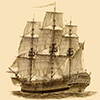 Atlas (generic)
References
| Primary Source | Sainty, Malcolm & Johnson, Keith; Census of New South Wales 1828 Baxter, Carol, ed; General Muster of New South Wales 1822. Mayberry, Peter; Irsih Convicts of New South Wales 1788-1849 |
Claims
"William was my 3rd great grandfather on my mothers paternal side. Maiden name Carroll."

Photos
No photos have been added for William Welch.
Convict Notes
Tried and convicted in Co. Wicklow as an Irish Rebel in 1798, sentenced to transportation for life. Left Cork on 30th May 1802. Ship:- the 'Atlas II' sailed with 200 male convicts on board of which 20 died during the voyage. Arrived on 30th October 1802. Married convict Eleanor Rice ('Northampton' 1815) on 30th October 1815 at Parramatta, they had 7 children between 1816-1831. Citation details: No. 493 William Welsh, prisoner ship Atlas II age 34 of the parish of St John Parramatta and Eleanor Rice, prisoner per ship Northampton age 28, of ditto were married in this church by banns this 30th October 1815 by me Samuel Marsden. William and Eleanor both made their X marks in the register in the presence of Luke Grant and Mary Leonard who also both made their X marks. William was granted a Conditional Pardon by Governor Macquarie on 31st January 1818 William died on 4th June 1861 at Mittagong. Wicklow United Irishmen (1797 - 1804) Wicklow was one of the most violent sectors in Ireland during the Rebellion of 1798 and the most consistently disturbed county in its aftermath. The pro-government loyalist community suffered the second highest property losses of any in Ireland in 1798 and remained vulnerable to rebel activity until 1804. The great struggle of the United Irishmen claimed hundreds of lives in Wicklow and resulted in the exile of many more to New South Wales, the West Indies, Prussia and elsewhere - No county sent more of its natives to the harsh penal colony of New South Wales, Australia. At least 14,000 Wicklowmen swore the oath of the United Irishmen and a comparatively high number of them turned out to fight after the outbreak of the Rebellion in late May 1798. The vast majority had joined in the spring and early summer of 1797 when republican emissaries crossed into the county from Kildare and Dublin. The United Irishmen were founded in late 1791 in order to unite 'protestant, catholic and dissenter' (presbyterian) in the cause of parliamentary reform. They wanted to replace the elite Dublin parliament at College Green with a democratic forum akin to those created by revolutions in America and France. Social, Political, economic and religious discrimination against catholics and presbyterians was to be abolished and the British parliament prevented from interfering in Irish affairs. Parts of Wicklow were militarised as early as September 1797 and much of the west of the county was placed under martial law two months later. By then arms raiding and pike making, the assassination of informers and the holding of seditious meetings had transformed one of Leinster's most peaceable counties into a hotbed of republican activity. Dozens of loyalist yeomanry corps were raised in Wicklow after October 1796 and these civilian volunteers used their government arms, pay and uniforms to police their neighbours. Some yeomen were members of the Orange Order from late 1797, a new force in county politics which proved prone to extreme conduct.
Census 1828; Welch, William, 50, CP, Atlas, Life, Catholic, Labourer, Ludnum, Bringelly. [Ref: W0852] Welch, Ellen, 35, FS, Northampton, 1814 [Ref: W0853] Welch, Elizabeth, 12 BC, [W0854] Welch, Sarah, 10, BC, [W0855] Welch, Jane, 8, BC, [W0856] Welch, Ellen, 6, BC, [[W0857] Welch, William, 2, BC, [W0858] Welch, John, 6m, BC, [W0859]
Muster 1822; Walsh, William, CP, Atlas, Life, Landholder, Liverpool. #Also notes Eleanor Rice FBS, Northampton 7 years wife of Willaiam Welch, Liverpool. and 3 children 5, 4 and 2 children of above, not named, all born in colony.
Muster 1814; Welch, William, Atlas, C, Off Stores. Mr Badgery. [Ref: 2390]
Muster 1811; Welch, William, Atlas. Tried Mar 1798, Wicklow, Life. [Ref: 6135]
Muster 1806; Walsh, William, Atlas. Indented to James Badgery. [Ref 4640]
William was initially assigned to James Badgery and was with him for some time. William married Eleanor Rice (Convict, Northampton 1815) soon after her arrival in the colony. Over the next years they raised a family of at least 6. William and Eleanor lived at Ludnam, Bringelly.