
Summary
Personal Information
Crime
Voyage
Transportation
William Westwood was transported on the Mangles, departing 18th Mar 1837 and arriving 10th Jul 1837 with 309 passengers.
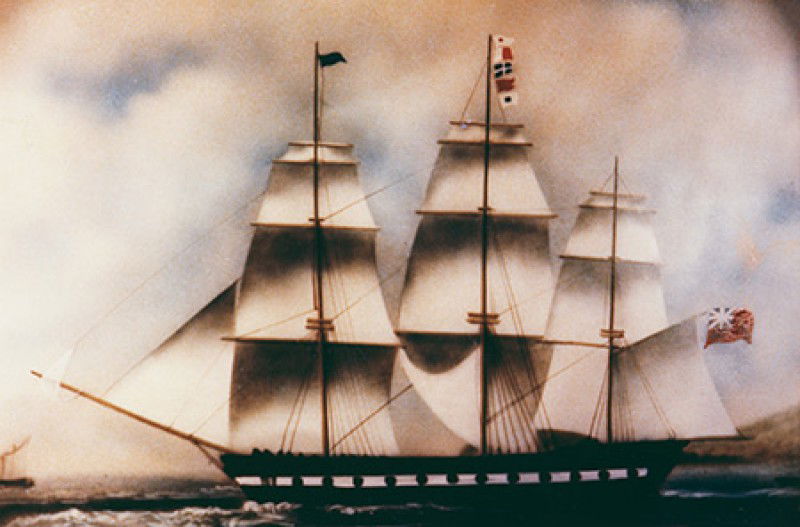 Mangles
References
| Primary Source | Australian Joint Copying Project. Microfilm Roll 90, Class and Piece Number HO11/11, Page Number 16 |
| Source Description | This record is one of the entries in the British convict transportation registers 1787-1867 database compiled by State Library of Queensland from British Home Office (HO) records which are available on microfilm as part of the Australian Joint Copying Pro |
| Original Source | Great Britain. Home Office |
| Compiled By | State Library of Queensland |
| Database Source | British convict transportation registers 1787-1867 database |
Claims
No one has claimed William Westwood yet.
Photos
No photos have been added for William Westwood.
Convict Notes

Sydney Chronicle (NSW : 1846 - 1848) Wed 23 Dec 1846 Page 3 JACKY JACKY. JACKY JACkY. We would urge the following letter upon the notice of our readers, it is one well worthy of perusal. It of speaks volumes as to transportation as a reformatory punishment, and we earnestly recommend it to the consideration of the pro-transportationists, they may learn from it a lessons of which they apparently stand in much need. The letter was written just previous to the execution of the unfortunate man, and is as follows: H. M. Gaol, Norfolk Island, Condemned Cells. 1846, Oct. the 8. Reverend Sir, -As in duty bound to you for the kindness you have shown to me, and the interest I have always seen you take in those that have ever been under your spiritual care, whatever may be it their fate, I have been induced to write to you, hoping this may find you in good health, and in the enjoyment of all God's choicest blessings. I have to inform you, that long before this letter reaches your hands, the hand that wrote this will be cold in death. I do not grieve that the hour is fast approaching that is to end my earthly career. 1 welcome death as a friend ; the world, or what I have seen of it, has no allurements in it for me. Tis not for me to boast; but yet, sir, allow a dying man to speak a few word to one who has always shown a sympathy t for the wretched outcasts of society, and ever, with a Christian charity, strove to recall the wretched wanderer to a sense of his lost condition. I started in life with a good feeling for my fellow man. Before I well knew the responsibility of my station in life, I had forfeited my birth-right. I became a slave, and was sent far from my native country, my parents, my brother, and sisters-torn from all that was dear to me, and that for a trifling offence. Since then I have been treated more like a beast than a man, until nature could bear no more. I was, like many others, driven to despair by the oppressive and tyrannical conduct of those whose duty it was to prevent us from being treated in this way. Yet these men are courted by society and the British Government deceived by the interested representations of those men, continue to carry on a system that has and still continues to ruin the prospects of the souls and bodies of thousands of British subjects. I have not the ability to represent what I feel on the subject; yet I know from my own feelings that it will never carry out the wishes of the British people The spirit of tile British law is reformation. Now, years of sad experience should have told them, that instead of reforming, the wretched man, under the present system, led by example on the one hand, and driven by despair and tyranny on the other, goes on from bad to worse, till at length he is ruined body and soul. Experience, dear bought experience, has taught me this. In all my career, I never was cruel; I always felt keenly for the miseries of my fellow creatures, anti was ever ready to do all in my power to assist them to the utmost, yet my name will be handed down to posterity, branded with the most opprobrious epithet that man can bestow. But 'tis little matter now. I have thus given vent to my feelings, knowing that you will bear with me, and I know that you have and will exert yourself for the welfare of wretched men. It is on this account that I have strove, though in but a feeble manner, to express my feelings. The crime for which I am to suffer is murder. Reverend Sir, you will shudder at my cruelty, but I only took life; those that I deprived of life, though they did not in a moment send a man to his last account, inflicted on many a lingering death-for many years they tortured men's minds as well as their bodies, and after years of mental and bodily torture sent them to a premature grave. This is what I call refined cruelty, and it is carried on, and I blush to own it, by Englishmen, and under the enlightened British Government. Will it believed hereafter, that this was allowed to be carried on in the nineteenth century I will now proceed to inform you what has happened to me since I left Port Arthur. I was sent to Glenorchy probation station. I was then determined if possible to regain my freedom, and I visit my dear native country, and see my parents and friends again. I took the bush with two men : one of them said that he knew the bush well, but he deceived me and himself too. Our intention was to take a craft from Brown's River; we were disappointed there was no craft there. We then turned to go Launceston, thinking to get one there, and to cross the Sydney main. But after leaving New Norfolk I lost one of my mates, and the same night the other left me at the Green Ponds. I was soon after taken and sent to Hobart Town, I was tried and sent to Norfolk Island, and this place is now worse than I can describe. Every species of petty tyranny that long experience has taught some of these tyrants, is put In force by the authorities. The men are half-starved, hard worked, and cruelly flogged. These things brought on the affair of the 1st of July, of which you have no doubt heard. I would send you the whole account, but that I know you will have it from better hands than mine, I am sorry that this will give you great pain, as there at are several of the men that have been under your charge at Port Arthur concerned in this affaiir. Sir, on the 21st Sept,, 1810, Mr. Brown arrived in the it Island with a commission to form a Court. Fourteen men were then arraigned for the murder of John Morris, that was formerly gate-keeper at Port Arthur,. The trial occupied the Court nine days, The jury retired, and returned a verdict, and found twelve out of fourteen guilty of murder. On the 5th of October the sentence of death was then passed on us, and to be carried into effect on the 13th of October, 1846. Sir, the strong ties of earth will soon be wrenched, and the burning fever of this life will soon be quenched, and my grave will be a haven -a resting-place for me, William Westwood. Sir, out of the bitter cup of misery I have drank from my sixteenth year ten long years,-and the sweetest draught is that which takes away the misery of living death; it is the friend that deceives no man; all will then be quiet; no tyrant will then disturb my repose, I hope, Wm. Westwood.. Sir, I now bid the world adieu, and all it contain.. Wm Westwood, his writing.
WILLIAM WESTWOOD, ALIAS JACKEY JACKEY BUSHRANGER. William Westwood convict and bushranger, was born on 7 August 1820 and baptized on 27 August at the church of St Mary the Virgin, Manuden, Essex, England, one of several children of James Westwood, labourer, and his wife Ann. William learned to read and write and became an errand boy. He had previously served twelve months for highway robbery when he was tried on 3 January 1837 at the Essex Quarter Sessions, Colchester, for stealing a coat. Sentenced to transportation for fourteen years, he reached Sydney on 9 July 1837 in the Mangles. He had a ruddy complexion, brown hair, dark grey eyes and various scars. Assigned to Phillip Parker King, Westwood was sent to his station, Gidley, near Bungendore, where the overseer ill-treated him and provided insufficient food and clothing. On 19 April 1838 Westwood was sentenced to six months imprisonment for stealing wheat. Sent back to his master, he escaped but was quickly recaptured and received fifty lashes on 4 February 1839. From September 1840 Westwood 'was out 7 Months in the bush under Arms'. Known as 'Jackey Jackey', he roamed the Southern District, eluding capture by retreating to mountain hideouts and riding long distances in a very short time. He stole horses, money, clothes, provisions and arms, but never hurt his victims and was courteous towards women. On one occasion he held up the mail, took £200 and spent a month in Sydney, staying at a hotel in George Street. Old hands remembered him as 'the gentleman bushranger'. At Berrima on 15 April 1841, Westwood was tried for robbery with firearms and stealing a mare, and was sentenced to transportation for life. Although in chains, he escaped from the Stonequarry (Picton) lock-up on the way to Sydney and hid up a tree. The Australian commented that the 'cool intrepidity and daring of this man is astonishing . . . he is moreover well-dressed, assumes all disguises'. Recaptured in mid-July, he was held in the prison on Cockatoo Island, Port Jackson, until transported to Van Diemen's Land in the Marian Watson. Reaching Hobart Town on 8 March 1842, Westwood was sent to Port Arthur. He twice absconded that year and twice received 100 lashes. On a third occasion he escaped from Port Arthur—this time by swimming across the channel; his companions were eaten by sharks. On 7 November 1843 he was sentenced to twelve months imprisonment with hard labour, with three months in solitary confinement. Next year W. T. Champ, the new commandant, promoted Westwood to his boat crew. After the crew had rescued two men from drowning, the lieutenant-governor approved of the removal of Westwood from Port Arthur in May 1845 to serve six months probation at Glenorchy. Habit was too strong: on 4 September 1845 he was tried in the Hobart Supreme Court for robbery, 'being armed whilst illegally at large'. As he had not harmed anyone, the death sentence was commuted to transportation for life to Norfolk Island. Instructed by the British government to impose strict discipline, Joseph Childs, commandant of Norfolk Island, ordered the secret removal of the prisoners' 'tins and knives, and other utensils for cooking their food'. The next morning, 1 July 1846, Westwood led a mutiny and killed an overseer and three constables before being overpowered by the military. In the condemned cell he was befriended by the religious instructor Thomas Rogers who encouraged him to write (or dictate) an account of his life—Rogers, as 'Peutetre', published it in the Australasian in 1879. Sentenced to death with twelve others, Westwood was hanged on 13 October 1846. Although he was in communion with the Church of England, he was buried in unhallowed ground. Westwood had written to his parents, sending them a lock of his hair, and also to a clergyman: 'Sir, out of the bitter cup of misery I have drank from my 16th year,—ten long years—and the sweetest draught is that which takes away the misery of a living death; . . . all will then be quiet--no tyrant will then disturb my repose, I hope'. Record From Van Diemans Land: Name: William Westwood, alias Jackey Jackey Tried: essex 3 Jan 1837- 14 years (arrived in sydney 9 Jul 1837 per Mangles) Tried Berrima NSW: 15 Apr 1841- Life (transported on the Marion Watson) Arrived: 8 Mar 1842 (Hobart) Tried Hobart: 4 Sep 1845- life (transported to Norfolk Island) Description: Trade: laborer Height: 5.8 1/4 Age: 22 (at 1842 Hobart) Complexion: pale Head: round large Hair: light sandy brown Whiskers: light brown Visage: broad Forehead: broad Eyebrows: light brown Eyes: light hazel Nose: large Mouth: medium Chin: thick Native Place: Manuden, nr Bishop, Stopford, Essex Remarks: 1837 January 3 & 1820 August 7 left arm, sun on back of same hand (tatts). scar on right side of upper lip, scar on back of left wrist. Conduct: Extract from Sydney records, tried at colchester 3 Jan 1837- 14 years 19 Apr 1838: i was stealing wheat- 6 momths (NSW) 4 Feb 1839: absconding- 50 lashes (NSW) 12 Feb 1840: absenting- 50 lashes (NSW) 14 Dec 1840: run (NSW) 15 Apr 1841: robbery with firearms, transported for life to a penal settlement, 7 months in the bush (NSW) 30 Mar 1842: absconding- 100 lashes 24 Aug 1842: absconding- 100 lashes 2 Jan 1843: insolence- 7 days solatary confinement 1 Sep 1845: robbery whilst at large- death recorded- to be transported for life, Norfolk Island for 10 years Executed 13 oct 1846: leading a mutiny References and Sources: G. E. Boxall, The Story of the Australian Bushrangers (Lond, 1899) R. Nixon Dalton, Colonial Era Cemetery of Norfolk Island (Syd, 1974) G. Dick, The Bushranger of Bungendore (Bungendore, NSW, 1979) ‘Correspondence on the Subject of Convict Discipline and Transportation’, Parliamentary Papers (Great Britain), 1847, vol 48, p 174 Canberra Historical Journal, Sept 1975, p 92 Australasian, 20 Apr 1841, p 2, 27 May 1841, p 2 1 Feb 1879, p 134, 8 Feb 1879, p 166, 15 Feb 1879, p 199, 22 Feb 1879, p 231 Hobart Town Courier, 2 Sept 1842, p 3, 6 Sept 1845, p 3 Hobart Town Advertiser, 7 Oct 1843, p 3, 6 Sept 1845, p 3 Britannia (Hobart), 5 Nov 1846, p 3, 4 Apr 1847, p 4, 29 Apr 1847, p 4 CSO 20/2/64, CSO 22/19/779, ff 1-5, and Con 55/1, p 597, no 3035 (Archives Office of Tasmania) Index to New South Wales Convicts, 1788-1843, fiche 727, p 95.