Summary
Personal Information
Crime
Voyage
Transportation
George Wills was transported on the Bangalore, departing 11th Apr 1848 and arriving 14th Jul 1848 with 205 passengers.
Built 1843 at Jersey. Wood barque of 877 Tons.
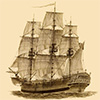 Bangalore (generic)
References
| Primary Source | Australian Joint Copying Project. Microfilm Roll 92, Class and Piece Number HO11/15, Page Number 294. -0- UK, Criminal Records, 1780-1871; Prison Registers and Statistical Returns; 1845-1846; HO 24/2. -0- England, Criminal Lunatic Asylum Registers, 1820-1876; Quarterly Returns of Prisoners in Hulks; 1845; December. |
| Source Description | This record is one of the entries in the British convict transportation registers 1787-1867 database compiled by State Library of Queensland from British Home Office (HO) records which are available on microfilm as part of the Australian Joint Copying Pro |
| Original Source | Great Britain. Home Office |
| Compiled By | State Library of Queensland |
| Database Source | British convict transportation registers 1787-1867 database |
Claims
No one has claimed George Wills yet.
Photos
No photos have been added for George Wills.
Convict Notes


DEATH 1863, 23 October: George Wills died a pauper, aged 59, at Brickfields Convict Depot; death registration year 1863; registered at Hobart; death reported by John Withington, Superintendent Brickfields Depot; cause of death phthisis (TB/consumption); Registration number 4140 (https://stors.tas.gov.au/RGD35-1-6p303j2k). Note: The Brickfields Hiring Depot was located in North Hobart on the site of the current North Hobart Oval. It was completed by the Royal Engineers Department in October 1842 and operated as a depot for 10 years. Female convicts were held there awaiting hire as probation pass holders from February 1842. After its closure in November 1852, Brickfields became a pauper establishment, and later an immigration depot (https://en.wikipedia.org/wiki/Brickfields_Hiring_Depot). --000--
BRANDED with a “D” Up to 1829, any soldier in the British military could be branded, but after that it was reserved for deserters who were “‘branded’ with a D on their left sides as a means of humiliating offenders” (Hilton, 2010, p140 at https://eprints.utas.edu.au/17678/2/Hilton_Thesis.pdf). Hilton doesn’t say how the branding happened and there are conflicting versions among writers. For example, some writers refer to barbaric fire brandings, while others describe painful tattooing using India ink. A post on the Irish Garrison Towns website (http://irishgarrisontowns.com/d-for-deserter/) says both practices were used – hot iron/fire branding being the preferred method until around the mid-19th century when it was replaced by tattooing: “A new device was created to mark the soldiers’ skin with ink, or even gunpowder… The large, blunt points [on the branding tool] hint at the pain it caused as a spring mechanism forced these points into the skin. Regimental doctors described the practice as ‘cupping’." Simon Barnard’s book “Convict tattoos: Marked men and women of Australia” (p55) has several shots of one of these spring loaded, brass “branding instruments”, manufactured by John Weiss & Sons of The Strand, London. Barnard says they were used by medical officers to tattoo army deserters. The head of the “Weiss’ Invention” model holds 47 needle points arranged in the shape of a “D”, all clearly capable of puncturing human skin. So, too, the points of the brass instrument featured on the Science Museum of London’s website. Made by the major surgical instruments manufacturer of the 18th century, Savigny & Co of London, its adjustable points “still bear traces of ink” and were pushed through the skin by a spring-powered mechanism”. The Museum says branding was abolished in 1829, except for army deserters. The English Mutiny Act of 1858 provided that, in addition to other penalties, a court martial could order that a deserter be marked with the letter D on the left side, 2 inches (5.1 cm) under the armpit, with such letter to be more than 1 inch long. From 1829, the mark was tattooed on the body until the practice was abandoned altogether in 1879 (https://collection.sciencemuseumgroup.org.uk/objects/co155799/branding-tool-for-marking-deserters-london-england-1810-1850-branding-tool). --00--
1848, 14 July: On arrival in VDL, George Wills was listed as convict #20857; 42, draper, single, literate, Protestant (Church of England); native place Chichester, Sussex; court martial London 11 October, 1845, desertion, 7 years; gaol report none; stated this offence “Desertion from the Grenadier Guards, absent 13 months. Desertion 6 months, 3 months and two months”. In the Guards 14 years. Ticket of Leave on arrival. No offences in his Conduct record. Only entries are “27/10/48 [made] Constable”, and “Free Certificate 27/10/52” (http://fasarchive.org/pubsearch/convict/chain/ai77163). Other: Family – sisters Charlotte at Brighton, and Anne at Chichester. Earnings on Bermuda (wages): £5/18/3 (https://stors.tas.gov.au/CON14-1-39$init=CON14-1-39P86). Described as: Fair complexion, light brown hair, grey eyes; [branded] D on left side. (https://libraries.tas.gov.au/Digital/CON18-1-51). --0--
From: The Courier, 19 July, p2: “THE ‘BANGALORE.’ — This convict ship, Harvey Morris, Esq., Surgeon-Superintendent, J. A. Martyn, master, arrived here on Friday last, bringing upwards of two hundred prisoners from Bermuda, who are to receive tickets-of-leave, not conditional pardons [some men did receive Conditional Pardons – see individual convicts’ details]. These men, it is stated, have been selected by the Governor of Bermuda not only for their good behaviour during their detention at that island, but also for their mechanical acquirements. Favourable reports are said to have been forwarded to the Convict Department respecting their behaviour during the voyage. Lieutenants D'Oyley and Hague, of the 11th regiment, also arrived in this vessel, having command of small detachments on the way to join their respective regiments in these colonies. The Bangalore experienced a rather rough but good passage. A soldier of the 11th regiment and one prisoner [James Fitzsimones] died on the voyage. THE EXILES or ticket-of-leave men just arrived from Bermuda are reported, upon very good authority, to have brought upwards of a thousand pounds' worth of cash amongst them [see the Governor of Bermuda’s despatches above], the amount received by them as wages earned in that island. They are waiting engagement on board the vessel; but, after to-day, can only be obtained from the New Town Depot. Orders to go on board can be procured on application to the Comptroller-General. There are 93 farm labourers and 8 domestic servants; amongst them, 2 grooms, six carpenters, and 7 miners.” --00--
REACTION TO ARRIVAL “LONDON AGENCY PAPERS... we cannot but notice the shameful conduct of the British Government, or rather our Governor, Earl Grey, in sending another bad cargo of exiles which has arrived by the Bangalore from Bermuda. When this abomination is to terminate it is difficult to say, but not, we firmly believe, until we receive our full rights from the British Government:— London, March 10, 1848.” (Colonial Times, 18 July, p3, at https://trove.nla.gov.au/newspaper/article/8763150) Note: According to Bateson (2004, p7), “exiles” specifically referred to “prisoners who had served a probationary period in England and had been pardoned on condition of deportation”. However, the men on the Bangalore had served the bulk of their sentences on Bermuda rather than in England. Most were sentenced to terms of 7 and 10 years. Others were serving 14 and 15 years. Only one man had a life sentence. Their records show they all held either Tickets of Leave or Conditional Pardons on their arrival during this period of the Probation System in VDL. --0--
ARRIVAL AT VDL “July 14, 1848: — Arrived the barque Bangalore, [departed] from Bermuda 11th April last, with 202 male convicts [landed]. Passengers -- Dr. Morris, R.N., Surgeon Superintendent, Lieut. D'Oyley and Ensign Hague 11th Regt., 49 rank and file 11th, 96th, and 99th regiments, 4 women, and 4 children.” (Colonial Times, 18 July, p2, at https://trove.nla.gov.au/newspaper/article/8763146) --0--
1848, 15 April: From despatches from Charles Elliot, Governor of Bermuda: Description: Reports the departure of the Bangalore [sailed 11 April, 1848] with 203 convicts bound for Australia. Comments on the £1071 they would receive for their reserve earnings. Notes that the £492, which was earned during their probation period, could be used to help purchase the passages of any female relatives who wished to join them. [Printed for Parliament September 1848.] Reference: CO 37/121/30; Convicts, No. 26, folios 207-219. Date: 1848, Apr 15 (National Archives, Kew, at https://discovery.nationalarchives.gov.uk/details/r/C10231720). --00--
EMBARKATION, BANGALORE LEAVES BERMUDA 1848, 11 April: The Bangalore loaded its 203 male convicts, including George Wills, on 9 April, and two days later sailed from Bermuda for VDL. --0--
1848, June quarter: Aboard Thames hulk – convict #316, George Wills’s health “good”, behaviour “good” for June quarter; good behaviour for all of 8 previous quarterly musters on Bermuda (England, Criminal Lunatic Asylum Registers, 1820-1876; Quarterly Returns of Prisoners in Hulks; 1848; June at https://www.ancestry.com.au/imageviewer/collections/9163/images/ho8_096_00190). --00--
1846, June quarter: Bermuda – Thames hulk, listed as convict #316, 39, desertion, court martial Wellington Barracks, London, 11 October 1845, 7 years; “sick at hospital”; received from England per Barretto Junior on 1 April 1846 (England, Criminal Lunatic Asylum Registers, 1820-1876; Quarterly Returns of Prisoners in Hulks; 1846; June at https://www.ancestry.com.au/discoveryui-content/view/441192:9163, image 157). Note: He was in the sick bay again in the March quarter, 1848. No illness named. The Thames became a convict hulk at Bermuda in 1844 (https://sites.rootsweb.com/~pbtyc/18-1900/T/04637.html). --0--