
Summary
Personal Information
Crime
Voyage
Transportation
George Wills was transported on the Bangalore, departing 11th Apr 1848 and arriving 14th Jul 1848 with 205 passengers.
Built 1843 at Jersey. Wood barque of 877 Tons.
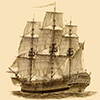 Bangalore (generic)
References
| Primary Source | Australian Joint Copying Project. Microfilm Roll 92, Class and Piece Number HO11/15, Page Number 294. -0- UK, Criminal Records, 1780-1871; Prison Registers and Statistical Returns; 1845-1846; HO 24/2. -0- England, Criminal Lunatic Asylum Registers, 1820-1876; Quarterly Returns of Prisoners in Hulks; 1845; December. |
| Source Description | This record is one of the entries in the British convict transportation registers 1787-1867 database compiled by State Library of Queensland from British Home Office (HO) records which are available on microfilm as part of the Australian Joint Copying Pro |
| Original Source | Great Britain. Home Office |
| Compiled By | State Library of Queensland |
| Database Source | British convict transportation registers 1787-1867 database |
Claims
No one has claimed George Wills yet.
Photos
No photos have been added for George Wills.
Convict Notes


CONVICT LIFE ON BERMUDA From The Pilot, 3 July, 1848, p4, at https://www.britishnewspaperarchive.co.uk/viewer/bl/0001301/18480703/045/0004 “THE BERMUDAS: ... the following account of the convict establishments in those islands, furnished by a correspondent, will doubtless prove acceptable to our readers. There is one on the principal island, called St. George’s, and another 21 miles further up the harbour... called Ireland’s Island. The treatment at each is precisely the same, rations ditto, with this difference in the employment; those going out in working parties from the ship at St. George’s have with them a file of men, termed a convict guard; at Ireland Island, although there are military on the island, they never do duty over the convicts. It is thought the chances of escape are greater from St. George’s, although there never has been an instance in which men have succeeded in reaching any other island; in fact, they have but few records of attempts to escape. The rations, which are served out twice day are as follows:—ln the morning a pint of cocoa with, on four days in the week, one pound of good biscuit; and on the other three days, one pound and a quarter of white bread per day; boiled pork, with pea soup, serves for dinner four days per week, and twelve ounces of fresh beef on the other three. Nothing is given from the ship after the mid-day meal, with the exception of the grog, which is given twice every day—it consists of half a gill of rum to three half gills of water. The government have caused very great alterations to be made in the various establishments, as there have been many men who have saved, while out there, sums varying from 50l. [50 pounds] to 70l., and, in several cases, to a larger sum, as 300l. and 400l. They were some ten years since allowed work at any occupation fancy dictated to them; this was in addition to their daily labour, and some of that could at times be done by proxy. Some of the labour being task-work, a man could finish his task when it pleased him, and would then do that of another; but after the general labour of the day was over, they were to be seen plying different crafts, many of them as happy (except when there was any stir, such as a ship coming out to take some home) as though they had been free; gold and silver smiths, or working jewellers, watchmakers, shoemakers, tailors, hat makers, brush makers, hair-workers, &c. &c. There were also a good many who got up various ornaments, which they termed specimens manufactured from a very beautiful stone, found on the island; also from the white choral [sic] which is found here. A pair of guns, manufactured from the stone mentioned above, and gold-mounted, have frequently been sold for four pounds and through so many men becoming thus employed, it opened another field for others to wait upon them; in washing for them, cooking, &c., &c , each man being required to wear two clean suits of clothes per week, consisting of shirt, frock, and trousers, and there were many who wore flannels; all this brought grist to the mill in some way or other. Others there were, who carried on a large business as general dealers, supplying the others with butter, coffee, cheese, sugar, &c; as we have said before, there being no meal allowed after the one at mid-day, the men have to provide for themselves. Here might be seen one fellow with two large kettles filled with coffee, each one holding not less than eight or ten gallons, which they could afford to retail at one penny per quart. On Ireland’s Island is the hospital, and a very nice building it is, both as regards its construction and its accommodation for the sick. It is for the reception of seamen, or for convicts; but the treatment, diet, &c , is the same; there are different wards for them, but the convict is as much at liberty as the sailor—he may at any hour of the day or night go over any part of the hospital or grounds. – Lloyd's Weekly Newspaper.” --0--
BERMUDA & THE PENAL SYSTEM Portsmouth, Portland and Chatham in England, Spike Island in Ireland, along with Gibraltar and Bermuda were listed public works stations and the second stage in the penal process. After separate confinement, prisoners were “placed on work parties at various locations, most commonly naval stations, where maintenance of facilities was vital for the effective protection of Britain’s far flung commercial and military influences around the world. While there, attitude and behaviour were monitored closely. In theory, only after consistently positive reports was a prisoner moved on to the third stage of his incarceration—transportation.” (Edgar 2018, p40). --0--
1845, 10 December – from the Morning Chronicle, p4: “The Barretto Junior left her moorings off the Royal Arsenal, and was towed down the river by the Monkey steam-vessel, Sir William Bryant master. The Barretto Junior has 200 convicts on board, and a guard of the 20th Regiment of Foot for Bermuda, and it is expected she will return with about 150 convicts from that place whose periods of transportation have expired, or been commuted to five years and lesser periods in consequence of their good conduct. The China, hired convict ship, dropped down from Deptford yesterday to moorings off the Royal Arsenal, to take on board convicts for Norfolk Island. It is said that 800 convicts altogether will leave this country before the expiration of the present month.” (https://www.britishnewspaperarchive.co.uk/viewer/bl/0000082/18451210/010/0004) Note: After a long delay due to a cholera outbreak on board, and adverse weather, the Barretto Junior set sail for Bermuda on 2 February, 1846. She returned to England from Bermuda on 7 May. --0--
EMBARKATION FOR BERMUDA 1845, 8 December: Sent from Warrior hulk to board the Barretto Junior for Bermuda (England, Criminal Lunatic Asylum Registers, 1820-1876 for George Wills; Quarterly Returns of Prisoners in Hulks; 1845; December; at https://www.ancestry.com.au/imageviewer/collections/9163/images/ho8_086_0085, image 93) --0--
1845, 3 December: Sent from Millbank and admitted to Warrior hulk, Woolwich, awaiting transportation to Bermuda per Barretto Junior – inmate #3309; all other details as per Millbank record (https://www.ancestry.com.au/imageviewer/collections/61805/images/ho24_002_00193, image 193). --0--
PRISON & HULKS 1845, 27 October: Admitted to Millbank Prison, London, from Wellington Barracks – inmate #7389, George Wills, 39, single, literate, linen draper and soldier; General Court Martial 11 October, 1845, London, desertion, 7 years. “Has deserted three times, and imprisoned each time” (UK, Criminal Records, 1780-1871 for George Wills; Prison Registers and Statistical Returns; 1845-1846; HO 24/2 at https://www.ancestry.com.au/imageviewer/collections/61805/images/ho24_002_00193, image 193). --0--
COURT MARTIAL 1845, 11 October: At Wellington Barracks, London – Private George Wills, Grenadier Guards (First or Grenadier Regiment of Foot Guards), sentenced by General Court Martial to 7 years’ transportation for desertion; three previous jail terms for desertion. Wellington Barracks in Westminster, central London, was built in 1833, and today houses the Foot Guards battalions on public duties in that area. The building is located about three hundred yards from Buckingham Palace, allowing the guard to be able to reach the palace very quickly in an emergency, and lies between Birdcage Walk and Petty France. Three companies are based at the barracks, as well as all of the Foot Guards bands and the regimental headquarters (https://en.wikipedia.org/wiki/Wellington_Barracks). --0--