Summary
Personal Information
Crime
Voyage
Transportation
William Wilmott was transported on the Shipley, departing 18th Jul 1818 and arriving 18th Nov 1818 with 150 passengers.
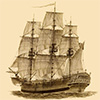 Shipley (generic)
References
| Primary Source | Australian Joint Copying Project. Microfilm Roll 88, Class and Piece Number HO11/3, Page Number 43 (23) |
| Source Description | This record is one of the entries in the British convict transportation registers 1787-1867 database compiled by State Library of Queensland from British Home Office (HO) records which are available on microfilm as part of the Australian Joint Copying Pro |
| Original Source | Great Britain. Home Office |
| Compiled By | State Library of Queensland |
| Database Source | British convict transportation registers 1787-1867 database |
Claims
No one has claimed William Wilmott yet.
Photos
No photos have been added for William Wilmott.
Convict Notes

It is possible that William was baptised in the village of Cookham, Berkshire, on August 12th, 1798, the son of Thomas and Elizabeth Wilmot. [This is currently not proven.] He was convicted at the Berkshire Assizes (held in Reading) on March 7th, 1818, of "stealing from the house of Sarah Gooden, at Speenhamland, a promissory note, value five pounds" and sentenced to death. He, along with all other prisoners sentenced to death at the same Assizes, was reprieved, and subsequently sentenced to 7 years' transportation. He arrived in Sydney on November 18th, 1818 aboard the convict transport "SHIPLEY". According to the indent for that ship, he was aged 20, came from Newbury, was 5 feet 6 and a half inches tall, with black hair, hazel eyes and a pale complexion. The 1822 Muster shows William as being employed by William Lawson. The 1825 Muster shows him as a labourer, of Sydney, and the 1828 Census shows him as a labourer to Morgan Jones (entry W2111 - see also the corrigenda). In 1824 he was given approval to marry Mary Clever, and banns were to be published at Parramatta (see Col. Sec. Letter Book A.01 4/3511). However, there is no evidence that this marriage ever took place, although it appears a daughter, Sarah, was fathered by William about 1827. William was granted his certificate of freedom in 1825 (63/3291 dated March 3rd, 1825). By 1832 he was the licencee of the "Coach and Horses" at Parramatta, where he continued until at least 1837. During this period he met Fanny Whitley. Fanny was the daughter of William Whitley and Hannah Perry. Her father, a gardener, had been convicted at Chester on March 22nd, 1833 and sentenced to transportation for 14 years for stealing flowers. He arrived in Sydney on December 18th, 1833 aboard the convict ship "LLOYDS", and was assigned by special application as a gardener to Miss Julia Johnston of Annandale. William Whitley did not apply to the government to have his family brought out, as was the usual custom. Instead, Hannah and 6 of their children (Fanny being one) arrived as steerage passengers aboard the "ELLEN" on February 21st, 1836. William and Fanny were married at St. Philip's Church Of England, Sydney, on November 18th, 1836. Fanny, being underage, had the consent of her "parent", presumably Hannah. Fanny was either pregnant when she met William, or became pregnant by him very soon after her arrival, as their first child, James, was born at Parramatta on October 16th, 1836 and subsequently baptised at St. John's Church of England, Parramatta. In early 1837, illness claimed the lives of William's 9-year-old daughter, Sarah (February 8th), and baby James (March 26th). The two are buried in St. Johns' Cemetery, Parramatta, where a headstone still survives (Section 1, Row I, number 7). Fanny's sister, Susannah, had married Samuel Phillips and moved to Molong, and sometime in 1838 or early 1839, William and Fanny joined them. William worked at a variety of labouring jobs for the remainder of his life - why he gave up his publican's licence is still a mystery. The family stayed in the area around Molong and Wellington until about 1845 or 1846, when they moved to Kiama. Between 1847 and 1858, 6 more children were added to the family in Kiama. This was not a happy time for Fanny, as the records of the Kiama Court show William did not provide very well for his family. It is not known when William moved to Milton, but Fanny remained in Kiama, becoming a well-known midwife, until her death on March 13th, 1871. I believe William had left his family by this time (sons John and William were living in the Milton area in the early 1860s, with William eventually following his father's old occupation of publican). William died at Milton on July 17th, 1886. He was living on the Ewin property, "Woodstock" at the time. (John Graham johngrah@ozemail.com.au)