Summary
Personal Information
Voyage
Transportation
Charles Kilmeister was transported on the Lord Lyndoch, departing 30th May 1833 and arriving 18th Oct 1833 with 330 passengers.
1838 Voyage - Lord Lyndoch. Surgeon Superintendence; Doctor Pineo, From the Surgeons Notes; " Total Embarked; 330 Male Convicts. 19 Died on Passage. 8 Died of Scurvy, 11 of Old age and diseases contracted previously to embarked which could not be detected ...... An accident occurred whereby 16 men were dreadfully scolded with boiling tea. many of them from the shoulders down to their knees.. 112 were sent to the Sydney Hospital on arrival "
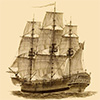 Lord Lyndoch (generic)
References
| Primary Source | Australian Joint Copying Project. Microfilm Roll 90, Class and Piece Number HO11/9, Page Number 122 |
| Source Description | This record is one of the entries in the British convict transportation registers 1787-1867 database compiled by State Library of Queensland from British Home Office (HO) records which are available on microfilm as part of the Australian Joint Copying Pro |
| Original Source | Great Britain. Home Office |
| Compiled By | State Library of Queensland |
| Database Source | British convict transportation registers 1787-1867 database |
Claims
No one has claimed Charles Kilmeister yet.
Photos
No photos have been added for Charles Kilmeister.
Convict Notes
Charles Kilminster was listed as 18 years old on arrival. Native Place: Bristol. Age 17. Received on to the hulk Justitia on 19th February 1833. Had been tried at Bristol Quarter Sessions 31st December 1832 and found guilty with Henry Harborne and Thomas Nott of stealing from a dwelling house of goods to the value of 54 pounds. Transferred to the Lord Lyndoch for transportation on the 18 May 1833 Charles could read, was Protestant, single, 5'4¾" tall, sallow and pockpitted complexion, black hair, hazel eyes, chin declining, raised scar forefinger of right hand. Newcastle Gaol Entrance Book. State Archives NSW. Roll 136 Details: John Blake, Charles Kilmeister, William Hawkins, John Johnstone, Charles Toulouse, James Lamb, Edward Foley, James Oates, James Parry, George Palliser all admitted to Newcastle gaol from the Big River charged with murder. Forwarded to Sydney Gaol 15th September 1838 Date: 5 December 1838/ 20 December 1838 Place: Sydney Source: The Colonist; Sydney Gazette Details: The Liverpool Plains Massacre - (Myall Creek Massacre) - The trial took place in the Supreme Court on Thursday 29th November, before is Honor Judge Burton and the following civil jury: - Mr. John Sewell, Foreman; Mr. William Knight of Castlereagh Street; Mr. Francis King, soap boiler, King Street; Mr. John Little, publican, King Street; Mr. Richard Leworthy, tailor, George Street; Mr. Henry Linden; Mr. Benjamin Lees, Parramatta; Mr. E. Hyland, Redwood; Mr. W. Johnson; Mr. Alexander Long, publican, York Street; Mr. John Leary, publican, York Street, and Mr. William Jones, Pitt Town. The prisoners arraigned at the bar were Charles Kilmaister, James Oates, Edward Foley, John Johnson, John Russell, William Hawkins and James Parry. The indictment contained twenty counts, the first five charging the prisoners with the murder of an aboriginal child; the next five with the murder of a male aboriginal child; the next five with the murder of a female aboriginal child, and the last five with the murder of an aboriginal boy named Charlie. The case for the prosecution was conducted by the Attorney General, assisted by Mr. Therry. The defence was conducted by Messrs A'Beckett, Foster and Windeyer, who had been specially retained for that purpose by the Hunter River Black Association. Witnesses included Thomas Foster, superintendent on the estate of Dr. Newton at the Big River about 150 miles beyond Invermein; William Hobbs, superintendent on Henry Dangar's estate at the Big River; Edward Denny Day, Police Magistrate; George Anderson, an assigned servant of Henry Dangar; John Bates, assigned servant to Mr. Dight of Richmond and employed on Dight's station at the Big River; Mr. Kinnear Robertson, Colonial Surgeon; Robert Sexton, assigned servant to Dr. Newton; Charles Reid, a ticket of leave holder employed by Henry Dangar; Andrew Burrows, an assigned servant to Henry Dangar. At a quarter past one the Jury retired, and at two o'clock returned to Court with a verdict, finding the prisoners guilty on the first five counts of the indictment and acquitting them on the last five. On Tuesday morning 18 December 1838 at nine o'clock, Kilmaister, Hawkins, Johnson, Parry, Foley, Oates and Russell, the seven men convicted of the murder of the blacks at Liverpool Plains, underwent the last penalty of the law at the rear of the gaol. From the time they received sentence, even up to the morning of their execution, there were many persons who thought it probably that the sentence would not be carried into execution, and attempts were made by petitioning His Excellency to extend mercy to them; but the reply was, that the law must be carried into effect. Shortly before nine a guard of eighteen men of the 59th regiment under the command of Lieut. Sheaffe arrived and immediately afterwards the Sheriff. The men had been engaged in their religious exercise previously and when the clock struck nine, the procession began to move. Kilmaister, Hawkins, Johnson and Parry, Protestants, were attended by the Rev. Mr. Cowper and Mr. Hyndes of Sussex Street; and Foley Oates and Russell, Catholics by the Rev. F. Murphy. They seemed greatly dejected, and Russell was much agitated, that he was obliged to cling to the Priest's coat for support. As soon as they had entered the yard, the High Sheriff read over to them the warrant for their execution, which he said by a letter from His Excellency the Governor had been appointed to take place that morning. When the warrant had been read over, Foley, the youngest of the culprits, addressed Mr. Macquoid and requested permission to embrace his unfortunate companions and the request being complied with, they kissed and shook each others hands and with eyes streaming with tears, bade each other a last adieu. The shook hands with Mr. Keck and embraced Mr. Hibbs the turnkey and then knelt down and proceeded with their devotions at the close of which they mounted the scaffold, attended by the clergymen who continued to exhort them while the final preparations were being completed. These don, the Rev. Gentlemen and the executioners descended from the scaffold, and in the short interval that followed previously to the falling of the drop, the cries of the men to God for mercy were distinctly audible, and they were soon launched into eternity 18/12/1838: Charles Kilminster was executed after being found guilty of taking part in the Myall Creek Massacre.