Summary
Personal Information
Crime
Voyage
Transportation
John Frost was transported on the Mandarin, departing 24th Feb 1840 and arriving 30th Jun 1840 with 212 passengers.
640 ton ship. The 1843 voyage carried the 51 Parkhurst Boys from the Isle of Wight bound for Van Diemen's Land. (Another 31 went to New Zealand.)These boys were categorised as "ticket of leave" or "apprentice" boys.
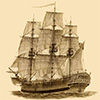 Mandarin (generic)
References
| Primary Source | Australian Joint Copying Project. Microfilm Roll 91, Class and Piece Number HO11/12, Page Number 153 (78) https://www.chartistancestors.co.uk/john-frost-1784-1877/ |
| Source Description | This record is one of the entries in the British convict transportation registers 1787-1867 database compiled by State Library of Queensland from British Home Office (HO) records which are available on microfilm as part of the Australian Joint Copying Pro |
| Original Source | Great Britain. Home Office |
| Compiled By | State Library of Queensland |
| Database Source | British convict transportation registers 1787-1867 database |
Claims
No one has claimed John Frost yet.
Photos
No photos have been added for John Frost.
Convict Notes
The website page on John Frost from the Chartist Ancestors site includes a contemporary (1839) description of Frost's political work prior to the Newport Rising.
Wednesday se'nnight the convict ship having on board Frost, Jones, and Williams, put into this port (Falmouth) with loss of topmasts. It appears that these leaders were embarked on board the andarin at the last moment before she left Portsmouth. From our inquiries we learn that they are separate from the other convicts, and that they inhabit a cabin of 12 feet in length and about 8 in breadth, having three comfortable sleeping berths, a bathing machine, &c., fitted, and other conveniences ; although dressed In convict's attire, they were not shackled. When visited to-day at noon, Frost was reclining on his berth, sad appeared very dejected; but his companions were in good spirits; they had a large supply of books, with which Jones and Williams apparently had been amusing themselves. The convicts were generally occupied today in writing letters. From the expedition manifested in getting the vessel re-masted, Is is said that she will go out to-morrow at noon, Cambridge General Advertiser, 18 March 1840.
I have added some of the story of John Frost and his attempt to stand up for the poor. These paragraphs are taken out of the article where John Frost is mentioned Some excerpts from: 'Newport First Stop' - 100 Years of News Stories by Derrick Cyril Vaughan http://www.newportpast.com/nfs/y30t39/chapter2.htm Politics were much to the fore in the 1830's and no more so than in the hills and valleys of South Wales. Merthyr particularly was in an almost permanent state of riot and troops were regularly to be seen passing through Newport to the scene of the disturbances. Reform of Parliament was the cry but how to set about it was another matter. The powerful landowners would give nothing away, continuing to protect their interests by buying the votes of the burgesses of the cities and towns, using any means to get their man elected. In Newport the feud between John Frost and Thomas Prothero continued unabated, Frost continually accusing his arch enemy of corruption. Meanwhile, John Frost had not been idle, he had watched the machinations of his old enemy and realised that only the power of his pen could help eradicate the corruption which he saw on every side, not least in the Council Chambers. His was a war of dedication against the evils of his time. More and more he left the running of his drapery shop in the capable hands of his wife, while he fought for the rights of the underdog and the deprived which continued to be a source of inspiration for his pamphlets. In September 1835 the Municipal Reform Act was passed. Among its provisions it gave the vote to the occupants of houses worth ten pounds a year. This new Act was implemented in Newport in the election of that year when John Frost and Mr. Townsend, an honest man of independent ideas, were the first persons elected as Councillors. Mr. Joseph Latch became the first Mayor and John Frost was elected Mayor and Chief Magistrate in the following year. This at last gave him the chance to open up the can of worms. John Frost was attracted to Chartism from the earliest days and on being approached eagerly joined the movement, seeing in it a vehicle from which to enhance the work he had been undertaking for years on behalf of the exploited people of the valleys and of the deprived in Newport. The leaders in London were delighted to have a Magistrate and an ex-Mayor as an ally in the most important town in an area which they had already chosen as the most suitable for their purpose. Frost eagerly accepted his role as a co-ordinator of the Chartists in South Wales. In 1838 and 1839 he travelled widely in the coalfields taking the Chartist message to groups of workers wherever he could find then, ably helped by Henry Vincent, the Yorkshireman with the golden voice, Zephaniah Williams, William Jones and many others. The unrest in the hills had by this time alerted the Government, and when Vincent and three of his companions returned to Newport, they were immediately arrested and charged with conspiracy and illegal assembly, being sent to Monmouth gaol to await trial. In Newport, the Mayor Thomas Phillips and the other magistrates were well aware of the dangerous situation in the hills and even in the town there were many convinced Chartists. The arrest of Vincent and his friends sent a wave of anger through the movement and there were many ugly scenes which John Frost did his utmost to calm. He had by now emerged as the leading figure of the Chartist cause in South Wales; although this position had been thrust upon him, he willingly accepted it and seemed to give little thought at this time to the danger he was in. He was falsely led into the belief that the pressure of the organised movement would in due course, cause the Government to give in to the demands of the Chartists peacefully. Frost was dazzled by the position he had attained. It had been suggested to him by the leaders in London that after the bloodless revolution he would be made Lord Protector of South Wales and in fact leaflets had already been printed to this effect. The thought that his enemies, Thomas Prothero and his cronies, would be brought to low estate spurred him on to greater efforts; he became more enmeshed in a web of his own making, and was helping to create a monster which he would be unable to control, leading to the great march on Newport, the insurrection and the awful consequences. The march had already commenced but was making slow progress. Down the valleys they came, their numbers swelling with every village they passed. Many of them carried guns of a sort and all had weapons including pikes and mandrills. It had been decided that Frost and Zephaniah Williams would lead the march down the western valley and Jones via Pontypool - the eastern valley, their aim being to take Newport in a pincer movement and prevent the coach carrying the mail to Birmingham leaving the King's Head, the non arrival of which would be the signal for the Chartists of that city to rise. The men of the hills continued their slow progress through one of the stormiest nights of the year, many of the marchers were dispirited and all were sodden. At dawn on the 4th, Frost and Williams arrived at the Welsh Oak on the Risca Road at the head of 5,000 men; Jones was reported to be nearing Malpas with another 3,000. Frost led his men across Tredegar Park to the weighing machine at Court-y-bella where they were formed into ranks, five abreast, the men with guns at the end of each line. Having obtained some sort of order the long column, with Frost and Williams at its head, climbed the hill to St. Woolos Church. When John Frost started down Stow Hill to the Westgate, with the noisy mob behind him, that fateful Monday morning at nine o clock, he realised for the first time he had unleashed a power he could not control. As the front of the column wheeled round the west side of the inn, Frost approached the gates to the courtyard, but finding them locked he turned to move to the front entrance but was forestalled by the mob which had already mounted the attack and were fighting in the hall-way. Suddenly the shutters of the room in the east wing were raised and the twenty nine soldiers of the 45th fired the first of many volleys into the crowd - Frost fled, leaving those whom he led to fend for themselves and suffer the consequences. He is reported to have said later in Monmouth gaol "I was not the man for such an undertaking, for the moment I saw blood flow, I became terrified and ran." Thus John Frost's foolish bid for power was all to no avail. At the age of 53 he found himself, with others, on a charge of High Treason. The position he had gained in the community as Mayor, Magistrate and defender of lost causes was as nothing compared with the loss of his liberty, probably his life, and the deprivation of his wife and family.

It's not a particularly important point but the date of birth traditionally give for John Frost is incorrect. Unfortunately, the professional historian who established John Frost's birthday was unaware that his parents had baptised two sons named John Frost, the first - whose birthday is the one now generally accepted - died in infancy. He was baptized on the 9th November 1783 "son of John FROST and Sarah his wife" and his burial was recorded as follows "Buried 23rd December 1784 John FROST: Son of John FROST." The dead boy's brother was obviously born sometime after his demise and was baptised on the 3rd of July 1785 "son of John FROST and Sarah his wife".
John Frost was 55 years old when transported. He was one of three leaders of the Chartist movement that led a march on the Westgate Hotel in Newport. Zephania Williams and William Jones were all sentenced to be hung and quartered, but received transportation for life to VDL. At the age of 16 he became a draper's apprentice and tailor. He started his own business around 1806 and became prosperous. In 1812 he married Mary Geach, a widow, and had 8 children. Several efforts were made in the House of Commons to procure their release, but Frost, Williams and Jones sailed together in the Mandarin and reached Hobart Town on 30 June 1840. In accordance with practice the three Chartists were given the privileges of political prisoners: they were allowed to keep their own clothes and, instead of being put on road work, were sent direct to Tasman Peninsula, where Frost became a clerk in the commandant's office at Port Arthur, Williams a superintendent in the coal-mines, and Jones an overseer blacksmith in the boys' penitentiary at Point Puer. Frost's employment as a clerk ended in 1841 and he was transferred to Brown's River, possibly for displeasing Lord John Russell by an indiscreet letter to England, but of this there is no official record. While at Brown's River, he was sentenced to three days solitary confinement for insolence to the superintendent; although recommended to be removed to Port Arthur and 'employed at labour in the same manner as other convicts', he was sent instead to Impression Bay on Tasman Peninsula, where he became a schoolmaster and was commended for being 'studious, quiet and obedient'. On 17 November 1843 his probation term ended and he was sent to New Town to work for W. Carter and later for Rev. W. Jarrett. In May 1846 he was sent to work for W. Chester at Bothwell and received his ticket-of-leave next November. On 27 June 1854 after teaching in various places in Tasmania, he received a conditional pardon and six months later sailed for America with his daughter Catherine, who had recently joined him in exile. At New York in May 1856 he received news of his free pardon. He arrived in England on 12 July and on 31 August gave lectures at Padiham on his experiences. These were printed as Horrors of Convict Life (London, 1856) and A Letter to the People of Great Britain and Ireland on Transportation (London, 1857). He went to live with his family at Stapleton, near Bristol, and as old age crept on abandoned politics for spiritualism. He died at Stapleton at 27 July 1877.