Summary
Personal Information
Transportation
John O'hara was transported on the Neptune, Scarborough And Surprize, departing 30th Nov 1789 and arriving 26th Jun 1790 with 1084 passengers.
Neptune 809 tons built on the River Thames 1779. The largest ship of the Second Fleet.
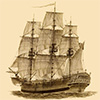 Neptune, Scarborough And Surprize (generic)
References
| Primary Source | Australian Joint Copying Project. Microfilm Roll 87, Class and Piece Number HO11/1, Page Number 50; Stevens, H 2000, ‘The O’Hara story: John and Mary O’Hara and their descendants’, Diploma thesis, Society of Australian Genealogists; Old Bailey Proceedings Online |
| Source Description | This record is one of the entries in the British convict transportation registers 1787-1867 database compiled by State Library of Queensland from British Home Office (HO) records which are available on microfilm as part of the Australian Joint Copying Pro |
| Original Source | Great Britain. Home Office |
| Compiled By | State Library of Queensland |
| Database Source | British convict transportation registers 1787-1867 database |
Claims
No one has claimed John O'hara yet.
Photos
No photos have been added for John O'hara.
Convict Notes

I would like to make a correction to the earlier notes: Thomas Daveny, also known as Thomas Daveney was not a marine - he was mariner. He was a seaman on the Sirius.
John O'Hara - the trial at the Old Bailey JOHN O'HARA, Theft > grand larceny, 7th May 1788. 382. JOHN O'HARA was indicted for feloniously stealing, on the 27th of March , a pair of mocoa studs, set in silver, value 2 s. a silver tea spoon, value 2 s. four silver table spoons, value 30 s. one gold ring, set with garnets, value 10 s. one gold shirt buckle, set with garnets, value 5 s. a silver penny, one silver pap spoon, value 2 s. five tea spoons, value 5 s. the property of Eleanor Callow . (The case opened by Mr. Silvester.) JAMES BISHOP sworn. I live at Clapham; I had taken a house in Stafford-street, Bond-street ; I had removed a house of goods there, that was the 25th of March, Lady-day; I placed them in a two pair of stairs room, adjoining to where the prisoner lived; he lived in the next room where the goods were; there were linen and bedding, and wearing apparel, and in short every thing that we had that was movable; this plate in the indictment was with them; the things said to belong to me, do belong to me, only the silver-penny, that was my housekeeper's; I made the room fast with the folding doors; they properly call it a large closer, just room for one bed; there was a bed in it, but they took out the bed for me to put the things in; I sent for a carpenter to put on a padlock, clasp and bolt; there was a lock and no key before; I missed the things on Thursday, about five, that was the 27th of March, I was taken ill, and my housekeeper came to town for some clean linen; the man was apprehended in our tap-room; there was found upon him, a pair of studs, a breast buckle and a gold ring, which was my housekeeper's. Mr. Knowlys. Prisoners Counsel. Do you know how many persons lodged in this house? - No, I do not, my things were, I believe they were, put under forty shillings, I value them at thirty shillings. ELEANOR CALLOW sworn. I am housekeeper to Mr. Bishop; in this room in Grafton-street, there was a silver table spoon belonging to me, and the other things they were my property. What is the value of them; as near as you can guess? - Five shillings; I came to town on the 27th, and I found the box broke open; I found the drawers broke open; when I came in, I took the key and opened the door, and found two drawers in the bureau, and one in a chest of drawers broke open; the door was locked, they unlocked the door; the padlock that was on appeared to be bent; the carpenter that I sent for, his name is Jackson; he found the hinges of the door had been taken off. THOMAS JACKSON sworn. I am a carpenter; I made this place fast the 25th, by putting fresh bolts and a padlock; on the 27th I was sent for by Mrs. Callow; when I came, I found the lock bent very much; here is the lock which had been picked seemingly; the hinge of the door dragged very much, which it did not before; the nails of the hinges appeared to have been drawn out, and were put in slightly, I know nothing about the house. WILLIAM NATHALL sworn. I am a lodger in this house; I know this room where Bishop's things were, the prisoner and another man lodged in a room adjoining about nine or ten months; I believe he left the lodging about a day or two before he was accused, to the best of my recollection. Was he there at Lady-day? - Yes, Sir, and after, because when the things were missed, the lodgers were warned out of the house, and he was there before that time. Mr. Knowlys. You lodged in this house? - Yes, and had a considerable time. The prisoner you say, did not leave the house till about a day or two before he was apprehended? - One or two days, I am not sure which. He was apprehended I think about the 11th of April? - Somewhere thereabout. How many persons lodged in that house? - I cannot positively say, about half a dozen. What kind of house is this? - It is a public-house, the Goat, in Stafford-street. Then the street door is of course open the greater part of the day? - Yes, Sir. JOHN BOYD sworn. I am a pawnbroker; a servant to Mr. Kates, the corner of Bedford-street, in the Strand, on Wednesday the 8th of April, the prisoner, in company with a very genteel woman, came into our shop; she asked me, if I bought plate; I said, yes; upon that she put her hand in her pocket, and took out a handkerchief with this plate in it; and three more tea spoons, and a pair of sugar tongs; and said, she wanted to sell them; the tea pot she did not want to sell; she then gave me the five table spoons, the pap spoon and the pair of sugar tongs; and asked me what I would give her for them; I told her, I could give her three pounds for them; upon that, she referred to the prisoner, and asked him, if that would be money enough; she had the spoons in a handkerchief; the prisoner leaned on the counter, and he picked me out six tea spoons, and he asked me what I would give him for them; I told her, I could give thirteen shillings and six-pence for them; upon that she said something to the prisoner, and he said, that would do; and they wrapped up the other sugar tongs and three tea-spoons in the handkerchief, and went away; I gave them the money for them; after they were gone, I saw a hand-bill from Bow-street, giving a description of the plate; I applied to Bow-street, and found out where the plate was stole from; I went to the prosecutor's house, described the persons to him; and he directly fixed on the prisoner. Are you sure the prisoner is the man? - Yes, I am; and this plate I received from the woman. Mr. Knowlys. This was not till the 8th of April you say? - Not till the 8th. The person with whom you transacted this business you say was the woman? - I forgot to mention, when I laid down the money on the counter, the man took some, if not all the money. Whether he gave it to the lady or no, you do not know? - I do not know what he did with it. Your conversation was with the lady? - I did not hear him speak above two or three words. Certainly your attention was chiefly directed to the lady? - Where they are in company, and it is referred to the other person, certainly my attention must be refered to them both. Was not your attention particularly directed to the woman? - At first it was, because she took the plate out. She asked you whether you sold plate? - No, she did not, she asked me, whether I bought plate. How long was this woman there? - They might be there four or five minutes. Is your shop an open shop, or is it divided into boxes? - Part of the shop is divided into boxes, and part of it is open; we had just lighted candles; it is much darkened; it was just dark. The woman I take it stood forward? - They both stood even with the counter. Was this in the part where the boxes were? - No, it was not; it was in an open part of the shop. THOMAS DYER sworn. I apprehended the prisoner; I found on him one gold ring, set with garnets, a garnet breast buckle, a pair of studs, and a silver-penny; I found them just in the same state, in this box as they are now; they were in his pocket. (The tongs deposed to by Mr. Bishop.) It has my mark, J. M. B. and one spoon; I do not swear to the studs, but they are mine without doubt. (Mrs. Callow deposed to one table spoon, one pap spoon, and five tea spoons.) The garnet ring and the garnet breast-buckle, I have no doubt but they are my property; but I do not chuse to swear to them; the penny-piece is mine, it was given to my little boy, when he was a baby, with a hole to put round his neck. The prisoner called three witnesses, who gave him a very good character. GUILTY . Transported for seven years . Tried by the first Middlesex Jury before Mr. Justice ASHURST. [Old Bailey Proceedings Online (www.oldbaileyonline.org, version 8.0, 31 July 2018), May 1788, trial of JOHN O'HARA (t17880507-53).]
7 May 1788 at the Old Bailey in London, John O'Hara was convicted of theft, (described as 'Grand Larceny' as it involved the theft of goods of the value of 1 shilling or more). He was found guilty, and sentenced to transportation for 7 years. He spends the next year in Newgate prison. May 1789: transferred from Newgate to the Dunkirk hulk in Plymouth Harbour Dec 1789 transported as part of the Second Fleet, on the 'Neptune' which was probably the worst convict ship to come to Australia, with mortality of 147 men and 11 women. It arrived 26th June, 1790 1791 he is probably working at Toongabbie, at Superintendent Thomas Daveny's farm. Thomas Daveny had come to NSW as a marine in the First Fleet, had been appointed superintendent in April 1791, and in July married Catherine Hounsom (who had been tried the same day as O'Hara at the Old Bailey) - Catherine will later be a witness to John O'Hara's wedding. In January 1792 John O'Hara was a witness at the trial of John Davis who was charged with stealing corn from the government farm and a melon from Daveny's garden. [SRNSW Judge advoactes Bench Proceedings 1/296 reel 654] 2 Aug 1792 is the date of birth of his son James, mother Mary Jones (ship 'Mary Ann' 1791). He was baptised 12 Aug 1792 at Parramatta by Reverend Johnson: 'James Jones son of John O'Harra & Mary Jones born August the 2nd' 23 Jan 1797 Marriage of John 'O’Harra', ‘of Prospect Hill’ and Mary Jones, by Samuel Marsden by Banns at Saint John's Church Parramatta. John marked with a cross, and Mary signed. Witnesses Catherine Daveney (marked with a cross) and Robert Collett 1 Aug 1799: Land grant of 60 acres granted by Governor Hunter at 'Toongabbie', and the only description is 'bounded on the NE side by Martin Farm'. It is later referred to as being in Seven Hills [Old system grant 2-289]. 1800: The muster has the following information: 19 acres sown with wheat, 7 acres about to be planted with maize, and 10 hogs. He was receiving ‘no stock or slops [clothing] or tools’ from the Government. However, with no income from the farm as yet, his wife and child were still relying on government stores 1802: 30 acres of land had been cleared, most of this was planted with wheat and maize, and there was plenty of wheat and maize in store. He employed two free men and one convict, and was no longer on government stores 1806: The entire 60 acres of land is in production: 34 acres of maize, 20 acres of wheat, 2 acres of barley, 0.75 acre of peas and beans, 0.5 acre of potatoes, 2 acres of orchard and garden, and 0.75 acre of pasture. Stock consisted of one female horse, two cows, four oxen, 28 female goats, two female hogs. He had 80 bushels in hand of maize and he employed three convicts. 7 Dec 1806: Advertisement in Sydney Gazette for a lost promissory note: Lost by Richard Parsons, Government Gardener at Castle Hill, drawn by Patrick Brannan, settler at Seven Hills, in favor of John Brannan, £8 in copper coin, if rendered to John O'Harra, will be liberally requitted 1806: In a landholders petition to Governor Bligh: He is one of the 244 settlers of the Hawkesbury and adjacent areas, asking for a civil rather than military justice system, a stable currency, freedom of trade, and complaining of 'the Infringement made on our Rights, Privileges and Liberties by John McArthur ' January 1808: Several hundred of the ‘Free and Principal Proprietors of landed property’ signed a new year’s address of support for the Governor for 1808. Signatories included John O’Hara and his son James, who was now 15. However, Macarthur's Rum Rebellion is on 26th January. March 1809 In the Sydney Gazette, there is a description of an absconder, George Gilbert, a stockman to 'Mr O’Hara, settler at Seven Hills', who accused him of robbery, and has 'taken to the woods': 5 ft 4 in high, fair hair, is somewhat round-shouldered, and stoops in walking. He wore a straw hat, blue jacket, and nankeen trousers. 27 September 1809 This is the date of his death. His grave is in St Johns Cemetery Parramatta. It is now unreadable, but in 1950 a transcription of the ledger stone of the grave was made: Gloria in Excelsis Do IHS Sacred To the Memory of Mr JOHN O'HARRA who departed this life September the 27th 180- Aged 43 years also four lines of verse (which had worn away) ending with 'rise'. [J.Dunn (ed) The Parramatta Cemeteries: St Johns, 1991] Oct 1809: In the Sydney Gazette are notices that John O'Hara's son James has Letters of Administration for his father's estate. Source: Stevens, H 2000, 'The O'Hara story: John and Mary O'Hara and their descendants', Diploma thesis, Society of Australian Genealogists.