Summary
Personal Information
Crime
Voyage
Transportation
Margaret O'hara was transported on the Mexborough, departing 12th Aug 1841 and arriving 26th Dec 1841 with 147 passengers.
DEC. 26 - Arrived the barque Mexborough, 376 tons, Bridgman master, from Kingston (Dublin) 12th Aug., with 143 female convicts and 35 children. Surgeon Superintendent- Dr. Hampton, R.N. Passengers- Mary Penner, Mary and Jane Carroll, Ann Fox and 5 children, Hannah Murphy and 2 children, Jane and Catharine Nowlan. Colonial Times, 28 Dec 1841.
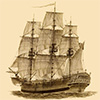 Mexborough (generic)
References
| Primary Source | an Diemen’s Land Return of Male and Female Convicts shewing their distribution throughout the Colony on the 31 st December 1841 (AJCP, HO 10/51 |
Claims
No one has claimed Margaret O'hara yet.
Photos
No photos have been added for Margaret O'hara.
Convict Notes
Orphan Number: 4196 Orphan: Patrick O'HARA Mother: O'HARA, Margaret Father: , Mother's ship: Mexborough Father's ship: Age when admitted: 6yrs Date admitted: 4 Jan 1842 Date discharged: 1 Jan 1846 Institution(s): Queens Orphan School Discharged to: mother, Ticket of Leave Remarks: References: SWD7, 28 https://www.orphanschool.org.au/showorphan.php?orphan_ID=4196
Margaret was born in 1797, 1841 was the eve of the Irish Famine. Margaret had lived with her three children in Ballitore, a small country town in County Kildare, Ireland. She worked as a cook and laundry maid. Kildare was an agricultural county with some small industries. A string of industrial closures had caused high unemployment. Many parishes were showing signs of distress. One observer wrote that children “were wretchedly off, their diet consisting of potato and salt, seldom three meals a day”. It is reasonable to suppose that Margaret was a hard working person from a rural village whose main aim in life was to support her family. On 15 March 1841, Margaret was convicted of stealing a cloak, value 2 shillings and sixpence. She was sentenced to transportation for 7 years. A Petition was presented to the authorities on Margaret’s behalf asking that she not be transported. It stated: The petitioner was never prone to vice, but in an evil hour was tempted to commit the felony for which she is about to suffer so severely. What makes her case more melancholy is that she is aged 44 years with 3 small children, who in the event of the petitioner being sent out o f the country will be left without protection. The Petition was refused. However, she was allowed to take two of her children with her. The Mexborough was a “Barque”. This was the name given by the Royal Navy to small nondescript ships. The Mexborough was very old and in a poor state of repair. The weather was bad during most of the voyage. Water continually entered the cramped area where the women were accommodated. Many of the women suffered from sea sickness and the smell of vomit must have been overpowering. To be on a Convict ship could be terrifying. The Second Officer on the Garland Grove (1842) recalled that when his ship had passed the Cape Verde Islands there was a heavy squall which did not trouble the crew. However, the female convicts confined below deck did not understand what was happening and no doubt few had experience of sea travel. He wrote: The women heard it below and they did screech and were very much frightened thinking that the ship was sinking.The women on the Mexborough would have encountered similar conditions. They must have sometimes feared if their ship was in danger. On further problem of an unusual and unpleasant nature developed on the Mexborough in respect of one of the convicts, Mary Holohan. Mary began behaving very strangely and appears to have developed some type of mental disorder. The most obvious problem was that: She was exceedingly dirty in her habits...using her shoe as a bed pan and keeping the shoe in her blanket, full of excrement. This happened more than once when she was in perfect (physical) health. On examination Surgeon Hampton found her “perfectly sensible and able to assist herself” (in other ways). However, she was unable or unwilling to stop using her shoe as a bedpan. She put up the “most violent resistance” when anyone tried to move or help her. She developed diarrhoea because of her continually dirty hands and died when the ship was only 60 miles from Hobart. After leaving Cape Town the ship was subject to gales and “very inclement weather” up to its arrival in Hobart. Huddled together on the upper deck would be up to 192 women and children. Especially as it passed through the Roaring Forties, this small ship would have been exposed fully to the elements – wild weather, large waves and persistently strong and cold wind. The women would endure these conditions from 10.30 am to late in the day. Despite the weather, the women would remain on the upper deck even when allowed to return to the quarters below. The sight of so many on the deck of a female convict ship was compared by a contemporary observer to “a slave ship of the old time”, the difference being that the women were crowded together on the deck and the slaves in the hold. The Mexborough arrived in Hobart on 25 December 1841. Two convicts had died. Margaret’s condition was described as “middling”. The O’Hara children were not treated for any illnesses. Break up of the Family Unit The convict system in Van Diemen’s Land did not respect the fundamental relationship between mother and child. Margaret was assigned to a master within a week of arrival.On 4 January 1842 Bridget and Patrick were sent to the Queen’s Orphan Schools in Hobart. Margaret had cared for her children in Ireland and on the voyage. She was now separated from them. . In 18 January 1842 Bridget was removed from the orphanage. She was 12 years of age. She was not placed in the care of her mother. Punishment in Cascades Female Factory In 1843 Margaret’s behaviour deteriorated and she commits a number of offences over the next three years. These include abusing her supervisor; being absent without leave; having a man in her room for “an improper purpose” and being drunk. She was sentenced to a number of a prison terms with hard labour. The total time served was seven months. At least part of these sentences would have been served at the Cascades Female Factory.She appears on the list “Female Convicts in Van Diemen’s Land at the Cascades Female Factory (an incomplete list)” on the Female Convicts Research By the 1840s there had been changes in the administration of the Factory. There was less brutality in the treatment of convicts but the cruelty remained. For example, the heads of women in the “Crime Class” who entered the Cascades Female Factory were no longer shaved. However, female convicts who were already traumatised were still punished with hard labour and solitary confinement in dark cells for long periods. Today a person who has been subject to trauma is counselled and encouraged to talk about their trauma. They are encouraged to “confront their demons”. Female factories treated women in the opposite way. It is difficult to think of a more inappropriate treatment for a traumatised person than solitary confinement. The detrimental effect on the mental health of many of the women must have been dramatic . On 1 August 1846 Patrick was discharged from the Queen’s Orphanage into Margaret’s care. On 18 March 1848 Margaret was granted a Certificate of Freedom. The Victorian Goldfields Margaret’s daughter, Bridget married John Smith, an English convict in 1848.The O’Hara family (Margaret, her son Patrick, Bridget and her husband) made their way to the Victorian Goldfieldsin the early 1850s. However, Vandemonians suffering from trauma were unlikely to receive sympathetic treatment in Victoria. They were feared (and demonised) by better established people. The family remained in the Ballarat area for some years. Margaret’s son- in-law, John Smith, was injured in the fighting at Eureka Stockade. This indicates rebellious attitudes within the family at that time.