Summary
Personal Information
Voyage
Transportation
William Garraway was transported on the Sarah, departing 29th Nov 1836 and arriving 29th Mar 1837 with 270 passengers.
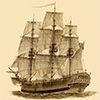 Sarah (generic)
References
| Primary Source | Australian Joint Copying Project. Microfilm Roll 90, Class and Piece Number HO11/10, Page Number 410 |
| Source Description | This record is one of the entries in the British convict transportation registers 1787-1867 database compiled by State Library of Queensland from British Home Office (HO) records which are available on microfilm as part of the Australian Joint Copying Pro |
| Original Source | Great Britain. Home Office |
| Compiled By | State Library of Queensland |
| Database Source | British convict transportation registers 1787-1867 database |
Claims
No one has claimed William Garraway yet.
Photos
No photos have been added for William Garraway.
Convict Notes

William and Hannah were married in Green Ponds Tasmania, where William was stationed on the road gangs.
William Garraway was born in the small village of Swainswick to poor parents. At age 22, he and his younger brother Cyrus were tried for the crime of '' HIGHWAY ROBBERY'' and ''ASSAULT'' on the 6 August 1836. The Local Newspaper Report: Bath & Cheltenham Gazette August 16th 1836 Page 4 Columns 3-4 John Cleverly, William Garraway, Cyrus Garraway, Charles Barrett and Moses Townsend were indicted for assaulting George Churchill, putting him in fear and robbing him of 9s 6d and other articles near Bath. George Churchill lived at Swainswick near Bath. On Saturday night 16th July he was returning from Bath accompanied by his son about 9 o’clock at night; he had a basket containing some sugar and other articles; when they got as far as Tadwick Lane he saw the five prisoners whom he had known for some time; he said to them ‘good night, gentlemen’; John Cleverley said ‘aye’ and then knocked him down. Cyrus Garraway then fell upon the witness, cut out his pockets with a knife and took away 9s 6d. Witness said ‘I have got no watch’. William Garraway said ‘search him’ and one of them searched him; they picked things out of his basket; Cyrus Garraway searched the boy and took the hat off his head; the other prisoners held him down; they all went away together. Witness remained there for some time – cross examined – The boy appeared to be much frightened; had drunk a pint of ale in Bath, and half a pint coming back. Henry Churchill the son of the last witness corroborated his father’s testimony. John Hulbert found a basket in a field on his way to Pinacre (?) on the morning of 17th July. Thomas Gunning lives at Swainswick, remembers the prosecutor coming to him at about 11 o’clock that night. Henry Perry, officer of Bath, apprehended William Garraway; he was in bed; told him what he took him for; he made no reply. Isaac Hall was at the White Lion tap on the night of the robbery and saw all the prisoners drinking together. Mr Baron Alderson having summed up, the jury found all the prisoners guilty – death recorded The sentence seems to have been commuted to ''LIFE'' imprisonment, and sent to the convict colony of ''Van Diemen's Land" in Australia (Launceston, Tasmania.) He was to spend the next few months on the convict ship "SARAH" and his conduct report indicates that his behaviour in the Hulk "GOOD" and the surgeons report "VERY GOOD". HM Convict Ship Sarah The HM convict ship Sarah was a 480 ton brig from London. The Sarah was converted from commercial use to convict transport. She was waiting outside Portsmouth harbour in 1836 to take on convicts. The surgeon-superintendant of the Sarah was James McTernan who was a royal naval surgeon. The surgeon-superintendants job was to ensure the safety of the convicts and make sure that they made it to Australia by keeping the convicts fit and healthy. For every convict that he delivered safe to the Australian colonies, James McTernan would receive half a guinea. The Sarah had already been to Australia and sailed back so she was relatively new and watertight. On the 22nd December 1836, the Sarah left Portsmouth harbour with the wind blowing from the north-north-east. When the Sarah got out into the English Channel, she was taking heavy seas over the forecastle and washing the convicts out of their bunks in the orlop deck. This bad weather lasted for a week and soaked the convicts and crew. Eventually as the ship sailed south, the weather cleared up and the convicts could dry their clothes and bedding. As they approached the equator they got more pleasant weather and the health of the convicts got a lot better. The Sarah did not stop at Rio di Janeiro because of fears that the convicts would mutiny and take over the ship, and officers would take in stores to sell in the Australian colonies. The Sarah sailed South-east towards the cape of good hope in hot weather, and then sailed a few points south to the tip of Tasmania at Port Davey, which she sighted ninety-three days after leaving Portsmouth. On the 28th March 1837, the Sarah entered the Hobart Town Heads after a voyage of 97 days and dropped anchor in The Cove. These are extracts from his Prison Conduct Report: * On the 29th June 1837, "Absent without leave" (punishment not listed) * On the 31st January 1838 "Absconding" ( 50 lashes ) * "Disobedience of orders" ( Impounded ) * On the 17th November 1840 Misconduct , "Refusing to clean cells out" ( punishment not listed ) * On April 20 1842 "Misconduct" ( 14 days - illegible ) * On October 17 1842 "Disobedience of orders, insolence and neglect of duty" (3 months hard labour in chains) * On the 11th June 1845 Misconduct "Assaulting James Anst" (6 months hard labour) William was listed as 5 feet 5inches , single , native place --- Swainswick, Trade -- Ploughman and Kitchen Gardener. There is record of a convict permission to marry in Tasmania for William and Hannah Matthews, and the paperwork indicates that a child may of existed but is unknown to me. They married in Brighton, Tasmania on the 12 August 1848. It seems that William an Hannah did not last long, as he seemed to be living life as a single man on the Gold Fields of Victoria (Ballarat) in 1853 until he got himself in trouble again.... Geelong Advertiser 27 April 1853, 2/2: DARING ROBBERY. Arthur Burrow and William Garroway were indicted for robbing William Harry Mitchell, at the Ballarat Diggings, Pennyweight Flat. Mitchell being sworn, deposed, that he, in company with another person, called at the prisoner's tent, to ask their way to their own encampment, on the night of the 10th of April. instant; five men were in the tent, and they all cried out to witness and his companion to "shout for something to drink:" not complying with their request, and retiring from the tent, one of those men, Garroway, seized the handle of a pickaxe, and struck witness over the back, whilst the other seized hold of a revolver, and fired at him, but missed his aim, as witness knocked the revolver, before it exploded, away from the direction of his person; witness then knocked the fellow down, when the short man, Barrow, caught hold of him by the throat, whilst two other of his companions rifled his pockets, and took away all the money that was upon him. By Burrow.—It was about 8 o'clock at night, witness came into your tent with his companion; you were one of the men that held him down at the door of the tent, whilst the rest robbed him; recognised you by the light of the fire, which was burning alongside the tent. By Garroway.—You were the man who struck witness with the pick axe handle. By the Judge.—Has not the slightest doubt touching the identity of the prisoners. Alex. McLean, being sworn, deposed—That being at Pennyweight Flat, near Ballarat, on the night of the 10th April, on his road home with the last witness, from Canadian Gully, they called at a tent to ask their way; there were four or five men in the tent, and they asked for liquor, which was refused; one of the prisoners, now before the Court, then ordered witness and his companions to leave the tent, and Burrow took up a heavy piece of wood, and struck his companion first, and afterwards struck witness; a revolver was then presented and fired at them, and their money demanded; after a considerable scuffle the last witness and himself escaped, and gave information to the police. Burrow stated that he knew nothing about the affair, as he was the worse for drink at the time. The other prisoner made much the same sort of defence. His Honor addressed the jury by observing that there could be very little doubt that both the prisoners were present at the tent when the violence and robbery was committed; and although some variation appears in the evidence of the two witnesses, one stating that Garroway used the pickaxe handle, and the other affirming that Burrow inflicted the blows with that instrument; still there could be little doubt but that both the prisoners were taking an active part on this occasion. As to the supposition that the two men were trespassing in the tent, it could not be reconciled with justice, should that even be the case, to subject them to such violence. It appeared to him to be another of those unfortunate instances where dram drinking had produced its baneful consequences. The jury returned a verdict of guilty against both prisoners, and His Honor, after severely commenting upon the enormity of the offence, sentenced each of the prisoners to 10 years' hard labour on the roads of the colony, the first of which to be worked in irons. He recieved his freedom ticket in 1860 and died of T.B in the township of Clunes in 1867. I am not sure what became of wife Hannah.